SOME THOUGHTS ON THE CALENDAR by Archpriest Isaac Skidmore

The Feast Day in the early Church was eschatological because it was the manifestation and actualization of the Church herself, as the new life, as an anticipation of the unending day of the Kingdom…. But to the extent that such a day was eschatological it was connected also with the real time of “this world,” since it was only for the sake of this world “which God so loved” that the Church was created…. Hence the significance of the early Church of a “reckoning of time,” a calendar, a correspondence between the liturgical year and the “cosmic” year….
orthocalThese words, from Father Alexander Schmemann in Introduction to Liturgical Theology (SVS Press, 1986, pp. 181-82), have bearing on the long-standing question of which calendar—the Old Calendar (the Julian), or the New Calendar (the Revised Julian)—is most appropriate for use in the Orthodox Church.

A fanciful scenario may be helpful to consider as we ask this question. Imagine you have been given a watch by someone you consider to be especially holy. You cherish the watch both for its usefulness and for the associations it holds for you with this saintly person. One day you notice that, when the watch says 12 noon, the sun is actually past its zenith. Do you adjust the watch, to bring it back into correspondence with the course of the sun? Or, do you refrain from doing so, believing that this would be disrespectful to the person who gave it to you? Do you imagine that this person, being holy, surely anticipated the watch’s eventual lapse in accuracy, but intended that you should continue to govern your activities by what it says, anyway? Considering this latter approach, you realize it entails that your daily routine—your sleeping, waking, and eating—will progressively fall out out of sync with the day, as it is indicated by sunrise and sunset. Incrementally, you will go to bed earlier and earlier, until sleep occurs during daylight, and waking life occurs at night. What do you do? Do you adjust the watch or not? Read More

OPEN LETTER DELIVERED TO THE BISHOPS

The following was sent this evening as a Word document to the main Orthodox jurisdictions in the United States. Since the Assembly of Bishops lists no email address, we contacted them via their internal messaging system to ask them to provide one.

If you are a member hierarch of the Assembly of Bishops and would like to receive an original copy of this letter, please email us at editors@orthodoxyindialogue.com. 

If you are a priest, deacon, or layperson and would like to ensure that your bishop receive an original copy, send us his direct email address.

In an email of January 25 we also invited St. Vladimir’s, Holy Cross, St. Tikhon’s, and Holy Trinity Seminaries to respond to our concerns, either individually or as a group.

To date at least one individual with first-hand knowledge of the matters addressed in our Open Letter is working on an expository article for Orthodoxy in Dialogue.

symbol-885482_960_720

January 31, 2018

TO: The Assembly of Canonical Orthodox Bishops of the United States of America
RE: White Supremacy in the American Orthodox Church

To the esteemed Member Hierarchs of the Assembly of Canonical Orthodox Bishops in the United States of America:

Masters, bless.

On January 22 Orthodoxy in Dialogue published an Open Letter to the Assembly of Bishops which is viewable here. The signatories include priests, deacons, theologians, laymen, laywomen, Orthodox Christians, and friends of Orthodoxy who constitute but a small representation of the several thousands of people around the world who have read and commented on our Letter in various social media. In less than 48 hours the Letter leapt to the number one spot among the 120 articles and editorials that we have published since we first launched in August 2017. The numbers, both of readers and signatories, continued to grow by the hour for an entire week after the Letter was published.

Our concerns have been reinforced by the claims of a recognized hate group to have made significant incursions among our clergy and seminarians: see here and here. Note especially the closing line in the first of these:

The road to hell is paved with the skulls of erring priests and bishops, and I will stomp on each one of them on my way to hell and back to win this war for the universality of Christianity in the West. Read More


CAN YOU BE ORTHODOX IN COMMUNION WITH ROME? by Brian A. Butcher, Liam Farrer, and Kevin Basil Fritts

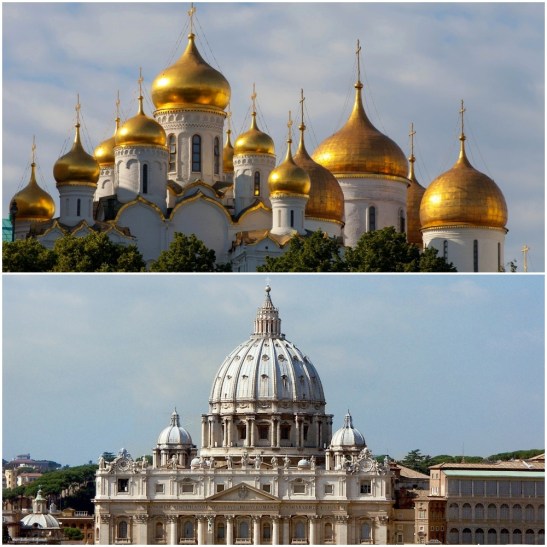
This is the second article in our Dialogical Series. The growing trend among some Eastern Catholics to identify as “Orthodox in communion with Rome” raises the present question. Our respondents are, respectively, Ukrainian Greco-Catholic, Roman Catholic, and Orthodox.

orthincommrome Read More