
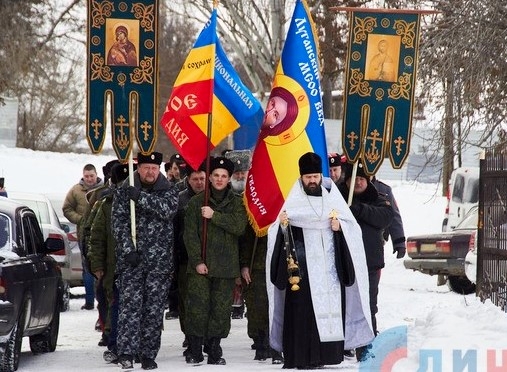
Yesterday we published Halya Coynash’s “Russia-Backed ‘Cossack’ Fighters Take Oath in Moscow Patriarchate Church,” in which she references an April 2015 study entitled, “When God Becomes the Weapon.” The study was produced jointly by the Center for Civil Liberties (CCL) in Kyiv and the International Partnership for Human Rights (IPHR) in Brussels.
Despite its being almost three years old, this study sheds important light on Russia’s ongoing low-grade war against Ukraine and the role of the Moscow Patriarchate in the Kremlin’s geopolitical aggressions.
Here we share a few key excerpts. The link to the full 22-page PDF is provided below.
 The Center for Civil Liberties (CCL) was established in May 2007 to promote human rights and the values of democracy and solidarity in Ukraine and Eurasia. The NGO is based in Kyiv, Ukraine. Last year, the Center for Civil Liberties began documenting human rights violations during the EuroMaidan events and subsequently in Crimea and Donbas. CCL conducts this work by deploying mobile groups to different parts of the liberated areas in Donbas to gather and verify information on human rights abuses.
International Partnership for Human Rights (IPHR) is a non-profit organization based in Brussels. Founded in April 2008, its mandate is to support local civil society groups in their work to eradicate violations of human rights and help their concerns and efforts be heard at the international level. Currently, the IPHR team is investigating war crimes and crimes against humanity in Ukraine by interviewing victims of violence, inspecting sites of conflict and collecting evidence. The goal is to collect enough substantial evidence to fight against impunity for those committing human rights abuses and to help victims seek just satisfaction through legal proceedings at national and international levels. Read More


 Many survivors of abuse can be triggered by simple gestures or images. In my case, it’s a challenge I have learned to manage well enough. It was terrible when I discovered how my feelings on a perfectly normal day could suddenly crash into dark despair because a gesture or an image rattled old feelings of terror or grief branded long buried. It was as if the abuse I had worked so hard to escape had resumed emotionally.
 One of the most referenced parables from the Gospels is the one we read before Great Lent concerning the Progidal Son. It is the perhaps the supreme example of how the love of God is manifested to us in understandable language. We should never forget that, even though we all may feel we grasp repentance, forgiveness, and salvation, it is never entirely completed in a single reading, or a single study, or a single homily. One of the reasons we revisit the Prodigal Son at this time of year, as we prepare for our Lenten journey, is exactly this: because each year is different for us, no matter how we may think we have not changed, or have changed, we need the reminder so we better contemplate our life and relationship to both Christ and each other.

