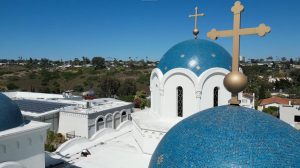
St. George Serbian Orthodox Church, San Diego, California
I was born into a half Orthodox, half Roman Catholic, half Ukrainian-Lemko, half Sicilian family 71 years ago. I was raised Catholic by a mother who had been raised Orthodox. Her maternal grandparents, my great-grandparents, were founding signatories of Holy Trinity Church (now OCA) in Willimantic CT, part of the exodus led by St. Alexis Toth. Her father, my grandfather, was a priest. Her family counted St. Nikolai Velimirović as a dear friend, who twice intervened pastorally at a moment of crisis, once for my grandparents and once for my preteen aunt. My aunt was 59 in 2003, pleased but unsurprised, when I shared the news of his canonization. My family always knew they had a gentle saint in their midst.
I had my first exposure to the Liturgy at age 12 in 1967. Two or three dozen people huddled into a classroom while the church was being built across the parking lot, St. George Serbian Church in San Diego. Two old cantors warbled through the responses, psalms, and hymns. The experience left me with the impression that Orthodox worship was ugly, boring, and intolerably long. I burst from the room in a paroxysm of joy when it was over.
We next visited San Diego in 1970, the summer I turned 15. The church was up, the mosaic half-finished. The Liturgy had been transformed into a timeless moment of heavenly beauty on earth by a near-professional choir directed by my 26-year old aunt, while the priest and servers wound their way through the scaffolding. With the permission of the young, post-Vatican II Catholic priest at our summer parish, Mom decided we’d attend St. George’s every Sunday. (No, we didn’t take Communion.) I joined the choir. I learned how to sing the Liturgy in Slavonic. For the first and only time in my life, I got to see Grandfather, now 83, serve at the altar. The joy of a 12-year old when it was over turned into the melancholy of a 15-year old. I would have happily carried on for another two hours. I made a vow to myself one Sunday: Some day, I will be part of this.
“Some day” came six years later, three months before I turned 21. I was received by Chrismation in a tiny OCA parish of mainly Ukrainians, in a homely little building in Edmonton with cartoonish icons, on the night of Pascha 1976. The congregation looked on quizzically at the young man one-third their age as their hieromonk-pastor anointed my body. Yet, they pooled their resources to present me with an exquisite Vladimir icon of the Mother of God.
I was a Roman Catholic seminarian sneaking away into Orthodoxy. I experienced conversion, not as a violent rupture with the beauty of my Catholic upbringing, but as the natural fulfilment of my childhood and adolescent faith in the fulness of beauty and truth I had found in the Orthodox Church. A parish couple my parents’ age threw their home open to me when I was told to vacate the seminary dorm. I stayed with them until I left for home in Jamestown NY two or three weeks later.
When I began reading Orthodox theology and spirituality at age 20 in 1975, Russian religious philosophy and Silver Age theology had fully blossomed in Paris. Converts and cradles of my generation devoured Schmemann, Meyendorff, and Ware, Florovsky and Lossky, Evdokimov and Clément, Bloom and Colliander, Elchaninov and Behr-Sigel and Gillet; and later, as translations became available, Florensky and Bulgakov, Stăniloae, Yannaras, Zizioulas. We fell in love with St. Silouan and Mother Maria Skobtsova. We read the elders of Optina and Igumen Chariton’s The Art of Prayer, St. John of Kronstadt, St. Seraphim of Sarov, The Northern Thebaid, the Desert Fathers. We rejoiced that we could fall down and get up, over and over. We ventured into Seraphim Rose. We revered his sanctity and his intense monastic devotion while distancing ourselves from some of his more fundamentalist views.
We sought spiritual maturation, not in creating bunkers and echo chambers, but in being challenged to test our understanding against the mind of the Church, whose Faith once for all delivered to the saints makes all things new. Spontaneously, without realizing it, we embodied St. Maximus’ expansive understanding of living Tradition as each generation’s creative discovery of new meanings hidden from our forefathers and foremothers, yet in an unforced continuum with them. Long before we heard of Jaroslav Pelikan’s dictum, we wrestled with the eternal question of Tradition vs. “the traditions of men,” even as we followed the Apostle to the Areopagus, bringing open minds and hearts to dialogue with the time and place in which we lived. We cherished the antiquity of our forms in a Faith that is never “ancient,” always conscious of the natural human tendency to idolize them and ossify the Church as an artefact in a museum, or to treat the Faith as little more than a rearview mirror.
It was a glorious, joyful time to be Orthodox, a gentler time. Our parishes were full of normal people who gossiped at the coffee hour, fought over Old World politics, drank too much at the church dance, flirted with someone else’s wife, ignored their gaydar before they even knew they had one, never heard of the Rudder, and stood broken-hearted before the iconostas on Sunday morning, weeping over their sins.
It was a time before Orthodoxism poisoned the well of Orthodoxy and made it barely recognizable to us oldsters in the Faith, before our pastors became culture warriors and spent more time on the internet and traveling the world spreading their deformed “Orthodoxy” than in their parishes, a time before the laity became self-appointed moral and doctrinal police, judges, and executioners.
Giacomo Sanfilippo is a communicant in the Orthodox Church, former priest, and Canadian theologian residing in Toronto. His PhD thesis in Theological Studies on Father Pavel Florensky’s theology of same-sex love is on hold at Trinity College, University of Toronto, while he writes his first book, Our Life in Christ: Orthodox Spirituality for Gay Men. He holds a BA in Sexuality and Gender Studies from York University and an MA in Theology from Regis College/St. Michael’s College. He is an alumnus of the Mark S. Bonham Centre for Sexual Diversity Studies at the University of Toronto. He completed the coursework for the MDiv at St. Vladimir’s Orthodox Theological Seminary in New York during Father John Meyendorff’s tenure as dean. He has five children and three grandchildren.


