
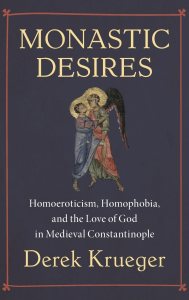
Current conventional wisdom would have one believe that same-sex physical affection has been consistently and uniformly condemned by Christianity throughout the ages. Within this mindset, it would be considered fully anathema to suggest that same-sex intimacy could be utilized as a metaphor for Divine-human intimacy. Derek Krueger’s new book, Monastic Desires: Homoeroticism, Homophobia, and the Love of God in Medieval Constantinople upends these assumptions. Exploring the deeply incarnational writings of St. Symeon the New Theologian (949-1022 C.E.), Krueger aptly seeks to situate Symeon’s writings within the Byzantine society in which Symeon lived.
Symeon was the abbot of St. Mamas Monastery in Constantinople and thereafter headed up a community at Saint Marina until his death. Fr. Alexander Golitzin of Marquette University describes him as “perhaps the most remarkable and influential mystic to appear in the history of the medieval Byzantine Church.”[1] Further championing Symeon’s orthodoxy, Fr. Golitzin notes that Symeon “was consciously and thoroughly in harmony with the doctrinal, liturgical, and ascetical traditions of Eastern Christianity.” For Golitzin, what makes Symeon most specifically the “New Theologian” was Symeon’s “open and emphatic appeal to his own, personal experience…. to insist on the use of the first person singular- ‘I’” in developing his theology.
Symeon deeply acknowledged the consequences of his baptismal christification. Baptized into the Body of Christ, one was truly a partaker of Christ, thereby divinizing the individual experience. Symeon explains:
We are made members of Christ, and Christ becomes our members, and Christ becomes my hand and the foot of all-wretched me…
Shocking even for modern audiences, Symeon graphically delineates the consequences of this oneness with Christ: “And thus you shall know well that both my finger and my penis are Christ. Do you tremble or feel ashamed?” Krueger explains this as one of “the ramifications of belief in the incarnation.”
While heading up a celibate male monastery and practicing ascetical chastity, Symeon writes of his past: “I also had become an adulterer at heart, and a sodomite in deed and by deliberate choice.” Krueger characterizes this as “one of the most striking confessions in all Byzantine literature.” Symeon accuses himself of a seemingly exaggerated, rhetorical list of additional sins, even murder. However, Krueger observes that “Symeon’s confession to being a sodomite is rather different.” Symeon qualifies it as “in deed” and intentional choice. This self-confession is an interpretive key to understand Symeon’s incorporation of homoerotic narrative into his spirituality. Knowing with St. Paul that “all things work together for good for those who love God,” Symeon has repurposed his “sodomite” past so as to explicate his own love relationship with God.
To this end, Symeon recasts the familiar Parable of the Prodigal. In place of the forgiving father is a manganous emperor. In place of the prodigal, there is a long-querulous rebel. When the rebel repents of his offenses against the emperor,
He approached the emperor and embraced his feet, he wept and asked forgiveness. Seized by unexpected joy, the good emperor immediately accepted him, wondering at his conversion and humility. The man… lay mourning over his tardiness and the crimes for which he had previously been responsible. Raising him up, the emperor fell upon his neck and kissed him all over, and on his eyes which had been weeping for many hours. Then, when he had ordered that a crown and robe and sandals be brought out that were like the ones he was wearing, he himself clothed his former enemy and rival, and in no way reproached him for anything. And not only this, but night and day he was rejoicing in him and being glad, embracing him and kissing his mouth with his own mouth. So much did he love him exceedingly that he was not separated from him even in sleep, laying down with him and embracing him on his bed and covering all over with his cloak, and placing his own face upon all his members.
Written for his fellow monks, Symeon explains by his parable “that it is in just such a manner that the good loving God welcomes and embraces those who repent, who… strip themselves naked of the affairs of this life and approach Him as King.” Symeon’s narrative might aptly be called the Parable of the Homoaffective Reconciliation, however Krueger entitles it “The Parable of the Rebel.” Symeon concludes by advocating for a similar attitude from his own monks: “Abandoning everything, let us run naked and approaching Christ the Master, let us fall down and weep before His goodness, so that He… welcome and honor us, and adorn us with His own robe and diadem, and make us worthy celebrants of the bridal chamber of heaven.”
Symeon further advises them, saying: “Be… like the prostitute and cling… to the Lord’s feet, kissing them and washing them… Be like a bride, lying down in union with Christ the Bridegroom.”[2]
Krueger notes the parable’s antecedents in the Parable of the Prodigal Son, but there is also likely dependency on Ephesians 2, where Paul writes: “In Christ Jesus, you who were once far off have been brought near… It is he… who made the two of us one by breaking down the barrier of hostility that kept us apart…” (v. 13-15) Paul then develops the “great mystery” of the bridal identity of the church wherein “the two shall become one flesh.” (5:31)
Symeon’s Armenian contemporary, Gregory of Narek (945-1003 C.E.), also a monk writing for a male audience, similarly advocates a bridal perspective for his readers. “Let us… show that God has love towards humanity as great as a groom’s for his bride. Isaiah says, ‘As the bridegroom rejoices in the bride, so does the Lord rejoice in you.’ David himself also says this in his lament over Jonathan, ‘Love of you pains me more than the love of woman.’”[3]
Both Symeon and Gregory show little difficulty in transitioning from heteronormative images of divine-human love to same-sex affection conveying the same.
John of the Cross (1542-1591) similarly uses same-sex affection to describe the Christian’s experience in the bridal chamber. In his commentary on the Spiritual Canticle, John explains “Love joins and binds God and the soul so strongly that it unites and transforms them. So great is this union that even though they differ in substance, in glory and appearance the soul seems to be God and God seems to be the soul. This union is more wonderful than all that can be said of it. Scripture mentions something about it in the Book of Kings in reference to Jonathan and David. The love Jonathan bore David was so intimate that it knitted his soul to David’s. If the love of one man for another was that strong, what will be the tie caused by the soul’s love for God, the Bridegroom?”[4] It is easily overlooked that in discussing bridal mysticism, John has seamlessly transitioned from a heterosexual marital metaphor into discussing the profundity of the love between two men.
While it is unlikely that John of the Cross had any dependency on or familiarity with St. Symeon, he would have been keenly familiar with the writings of the Castilian Franciscan, Ramon Llull (1232-1316). Ramon unflinchingly offered same-sex intimacy as paradigmatic of divine-human intimacy. His Book of the Lover and the Beloved was intentionally composed dependent upon Islamic mystical literature in an effort to convince his Muslim readers of the ascendancy of Christian truths. Llull’s book “belongs to the long tradition of mystical writing in which the relationship of God and the soul is portrayed in terms of sexual love, as in the Song of Songs.”[5] However, while using the Song’s language of “Lover” and “Beloved,” Llull intentionally rejects the standard heterosexual paradigm for these two, replacing it instead with two clearly male figures in his mystical romance. With an Islamic audience in mind, Llull adopted Sufi mystical literature stylistics which envisioned male-to-male intimacy as bespeaking the divine-human romance.[6] Centuries of subsequent Christian readers accepted Llull’s same-sex lovers unquestioningly, seemingly unbothered by the re-gendering of an otherwise standardly female character representing humankind in traditional mystical Christian writings.
The two main characters of Llull’s mystical romance are simply identified as “Lover” and “Beloved,” with the “Beloved” understood as Christ. The Lover is the man seeking after Him. Llull buys so fully into same-sex intimacy as a model for the divine-human romance, that he even creates an encounter in which his “Lover” happens upon two friends “who greeted and embraced and kissed each other with love and tears. And the Lover swooned, so strongly did these two lovers call his Beloved to mind.” Llull’s narrative progresses from describing them as “friends” and then more specifically “lovers.” The physical intimacy of the two occasions not merely the Lover being reminded of his love for God, but a mystical excess in which he swoons.
Llull’s Lover and Beloved are very similar to Symeon’s Rebel and Emperor, Llull even referring to the Beloved as “the sovereign.” There is initial discord between the two, as in Symeon. “The Lover and the Beloved struggled…”
Like the Emperor, the Beloved “would clothe” the Lover “with his own garments…” Their intimacy is not solely emotional, but overtly physical. “The Beloved revealed himself to the Lover, clothed in new and scarlet robes. He stretched out his arms to embrace him, inclined his head to kiss him…” And where in Symeon the Emperor had taken the Rebel into his own abode, in Llull “The Beloved came to lodge in his Lover’s dwelling.” Similar to Symeon, “The Lover and the Beloved met together, and their greetings, embraces, kisses, weeping, and tears testified to their meeting.” And further like Symeon, the romance progresses to a shared bed. “The Beloved came to stay in the Lover’s guest house and his Lover made him a bed of thoughts, and served him there with sighs and tears.” As in Symeon, the Lover has intimate access to his Beloved “so that he might kiss his feet.” “The Lover lay in the bed of love. His sheets were made of joys… and his pillow of tears.” And as every good romance always concludes: “the Lover remained forever in the companionship of his Beloved.”
Llull’s Book of the Lover and the Beloved is considered a renowned classic of Christian mystical literature. It has been printed in more than 128 editions. It helped lay the groundwork for the flowering of mysticism in Spain in such figures as Mother Juana de la Cruz, Teresa of Ávila, and John of the Cross. However, scant attention was paid to the intentional Islamic influence in Llull’s rendering of his characters, in spite of Llull’s own words: “…a Saracen had told him that they had certain religious men called Sufis… These men have words of love and short examples which communicate great devotion… he decided to make the book in the very way mentioned above…” What is not made explicit in Llull’s explanation is his coopting of male-male intimacy from his Islamic sources. And subsequent generations of Christian readers have nary batted an eye when reading his portrayal of male-male intimacy and physicality.
Common for both Llull and Symeon is that they each coopt same-sex intimacy to point to the divine romance. Krueger explains that “human longing offers the epistemological ground for Symeon’s love of God.” In a similar vein Llull writes: “The Lover yearned for his Beloved.” What Krueger writes of Symeon proves equally true for Llull (and John of the Cross and Gregory of Narek as well): “his carnal imagery fleshes out an understanding of the spiritual that is always also incarnate.” Krueger will go on to explain that those “who renounced sex provide important vantage points, as they transfigured desire…” Homoaffection gets enlisted in the cause of mystical union. “In Symeon’s writings, the erotic imagery takes its place within ascetic life… He illustrated deification with images of intimacy that monks had renounced and that their teachings condemned.” Krueger writes that “Symeon’s divine erotics were transgressive…” and he wielded them with purpose and intention. Strong human affections could be newly aimed at an even stronger and more primal impulse toward God. Krueger aptly labels this “an alternate erotics.”
He concludes his book with this this characterization: “Hot with love of God, and with the help of the Spirit, Symeon’s longing led him to insight and theosis. He preached a discipline always at the edge of desire, an alternate erotics. Instead of looking back toward Sodom, Symeon invited the monk to… look forward to consummation with the God who loved him ‘exceedingly’… Symeon composed his hymns… in a monastic world that held celibacy, homoeroticism, and the love of God in a nearly untenable tension.”
Krueger’s important book affords continuities for LGBTQ people today, creating a bridge to our shared past, making discernable voices which are otherwise all too easily overlooked when heard solely through the filter of heteronormativity. Symeon the New Theologian emerges ever newer and more relevant through Krueger’s critical analysis, contextualization, and his attention to Symeon’s seminal texts. In adding other Christian writers to the shared analysis and conversation, it is my hope that attention can be drawn to allied voices like Gregory of Narek, Ramon Llull and John of the Cross, who at critical points in their own writings diverge from a heteronormative stance and similarly align themselves with a positive employing of same-sex love. With the centuries-long popularity of Llull’s Book of the Lover and the Beloved, and the Roman Church’s recognition of both Gregory and John as “Doctors of the Church,” there is indication that the Church in some manner values their homoaffectional rendering of divine-human intimacy, even if it is unable to articulate it as such. For some LGBTQ folks today, hearing the message that same-sex intimacy models human-divine love could be life changing; for some weighed down by the burden of internalized homophobia, it might prove even life-saving.
[1] Alexander Golitzin, Preface to On the Mystical Life: The Ethical Discourses, Volume Two: On Virtue and Christian Life (Crestwood, NY: St. Vladimir’s Seminary Press, 1996), p. vii.
[2] On the Mystical Life, Fifteenth Ethical Discourse, p. 175.
[3] The Blessing of Blessings: Gregory of Narek’s Commentary on the Song of Songs (Kalamazoo, Michigan: Cistercian Publications, 2007), pp. 81-82.
[4] The Collected Works of St. John of the Cross (Washington, DC: ICS Publications, 1979) p. 531.
[5] The Book of the Lover & the Beloved, translated by E. Allison Peers (New York: Paulist Press, 1978), p. 8.
[6] In her commentary on The Book of the Lover and the Beloved, Eve Bonner highlights the shared masculinity of both characters, noting its Islamic influence. She reports that “the most striking Arabic influence on the Book of the Lover and the Beloved involves the masculinity of lover and beloved. This distinguishes Llull’s prose versicles from both the nuptial imagery of the biblical Song of Songs and from the profane love poetry of the Troubadours.” Doctor Illuminatus: A Ramon Llull Reader, ed. Anthony Bonner (Princeton, New Jersey: Princeton University Press, 1993), p. 181.
Kevin C.A. Elphick holds a DMin from Graduate Theological Foundation with a concentration in ecumenism. Earlier he had obtained an MA in Franciscan Studies from St. Bonaventure University and an MA in Religious Studies from Loyola University in conjunction with a joint studies program at Spertus College of Judaica. He is currently in studies with the Bethlehem Institute for Peace and Justice.


