TRANSITIONING GENDER AND TRANSCENDING GENDER by Metropolitan Hierotheos (Vlachos)

This article is four years old and clocks in at a mere 533 words. We publish it as part of our commitment to ensure that all voices in the Church be heard on the complex questions of sexuality and gender that face us today.

Orthodoxy in Dialogue published Intersex vs. Transgender in October 2017. At that time a colleague in Orthodox theology wrote to us: “I would encourage you to keep reminding everyone of the science related to all these issues. I don’t want our science determining our theology, but we can’t do good theology without the right science.”

When an esteemed churchman of Metropolitan Hierotheos’ stature ignores the contributions that the empirical sciences have made to our understanding of sexual and gender variance in human nature—such as the unarguably observable phenomenon of bodies born intersex (re: the “biological infrastructure” of gender cited below)—he does a disservice to science, to theology, and to human persons who simply do not fit into a tidy binarial schema of gender.
naupaktou

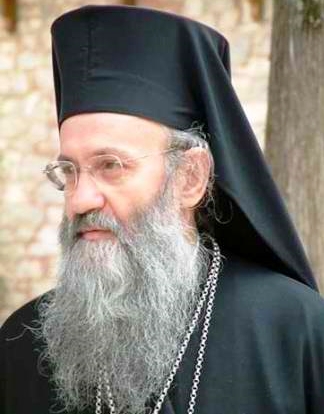
Metropolitan Hierotheos (Vlachos)

Until now we knew that there were two genders, the male and the female, or man and woman. There were also some who wavered from this for various reasons, primarily due to the passions. But recently there has arisen another person of the “third gender,” as it has been named by the courts, after many years of struggle made by such people of an “indeterminate gender” or “third gender.”

Someone named Norrie May-Welby, who was born in Scotland as a man, later went to Australia where he underwent gender reassignment surgery to become a woman, because he believed that he did not feel comfortable as an individual of the female gender, so he decided to discontinue hormone therapy to have an operation to avoid belonging to a “predetermined” gender. Then he began a long struggle to be legally recognized as a person of an “indeterminate” gender.

On Wednesday 2 April 2014 “the Supreme Court of Australia ruled that the State of New South Wales should recognize the existence of this third ‘indeterminate’ gender to which Norrie May-Welby belongs” (Ta Nea, 04/04/2014). Thus was born a person of an “indeterminate gender” (non-specific sex), who is neither a man nor a woman.

One is struck by the point to which a person can reach, who is frustrated by all things and wants to taste new experiences and situations. There are many who, claiming human rights for all people, are ready to accept and adopt such a mindset. But if we start accepting human rights without any necessary restrictions, then we will arrive at a social catastrophe. Read More

ROD DREHER GLORIFIES COLONIALISM, ADDS AFRICAN BARBARIANS TO LIST OF PEOPLE WHO TERRIFY HIM

pjimage (11)

Addendum: One of our readers has alerted us to this Snopes report, according to which Rod Dreher—in his article of May 8, 2017, “When Is It OK to Kill Whites?”—falsely accuses African-American professor Tommy Curry of advocating the murder of white people. According to Snopes, “After [Dreher’s] blog post was published, Curry started receiving death threats that were serious enough to warrant what he described as a constant police presence near his home.” Dreher remained unapologetic when Snopes reached out to him for comment.

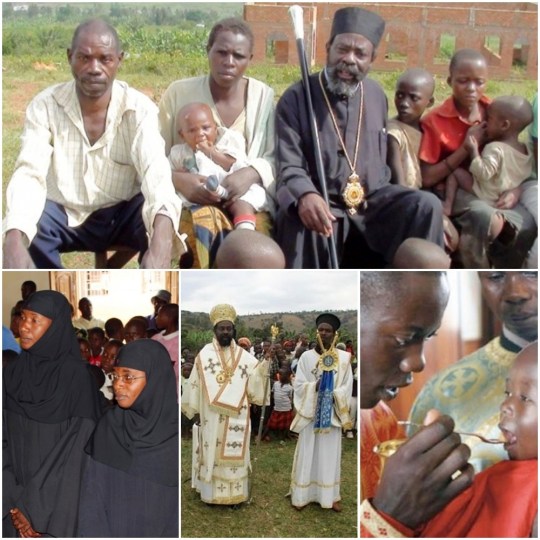
This morning Rod Dreher published “Miguel Monjardino’s República” at The American Conservative. In it he glorifies the West’s colonial past, adds 21st-century African barbarians to the list of people who terrify him, and finds yet another opportunity to plug The Benedict Option. (For critiques of the latter, see Giacomo Sanfilippo’s here, George Demacopoulos’ here, and Adam DeVille’s here.)

Our readers are encouraged to read Mr. Dreher’s piece in full to form their own opinion. Here we offer only a few of his more salient points:

One of the best things — the very best thing, in fact — about traveling is getting to meet extraordinary people.

We met Miguel and Kika at a picnic table down by the harbor in Angra do Heroismo, the capital city. We arrived on Terceira for the island’s annual St. John festival. Over platters of limpets (sea snails) grilled in their shell, in olive oil and chopped garlic, we got to know each other.

Miguel explained to us how the city was vital to Portuguese trade in the East Indies, and how much money had passed through the place during Portugal’s heyday as one of the world’s great colonial powers….

But the challenges the US faces are relatively small compared to the massive problems coming hard and fast at Europe, in the form of African migration.

Where are those Africans going to go? They’re going toward Europe, which is depopulating. Miguel said that given the geography of the Mediterranean, it’s going to be very, very hard for Europe to keep African migrants from entering.

Will the latter-day descendants of those Europeans be able to hold back the “barbarian invasions” from Africa in the 21st century?

Miguel Monjardino…is a secular Benedict Option abbot, working to keep tradition alive through the new Dark Age.

Be of good cheer, reader. The times are dark, but there are men and women of good will working to guard and spread the light in the hidden places of the crumbling Empire. Read More


ST. MAXIMOS THE CONFESSOR: ON DIFFICULTIES IN SACRED SCRIPTURE: THE RESPONSES TO THALASSIOS reviewed by Henry C. Anthony Karlson III

St. Maximos the Confessor: On Difficulties in Sacred Scripture: The Responses to Thalassios
Fr. Maximos Constas, Translator
Washington DC: Catholic University of America Press, 2018

maxconstSt. Maximos the Confessor is one of the most difficult and yet most rewarding patristic writers to read. As St. Photios the Great once indicated, he can be subtle and difficult to understand. This is because most of his writings are not meant for theological novices. He engages, criticizes, and develops the theological tradition which was handed down to him, answering questions which arise as a result of that tradition. He expects his readers to know the basics of that tradition and to be in agreement with it, making it rare for him to explain that tradition and establish its principles in detail before providing his unique theological contemplations. While this is true for most of Maximos’ writings, this is especially true for the answers to the sixty-five scriptural questions given to him by his friend, St. Thalassios.
Fr. Maximos Constas has done a fine job of not only translating Maximos’ text, but also of introducing the text and giving readers unfamiliar with Maximos’ theological premises the foundation that they need to understand his responses. Likewise, he has done a tremendous service by offering the scholia which went with the text. He explains that the two go together, with Maximos writing at least some of the scholia and the whole being seen and used together by later writers, such as those who edited his works for the Philokalia. The scholia can be very useful, as they provide a kind of engaged summary of what Maximos wrote, complementing the main text by making it more accessible. However, as is mentioned in various footnotes, sometimes the scholia differ with what Maximos wrote in the main text, making it sometimes difficult to trust all that is found in the scholia.  Read More


ARE THERE NO ORTHODOX BISHOPS AND PRIESTS IN LOS ANGELES?

pjimage (10)

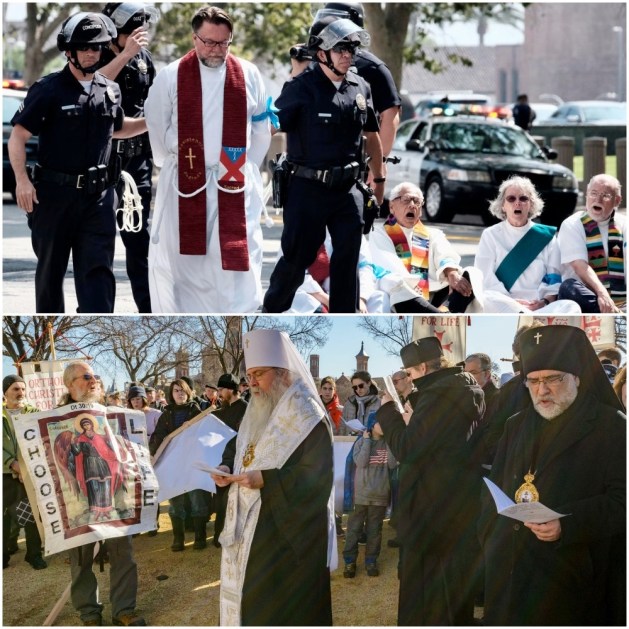
Clergy arrests, Los Angeles (upper); March for Life, Washington DC (lower)

When it comes to public symbolic gestures and photo ops, the Orthodox Church in the United States gives the impression that the lives of children before they’re born constitute the one and only issue worthy of our concern. Curiously we seem to vanish when the lives of born children hang in the balance and the cameras start rolling or clicking.

As widely reported, over two dozen individuals—most of them clergy of various faith communities—were arrested in Los Angeles on Tuesday of this week during an orchestrated act of peaceful civil disobedience.

Nathan Solis writes for Courthouse News Service: Police arrested priests, reverends, rabbis and other members of the faith community outside a California courthouse in downtown Los Angeles on Tuesday over a show of civil disobedience against the Trump administration’s immigration policies. They locked hands, blocked traffic and then sat in the middle of a street and waited for officers from the Los Angeles Police Department to arrest them…..

Haaretz reports (with a large number of photos): In Los Angeles, California clergy members, including Rabbis, pastors and other faith leaders, lined up outside the federal court house building ahead of a visit by Attorney General Jeff Sessions. They were later seen being taken into custody in a series of planned arrests, local media reported. Rabbi Jonathan Klein, who helped organized the protest, told the Los Angeles Times that demonstrating against U.S. President Trump’s immigration policies aligns directly with his faith…. Read More