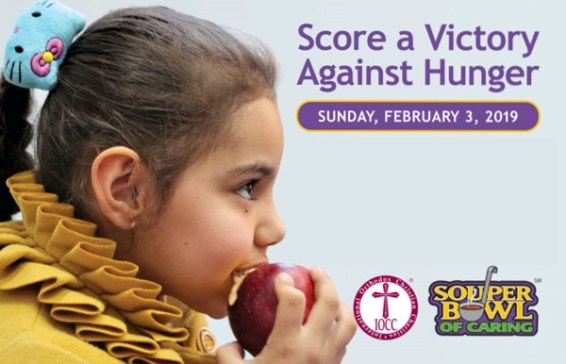
SCORE A VICTORY AGAINST HUNGER with International Orthodox Christian Charities

Orthodoxy in Dialogue is sharing this announcement as part of our wider commitment to raising awareness of the plight of, and collecting funds for, the homeless and the hungry in our midst—among the least of Christ’s brothers and sisters whom He singles out at the very centre of our responsibility to care for the suffering world where He has placed us. Speak to your parish priest to ensure that your congregation take part in this effort on Sunday, February 3. With only three weeks to go, share this post widely among your social media contacts.
Yet remember that the hungry are hungry every day of the year, and that our personal duty to give alms must be fulfilled every day of our lives.

iocc-tagline

iocc

Sunday, February 3, 2019 has been designated “Souper Bowl of Caring Sunday” by International Orthodox Christian Charities [IOCC].

This year’s 21st annual Souper Bowl Sunday—it’s name reflects the anticipated Super Bowl on the same day—aims at rallying parishes and their youth to champion feeding the poor and caring for those in need around the world.

A variety of resources — posters, bulletin inserts, and announcements — is available on the IOCC web site to generate a “team spirit” in the weeks leading up to the first Sunday of February.

IOCC offers parishes and youth groups the following easy, step-by-step tips for organizing a successful parish Souper Bowl Sunday. Read More


THE CHOICE FACING THE ARCHDIOCESE OF RUSSIAN CHURCHES IN WESTERN EUROPE by Victor Alexandrov

Readers unfamiliar with the context of this article should glance over Archdiocese/Exarchate to Be Abolished (11/28/18), It’s Official: Ecumenical Patriarchate Dissolves Russian Archdiocese of Western Europe (11/28/18), Rue Daru Responds: Communiqué of the Archdiocesan Council of the Russian Archdiocese of Western Europe (12/1/18), and the latter part of A Way Out of the Orthodox Church’s Present Crisis (1/2/19).
eglise-alexandre-nevsky (2)

St. Alexander Nevsky Cathedral, Rue Daru, Paris

While the attention of the Orthodox community and the secular world has been focused on the Ukrainian autocephaly, another “hot spot” has appeared on the Orthodox world map – the Archdiocese of Russian Churches in Western Europe[i]. On November 27, 2018, the Synod of Patriarchate of Constantinople announced a decision to revoke the charter (tomos), by which in 1999 autonomy was granted to the Archdiocese, and its own statutes were guaranteed.

In terms of numbers, the Archdiocese is a small church: it includes about one hundred parishes, two monasteries, and seven sketes in different countries of Europe, of which fifty-eight parishes are in France. However, the role that it has played in the history of Orthodoxy in the 20th and early 21st centuries is remarkable. Therefore, its fate for the present and future of universal Orthodoxy is important and symbolic, and it is impossible to consider what is happening with it without empathy.

The Archdiocese was formed soon after the exodus from the former Russian Empire of hundreds of thousands of emigrants fleeing from the Bolshevik dictatorship, and throughout its history, to one extent or another, it attempted, in its structure, to follow the spirit of the decisions of the Moscow Council of 1917-18. A presiding archbishop is elected, there is a functional diocesan council of clergy and laity, diocesan meetings are held, again, with the participation of clergy and laity, and parishes, where as a rule parish councils really work, are actually quite independent. It is this strong element of consultation and election in its structure that makes the Archdiocese unique in contemporary Orthodoxy. It can be compared only with the Orthodox Church in America [the OCA], which is a product of the same historical development, and whose internal structure also owes much to the Council of 1917-18, and to the theological ideas of the “Paris School” nurtured by the Archdiocese. It is not surprising that both of these churches, in different ways, act as irritants for “traditional” Orthodox Patriarchates seeking to keep their ethnic diasporas in Europe and America under their control. Read More


UKRAINE RECOGNIZES SEX WITHOUT CONSENT AS RAPE, CRIMINALIZES DOMESTIC VIOLENCE by Oleg Sukhov

The following report represents a refreshing instance of Ukraine charting a better course for itself than Russia with regard to human rights in general and protections for women and children in particular. For contrast with Russia see, for instance, On “Orthodox” Wife-Beating and Decriminalisation of Domestic Violence in Russia Leads to Fall in Reported Cases. The Russian Orthodox Church supports the weakening of women’s protections in Russia.
Note also Mr. Sukhov’s reasons for leaving Russia in his bio below.
verkh

Verkhovna Rada (Supreme Council, Ukraine’s Parliament). Kyiv.

Legislation that redefines rape as sex without consent came into effect in Ukraine on Jan. 11. The punishment for the crime remains unchanged: three to five years in jail.

Previously, Ukrainian legislation defined rape as sex by force, by threat, or one where perpetrator used the victim’s helpless state. Under the new legislation, seen as more progressive, consent to sex must be given.

The law specifies that consent must be “given by a person out of free will” and adds that “circumstances must be taken into account.”

The same legislation also introduces an increased punishment of five to 10 years for non-consensual sex when the victim and perpetrator are spouses, ex-spouses, or when they are or used to be in any close relationship. Read More


METROPOLITAN EPIPHANIUS OF KYIV COMMEMORATES PATRIARCH KIRILL OF MOSCOW AT NATIVITY LITURGY

In a report late in the evening of January 7 (the Nativity of Christ on the Julian calendar), the pro-Russian Union of Orthodox Journalists confirmed the inclusion of Patriarch Kirill of Moscow in the diptychs chanted by Metropolitan Epiphanius of Kyiv at the Great Entrance during the Primatial Divine Liturgy. This begins at 1:04 in the video above.

Although the UOJ used scare quotes around several key words in a juvenile effort to delegitimize everything pertaining to the Orthodox Church of Ukraine—including the “Nativity Liturgy”—their report and accompanying video attest very movingly to the fact that the newly autocephalous Church of Ukraine considers herself in communion with the Moscow Patriarchate and the entire Russian Orthodox Church. Read More