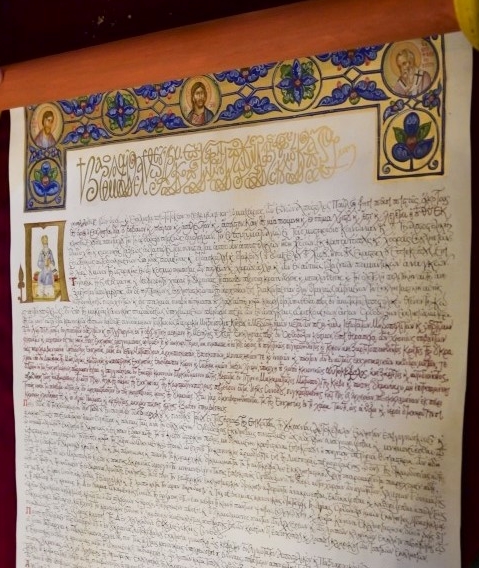
TOMOS OF AUTOCEPHALY: THE FULL TEXT

tomos1

✠

PATRIARCHAL AND SYNODAL TOMOS FOR THE BESTOWAL OF THE ECCLESIASTICAL STATUS OF AUTOCEPHALY TO THE ORTHODOX CHURCH IN UKRAINE

Bartholomew, by God’s mercy Archbishop of Constantinople-New Rome and Ecumenical Patriarch:

“You have come to Mount Zion . . . and to the Church of the first-born” (Heb. 12.22–23), as the blessed Paul, apostle to the nations, declares to all the faithful, appropriately likening the Church to a mountain to affirm conviction and recognition as well as steadfastness and stability. For although the Church of God both is and is called one flock and one body of Christ—everywhere sharing the confession of Orthodox faith, the communion through the sacraments in the Holy Spirit, and the constancy of apostolic succession and canonical order—already from the earliest apostolic times it also consists of local and native Churches internally self-administered by their own shepherds, teachers and servants of the Gospel of Christ, namely, their regional Bishops, not only for the historical and secular significance of these cities and lands, but also for the particular pastoral needs of these places.

Read More


EVANGELICALS SUE FOR RIGHT TO DENY SHELTER TO HOMELESS TRANSGENDER PEOPLE by Bil Browning

Orthodoxy in Dialogue shares this report with the following three caveats:
  1. LGBTQ Nation often has a tendency to create hyperbolic headlines that do not accurately reflect the content of their articles. Their reporting should be read with caution.
  2. While Orthodoxy in Dialogue has published extensively in support of transgender people and their rights, and of the Church’s pastoral responsibility to engage with them in a manner that recognizes their full human dignity and worth, we also acknowledge the concerns of women who have suffered from male-perpetrated sexual assault and simply cannot share intimate spaces (sleeping quarters, washrooms/restrooms, change rooms, showers, etc.) with male-bodied individuals. 
  3. Part of the unfinished (and unfinishable) task of any democratic society consists of negotiating the boundaries where the rights of one are felt to infringe on those of another. Our purpose in sharing this report is not to provide ammunition to the transphobes in our society and the Orthodox Church, but to encourage reasonable, charitable discussion of these difficult questions. Contact us by email if you wish to respond with an article or letter to the editors.

homeless

Alliance Defending Freedom, the far-right evangelical legal group that defended the “right” of a baker to deny service to gay couples before the Supreme Court, has a new target.

This time they’re suing to give a homeless shelter in Anchorage, Alaska, the “right” to deny help to transgender people. The federal court lawsuit seeks to overturn the city’s nondiscrimination ordinance that prohibits discrimination against LGBTQ people.

ADF attorney Ryan Tucker told the court that many of the shelter’s residents are survivors of domestic violence and “they would rather sleep in the woods” in the frigid Alaskan winter than share space with a transgender woman. Temperatures in the city in the past week have hovered around zero degrees Fahrenheit.

Hope Center, a Christian nonprofit that operates the shelter for homeless women, turned away a transgender woman twice in January. While the facility had cause to turn her away (she showed up drunk once and after hours the second time), they couldn’t resist taking a jab at LGBTQ people. Read More


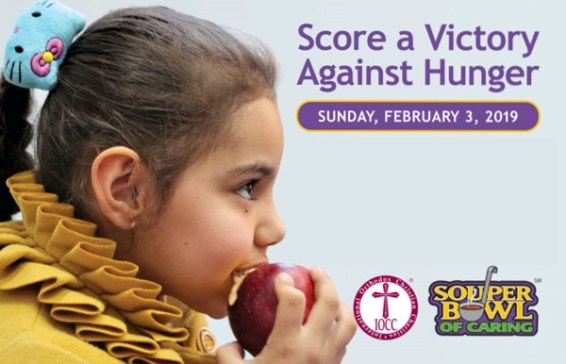
SCORE A VICTORY AGAINST HUNGER with International Orthodox Christian Charities

Orthodoxy in Dialogue is sharing this announcement as part of our wider commitment to raising awareness of the plight of, and collecting funds for, the homeless and the hungry in our midst—among the least of Christ’s brothers and sisters whom He singles out at the very centre of our responsibility to care for the suffering world where He has placed us. Speak to your parish priest to ensure that your congregation take part in this effort on Sunday, February 3. With only three weeks to go, share this post widely among your social media contacts.
Yet remember that the hungry are hungry every day of the year, and that our personal duty to give alms must be fulfilled every day of our lives.

✠

iocc-tagline

iocc

Sunday, February 3, 2019 has been designated “Souper Bowl of Caring Sunday” by International Orthodox Christian Charities [IOCC].

This year’s 21st annual Souper Bowl Sunday—it’s name reflects the anticipated Super Bowl on the same day—aims at rallying parishes and their youth to champion feeding the poor and caring for those in need around the world.

A variety of resources — posters, bulletin inserts, and announcements — is available on the IOCC web site to generate a “team spirit” in the weeks leading up to the first Sunday of February.

IOCC offers parishes and youth groups the following easy, step-by-step tips for organizing a successful parish Souper Bowl Sunday. Read More


THE CHOICE FACING THE ARCHDIOCESE OF RUSSIAN CHURCHES IN WESTERN EUROPE by Victor Alexandrov

Readers unfamiliar with the context of this article should glance over Archdiocese/Exarchate to Be Abolished (11/28/18), It’s Official: Ecumenical Patriarchate Dissolves Russian Archdiocese of Western Europe (11/28/18), Rue Daru Responds: Communiqué of the Archdiocesan Council of the Russian Archdiocese of Western Europe (12/1/18), and the latter part of A Way Out of the Orthodox Church’s Present Crisis (1/2/19).
eglise-alexandre-nevsky (2)

St. Alexander Nevsky Cathedral, Rue Daru, Paris

While the attention of the Orthodox community and the secular world has been focused on the Ukrainian autocephaly, another “hot spot” has appeared on the Orthodox world map – the Archdiocese of Russian Churches in Western Europe[i]. On November 27, 2018, the Synod of Patriarchate of Constantinople announced a decision to revoke the charter (tomos), by which in 1999 autonomy was granted to the Archdiocese, and its own statutes were guaranteed.

In terms of numbers, the Archdiocese is a small church: it includes about one hundred parishes, two monasteries, and seven sketes in different countries of Europe, of which fifty-eight parishes are in France. However, the role that it has played in the history of Orthodoxy in the 20th and early 21st centuries is remarkable. Therefore, its fate for the present and future of universal Orthodoxy is important and symbolic, and it is impossible to consider what is happening with it without empathy.

The Archdiocese was formed soon after the exodus from the former Russian Empire of hundreds of thousands of emigrants fleeing from the Bolshevik dictatorship, and throughout its history, to one extent or another, it attempted, in its structure, to follow the spirit of the decisions of the Moscow Council of 1917-18. A presiding archbishop is elected, there is a functional diocesan council of clergy and laity, diocesan meetings are held, again, with the participation of clergy and laity, and parishes, where as a rule parish councils really work, are actually quite independent. It is this strong element of consultation and election in its structure that makes the Archdiocese unique in contemporary Orthodoxy. It can be compared only with the Orthodox Church in America [the OCA], which is a product of the same historical development, and whose internal structure also owes much to the Council of 1917-18, and to the theological ideas of the “Paris School” nurtured by the Archdiocese. It is not surprising that both of these churches, in different ways, act as irritants for “traditional” Orthodox Patriarchates seeking to keep their ethnic diasporas in Europe and America under their control. Read More