This is the third article in our Reformation 500 Series.
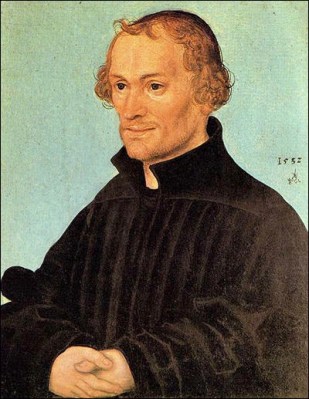
Philip Melanchthon
Though largely unknown to modern Christians, appeals to the Greek Church in both rhetorical usage and actual correspondence were pivotal during the formative years of the Reformation. In 1519, during the Leipzig Debate against Catholic interlocutor, Johann Eck, Martin Luther stated that the Greek Church had never accepted Rome’s claim to papal supremacy, and that it was the Greek Church that had produced the early Church’s finest theologians.
This and other comments made by Luther during his lifetime reveal that he held a generally positive view of the Greek Orthodox tradition, though his statements about the Greek Church were often made for polemical purposes. As such, many have concluded that Luther never engaged with the Orthodox tradition in any meaningful way, and that his statements should be viewed in this light.
The same, however, cannot be alleged of Luther’s comrade, Philip Melanchthon. Melanchthon has been called the mind behind the Reformation, a claim evidenced by the fact that he was the primary author and editor of the Augsburg Confession. He was a gifted linguist who excelled in both Greek and Latin, and was as familiar with the Church Fathers as was feasible during the 16th century. In his seminal work, Loci Communes, he makes several references to Church Fathers, including St. John Chrysostom, St. Basil the Great, and St. Gregory the Theologian. Melanchthon also demonstrates a profound interest in church history. Read More

 I can’t speak or write of these things without tears flowing down my face. I’m the father of a 35-year old transgender son. He’s probably the person I love most of all in the world. This isn’t to say that I love him “objectively” more than my other four sons, or more than my granddaughter, or my soon-to-be-born second granddaughter.