This is the second article in our Reformation 500 Series.

Saint Constantine Equal-to-the-Apostles and the Holy Fathers of the First Ecumenical Council with the Nicaean Creed
I can claim no more than the generalist knowledge of any reasonably educated Westerner of my generation concerning the Protestant Reformation and the situation of the Roman Catholic Church at the end of the Middle Ages that some say made it inevitable.
Much less can I claim to speak for the Orthodox Church. I offer the personal reflections of one Orthodox Christian.
Yet I hope that my readers will discern some measure of authenticity in my thoughts; that the main outlines of my presentation, if perhaps not every detail, will bear the ring of truth for my Orthodox brothers and sisters; that they will recognize herein, for the most part, the one, holy, catholic, and apostolic Faith that we Orthodox hold in common, “traditioned” (παραδοθείσῃ, traditae in the Vulgate) once for all to the saints; and finally, that the truth that I attempt to speak will be heard by those outside of the Orthodox Church as spoken in love. Many of my Protestant and Catholic readers are known to me personally. You enrich my life in ways immeasurable with your presence, your friendship, your deep love for Christ and His Gospel, your patience with my often inelegant and bumbling efforts to articulate this Faith of which I am unworthy to call myself an heir.
The fundamental question, it seems to me, is one of ecclesiology. Our theological understanding of the Church as Church will condition in large part how we view the Reformation. Here we should note that the Reformation eventually introduced categories into Christian discourses about the nature of the Church herself that exist nowhere in the New Testament, and nowhere in 1500 years of the Church’s self-understanding: “denominations,” “confessions,” the “branch theory” of “Christianity.” Read More


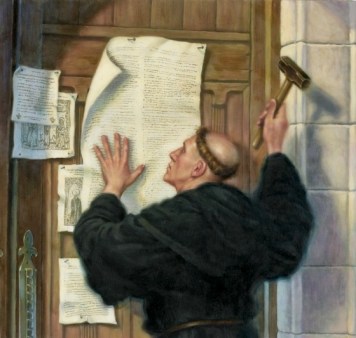 I credit the Orthodox theologian, Father John H. Erickson, for teaching me that ecclesial anniversaries are tricky occasions to prepare. As he noted at the June 1997 Orientale Lumen Conference between Catholics and Orthodox: