IT’S ORTHODOX TO HATE JEWS (AND OTHER GEMS) by Matt Parrott

EDITORIAL FOREWORD

Since January 22, 2018 Orthodoxy in Dialogue has published extensively on the cancer of white supremacy and neo-Nazism within the Orthodox Church in the US, our parishes, our seminaries, our monasteries. (See the White Supremacy and Racism category in our Archives by Author for a full list of articles, editorials, and letters.) Our motive in keeping this issue front and centre in our readers’ consciousness has been to ask the Assembly of Canonical Orthodox Bishops in the United States of America, its individual member hierarchs, the individual jurisdictions to which they belong, our seminaries, and our monasteries to acknowledge the gravity of our concerns and to deal with them in an open, public, and transparent manner.

To date we have been completely ignored. Not a single bishop has contacted us—not even the ones to whom we have reached out privately about our concerns in their specific jurisdictions. Only one—the highly respected Metropolitan Savas (Zembillas)—has seen fit to add his signature to A Statement Concerning the Sin of Racism. Not a single seminary has responded to our repeated emails requesting a statement from them.

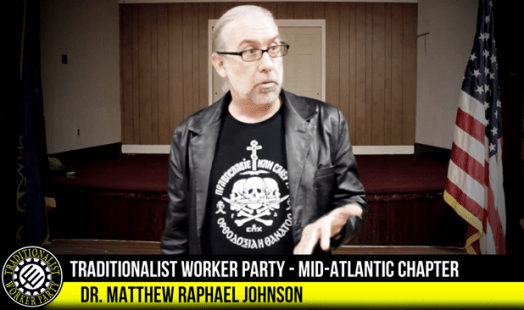
The following article represents white supremacist and neo-Nazi Matt Parrott’s fourth attack against our bishops and distortion of the Orthodox Christian faith to support his diabolical racism, xenophobia, and anti-Semitism. Although it was originally published on his hate group’s website on January 30, we have only just now become aware of it. This is the same Matt Parrott who previously boasted:

Absolutely every Orthodox Christian who gets thrown under the bus in this most recent multicult witch hunt is welcome to join us. We’re working in tandem with hundreds of seminarians, secretly supportive clergy, and prominent clergy abroad…. The road to hell is paved with the skulls of erring priests and bishops, and I will stomp on each one of them on my way to hell and back to win this war for the universality of Christianity in the West.

Heretics to Ameridoxy II: My Heretical Gab Posts

by 
Matt Parrott

saint-cuomo Read More


PAVEL FLORENSKY: EARLY RELIGIOUS WRITINGS 1903-1909 reviewed by Giacomo Sanfilippo

Pavel Florensky: Early Religious Writings 1903-1909
Boris Jakim, Translator
Grand Rapids MI: William B. Eerdmans Publishing Company, 2017

earlyflorenskyBoris Jakim began to establish his reputation as one of the foremost English translators of modern Russian religious literature when he published four books by S.L. Frank (1877-1950) between 1983 and 1993. He introduced Pavel Florensky (1882-1937) to the English-speaking world in 1997 with his translation of his magnum opus, The Pillar and Ground of the Truth: An Essay in Orthodox Theodicy in Twelve Letters, originally published in 1914. While it has become something of a commonplace to call Florensky one of the 20th century’s preeminent Orthodox theologians, very little of his literary corpus is available in English. Consequently anything like “Florensky studies” remains in its infancy among academics who do not read Russian fluently. Jakim’s latest contribution adds another important piece to the complex puzzle that comprises the man Florensky.

The years covered by this volume attest to Florensky’s extraordinary intellectual gifts in early adulthood: he wrote these essays between the ages of twenty-one and twenty-seven. After the secular upbringing typical of Russia’s educated classes at the time, and while a student of mathematics at Moscow University, he surprised his parents in 1903 by committing himself to the Orthodox Church in that era’s movement of “returning intelligentsia.” A year later he caused them even greater consternation when he abandoned a promising career in maths and sciences to enrol at the Moscow Theological Academy. There, as a seminarian and later lecturer while he completed his master’s degree and worked on Pillar and Ground, he wrote most of the essays presented in this collection. Read More


THE THREE-BARRED ORTHODOX CROSS IN THE NEWS (AND IT’S NOT GOOD)

tianatiana2

Today marks Week 6 since we posted our Open Letter to the Assembly of Canonical Orthodox Bishops in the United States of America on the alarming connection between the Orthodox Church in the US and white supremacists, neo-Nazis, and hate groups. This report is the sixteenth article, letter, or editorial that Orthodoxy in Dialogue has published in the past six weeks urging our hierarchs and seminaries—collectively and/or individually—to respond to this very grave matter, and to let our tens of thousands of readers around the planet know what steps they intend to take to investigate and to rectify where necessary. You can find these sixteen articles listed together under White Supremacy and Racism near the top of our Archives by Author page. Read More


ANOTHER WESTERN CAPTIVITY ALREADY? CALL FOR ARTICLES

3hiersWhether Father Alexander Schmemann coined the expression “the Western captivity of Orthodox theology” or borrowed it, he had in mind the Latinization and Protestantization of Orthodox thought due to the collapse of theological education in the former Byzantium after the fall of Constantinople, and the effects of Uniatism on theological education in present-day Ukraine and Russia.
 
The rediscovery of the Fathers in the 18th and 19th centuries (thanks largely to the efforts of St. Nicodemus of the Holy Mountain and St. Macarius of Corinth in the Greek world, and of St. Paissy Velichkovsky in the Slavic world), the recovery of authentic iconography, the fact that we never amended our liturgical texts to accommodate the Westernized theologies, our growing resistance to “school theology”—these kinds of things contributed to the beginning of the Orthodox Church’s theological liberation from this captivity. 
 
It seems to some of us that we are now descending into an even greater, more serious Western captivity. It comes not from Roman Catholicism or classical Protestantism this time, but simultaneously from two opposite extremes. What makes this new captivity baffling is that it emerges not from accidents of history over which we have no control, but from our own carelessness. 

Read More