Earlier today Orthodoxy in Dialogue published Joseph Zheng’s When Andrew Reigned Alone on the Earth: Ecclesial Implications of the Ukrainian Tomos. In it he draws our attention to the following interpretation of Constantinopolitan primacy and its attendant canonical prerogatives.
Metropolitan Elpidophoros turns 52 this year. Since he was born in Istanbul, and Turkish law requires that the Ecumenical Patriarch be a Turkish citizen by birth, it seems plausible that he could become the next Patriarch of Constantinople and have a very long reign on the Ecumenical Throne. We offer his understanding of the Ecumenical Patriarch’s personal primacy for careful study and robust debate throughout the whole Body of the Church.
First without Equals: A Response to the Text on Primacy of the Moscow Patriarchate
In a recent synodal decision,[1] the Church of Russia seems once again[2] to choose its isolation from both the theological dialogue with the Roman Catholic Church and the communion of the Orthodox Churches. Two points are worth noting from the outset, which are indicative of the intent of the Church of Russia’s Synod:
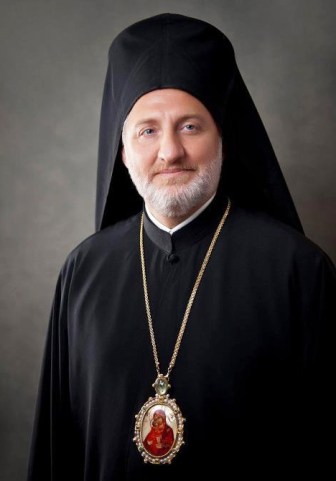
Metropolitan Elpidophoros of Bursa
First, its desire to undermine the text of Ravenna,[3] by invoking seemingly theological reasons in order to justify the absence of its delegation from the plenary meeting of the joint commission (an absence dictated, as everyone knows, by other reasons[4]); and
Second, to challenge in the most open and formal manner (namely, by synodal decree) the primacy of the Ecumenical Patriarchate within the Orthodox world, observing that the text of Ravenna, on which all the Orthodox Churches agreed (with the exception, of course, of the Church of Russia), determines the primacy of the bishop on the three levels of ecclesiological structure in the Church (local, provincial, universal) in a way that supports and ensures the primacy and first-throne Orthodox Church.
The text of the position of the Moscow Patriarchate on the “problem” (as they call it) of Primacy in the universal Church does not deny either the sense or the significance of primacy; and up to this point, it is correct. In addition, however, it endeavors to achieve (indeed, as we shall see, in an indirect way) the introduction of two distinctions related to the concept of primacy. Read More