This is the third article in Orthodoxy in Dialogue’s Faith & the Arts series.
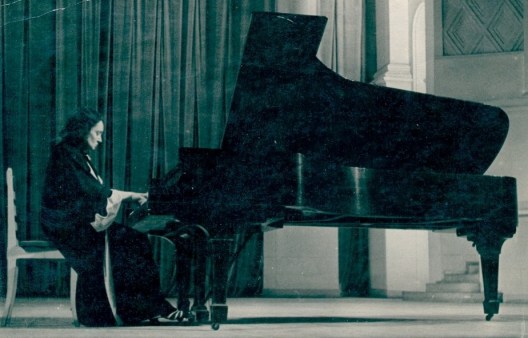
Maria Veniaminovna Yudina (1899-1970)
Armando Iannucci’s recent film, The Death of Stalin, briefly filled the two Moscow cinemas where it was being shown, but then was abruptly banned. The movie was described as an “unfriendly act by the British intellectual class” by Nikolai Starikov, head of the Russian Great Fatherland Party, and as part of a “Western plot to destabilize Russia by causing rifts in society,” by the head of the Public Council of the Russian Ministry of Culture.
In fact the film provides, in the form of a Dr. Strangelove-sort of black comedy, a remarkably accurate portrait of the end of Stalin’s ruthless reign and the subsequent battle for leadership among those in his inner circle. Though only Stalin looks like his historical self, the casting is superb. My only disappointment was the portrayal of the great Russian pianist, Maria Veniaminovna Yudina (Мария Вениаминовна Юдина).
In the film she is young and glamorous and, though despising Stalin, willing to make a special recording for him in exchange for a bribe of thousands of rubles.
The actual Yudina was very different. I have come to know her indirectly through the memoirs of her friend and one-time classmate, the composer Dmitri Shostakovich, as related by Solomon Volkov in his book, Testimony, and also through Tatiana Voogd, a founder of our Russian Orthodox parish in Amsterdam, who knew Yudina personally and even slept under her piano—“the most sheltered place in her apartment,” she told me. Read More




 Knowing the identity of sexual abusers reveals the truth about priests. To start, it’s important to know how sexual abusers are defined and, indeed, what sexual abusers are not.

