CRISIS AT THE BORDER: THE HOLY SPIRIT IS SPEAKING TO YOU. PAY ATTENTION! by James Martin, SJ

Orthodoxy in Dialogue has proposed that a few Orthodox priests co-author an open letter on the humanitarian catastrophe taking place on the US-Mexico border, which other clergy and hierarchs would be invited to sign. While awaiting a response to this proposal we are profoundly grateful to Father Martin for his voice.

On such a fundamental issue as this, servants of the Gospel cannot find themselves on the side of the “left” or the “right,” the side of “liberalism” or “conservatism,” but solely and squarely on the side of Christ.

If two or three of our priests would like to initiate an open letter, speak to one another and then contact us by email—making sure to cc one another—to discuss parameters before you start.

immchild

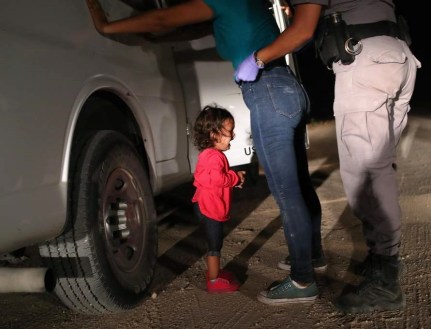
You know that feeling of anger when you read about children being taken away from their parents at the border in your government’s name?

You know that awareness of deep injustice when you realize the immoral path our country is taking? What is that?

It’s your conscience speaking to you. That’s how it works.

Sometimes we say, “Why isn’t God doing something?” “Why isn’t God intervening?” But the main way that God intervenes in human history is by rousing people’s consciences. This is the Holy Spirit speaking to us, inspiring us, telling us to do something.

In other words, the main way that God intervenes is through us. So what can we do? Read More


AWE AND WONDER AT THE MAJESTY OF GOD by Alexandros Mammas

Alexandros Mammas was a finalist in the Junior Division (grades 7-9) of the Greek Orthodox Archdiocese’s St. John Chrysostom Oratorical Festival 2018. Speakers were given a brief list of themes from which to choose. This speech is published with parental consent.

Division: Junior

Theme: Talk about a time and circumstance when you were in awe and wonder—where you sensed the majesty of God.

Oratorical image 2018Your Eminence Archbishop Demetrios, Your Eminence Metropolitan Nathanael, Reverend Fathers, and Fellow Parishioners, Good Morning/Afternoon: 

Yea, we beseech, You, visit our weaknesses, O Good One, and heal our infirmities both of spirit and of body through Your mercy; through the prayers of the all-pure, exceedingly blessed Lady Theotokos and Ever-Virgin Mary. 

The above text is taken from the liturgical service of The Order for the Lesser Sanctification of Water. During Liturgy, we are always reminded that we must have the fear of God, but what does this mean? It does not mean that we must be scared or intimidated by God. It is a reaction to God’s greatness, His limitlessness, the power of His love. All of this is what produces my awe of God. This awe of God is what makes me desire to have an intimate relationship with Him. 

My son, pay attention to what I say; turn your ear to my words.  Do not let them out of your sight; keep them within your heart; for they are life to those who find them and health to one’s body. (The Book of Proverbs)

During my fourteen years of life, I have undergone twelve surgeries and many medical procedures. I have always placed my trust in Jesus, reciting silently, “Lord Jesus Christ, Son of God, have mercy on me, a sinner.” I have found peace this way. While on a surgical table, waiting to be placed under general anesthesia, I have been in awe of God. Just by looking at the faces of the doctors, nurses, and my parents, I see God, since God created us all in His image. God has brought all these good people together to restore my body to health.  Read More


A RESPONSE TO METROPOLITAN KALLISTOS by Annalise Wolf

This is the first article in our new “The Wheel 13/14: Responses” series.

loveI read Metropolitan Kallistos Ware’s foreword on human sexuality with interest. I would like to reflect on his example of the “second anomaly,” while keeping in mind the pastoral reminders and exhortations of the first part: that Ware does not consider anyone guilty of a sexual orientation, and that it is possible for a person to choose celibacy rather than act on an orientation whose expression is not blessed within the teachings of Orthodoxy.  Here is the example, quoted in full:

A second anomaly is to be found in the way homosexuals are commonly treated in the sacrament of confession. All of us recognize that there is an important distinction to be made between those homosexuals who engage in casual encounters, seeking out in some “gay” bar a partner for a single night; and on the other hand, those homosexuals who are committed to a permanent relationship, faithful and monogamous, in which deep love is involved. Surely no Christian is in favour of sexual promiscuity. Yet what frequently happens in confession? Let us suppose that the one who is promiscuous comes to feel a sincere revulsion for his way of life, and with genuine penitence resolves to pursue a life of purity in the future. In that case, he will probably be given absolution by the priest and will be permitted, perhaps with certain restrictions, to receive holy communion. For a time, he refrains from sexual activity, but then from frustration and loneliness he relapses into another casual encounter. After that he repents, and is absolved, and is once more blessed to receive communion. Then after a time he again lapses. So the cycle continues. What happens, by contrast, to the faithful and monogamous homosexual? Perhaps the priest says in confession, “Are you willing to give up your homosexual relationship?” The penitent may answer, “I cannot do that.” The priest may rejoin, “You can continue to share a common life, marked by mutual affection; but will you abstain from further sexual activity?” The other may well reply, “I am not yet ready to undertake that.” (Yet I have known homosexuals who have indeed transformed their relationship in this way.) The priest, faced with this refusal, may well feel that he cannot bless the penitent to receive the sacrament. Now here certainly is a paradox. The homosexual committed to a stable and loving relationship is treated more harshly than the homosexual who is casual and promiscuous, and who is seeking not true love but passing pleasure. Something has gone wrong here. (9) Read More


RESPONDING TO THE WHEEL: CALL FOR ARTICLES

wheelOn August 27, 2017, less than a week after Orthodoxy in Dialogue’s official launch, we published our second editorial: “Same-Sex Love: The Church Needs a Conversation.” This remains one of our most popular articles of all time, currently sitting in 11th place.

Since then, a full 64 of our 274 articles—roughly 25%—have been archived under the separate category of Sexuality and Gender in our Archives by Author

The current, double issue of The Wheel (13/14 | Spring/Summer 2018) represents an enormous contribution to this conversation. For their boldness in grappling publicly with these complex questions in the face of inevitable backlash from certain quarters in the Church, we commend unreservedly editors Inga Leonova, Joseph Clarke, Katherine Kelaidis, and Gregory Tucker. 

We also commend each of the contributors. With the theme of Being Human: Embodiment and Anthropology, the issue features To Our Readers by the editors, a Foreword by Metropolitan Kallistos (Ware), an Editorial by Father Andrew Louth, and articles by the following authors: Father John Behr; Marjorie Corbman, Steven Payne, and Gregory Tucker; Beth Dunlop; Brandon Gallaher; Father John Jillions; Katherine Kelaidis; Bradley Nassif; Aristotle Papanikolaou; Giacomo Sanfilippo; Father Vasileios Thermos; Father Alexis Vinogradov; and Christos Yannaras.

Reflective of Orthodoxy in Dialogue’s continuing commitment to our part in this conversation, we issue this Call for Articles to prospective respondents representative of all sides of the questions raised in The Wheel. We have created a separate category for this project in our Archives by Author. Read More