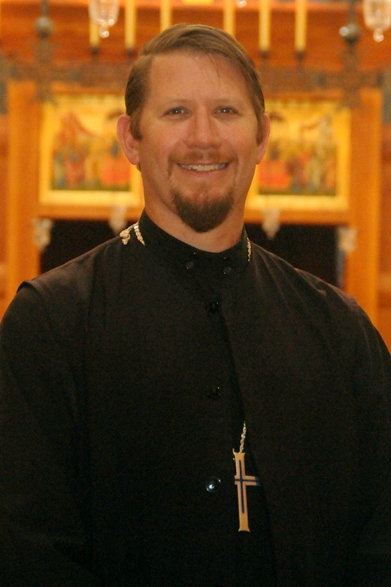
A BRIEF NOTE: THE PAST IS NOT OUR DESTINATION, FEAR IS NOT THE WAY by Archbishop Lazar (Puhalo)

In Orthodoxy in Dialogue’s A Conversation on Theology, Church, and Life by Father Andrew Louth, and again in his Editorial in the current issue of The Wheel, he cautions that fear never makes a legitimate starting point from which to do theology. In the same vein, Archbishop Lazar notes that fear incapacitates us as Church to encounter the world “with confidence and grace.”

deaconThere is certainly a major shift in society, and it is very frightening to some people. Such shifts have gone on before in history, and they have always been frightening to a segment of the population.

For some years now we have watched the erosion of the kind of democracy that has developed in the West, based on the British system of parliamentary democracy. At the same time, we have watched the slow atrophy of religion in the West. There has also been a rise in right-wing authoritarianism, both political and religious.

We have seen this type of reactionism at other times in history, and we have learned little from it. Reactionism has never worked, and it has always compounded the social transformation that it was fighting against.

We should be able to encounter these shifts and changes in society with confidence and grace. Certainly, the Orthodox faith has the capacity to engage social transformations with dignity and peacefully. We must, however, be willing to accept that the past does not have all the answers. The past may be a foundation, but it is not a destination.

Fear incapacitates us and leaves us unable to encounter the realities of social change in any positive manner. Fear can drive us into a cold, unreasoning fundamentalism which does not allow us to draw from the real strength of the Orthodox faith to minister to society in a creative way which fully upholds the Gospel—the Gospel, not a religious ideology. Read More


A POLITICAL STRATEGY OF PEOPLE WHO WERE DEEMED CONTAGIOUS BY THE SHIRTLESS PUTIN by Alexander Kondakov

The following article, written by a Russian scholar in sociology, makes no references to Orthodoxy in general or to the Russian Church in particular. Its relevance for Orthodoxy in Dialogue’s readers lies in the vaunted revival of “Byzantine symphonia” between church and state in post-Soviet, 21st-century Russia: arguably this “symphonia” makes the Moscow Patriarchate complicit—whether overtly or covertly—in the multiple levels of violence perpetrated against Russia’s sexual minorities.

This article analyzes conditions in which contagious populations have found themselves in Russia and reviews theories of queer/crip kinship from two perspectives: the theories developed in academic literature, and the conceptualization of queer/crip kinship that may be derived from everyday accounts of people. The latter position is shaped through an analysis of life history interviews with disabled people who identify on the LGBTIQ spectrum in Russia. The Russian context is different from many other geographical locations, but also relates to the more common condition of precarity shared under contemporary neoliberal capitalism. Crip kinship is understood as a prominent political strategy that brings new perspectives on our futurities outside of assemblages of oppression and exploitation that able-bodiedness, heterosexism, and misogyny provoke, sustain, and enforce.

putinshirtlessIn 2013, the Russian state passed an Administrative Code statute declaring “non-traditional sexual relations” such as “male homosexual relations, bisexuality, and transgenderism” as contagious and prohibited any form of “dissemination” or “propaganda” about such “non-traditional relations.” The law implies that sexual relations of this sort can be transmitted from one body to another and are dangerous for children because they can plant “non-traditional sexual attitudes” in their psyche, “provoke interest into such relationship,” and make children queer, enlarging the “diseased” population of the Russian Federation (Federal Law 2013). Within this contagious framing, the law seeks to prevent Russian children from becoming queer, and, in doing so, positions queer life as disposable (Evans and Giroux 2015). 

Recent episodes of NBC’s Saturday Night Live (2017) depict Russian President Vladimir Putin as shirtless (played by Beck Bennett), congratulating US citizens on electing Donald Trump. The image of a shirtless Putin suggests that “compulsory able-bodiedness” (McRuer 2006, 2) is an integral part of the exclusionary ideology promoted by the current Russian government and—as suggested in the show—transmitted to the United States as a kind of infection. The president’s body is imagined as a normative reminder of how a real man is supposed to look, enabling an assemblage of oppressive ideologies (Puar 2007) such as heterosexism, ableism, and misogyny. In referencing Putin’s exposure of his body to the public in myriad scenes of fishing, riding a horse, and swimming—all assumed to confirm his masculinity and potency—the media reassures his authority and reinforces traditional power relations by reproducing those images in various contexts, including in humor (Sperling 2015Novitskaya 2017). Though Saturday Night Live establishes that Putin is openly broadcasting oppressive ideologies through the exposure of his own body, the point is to look at not the form, but the content of these utterances. All societies are informed by heterosexism, ableism, and misogyny. Thus, I offer to regard the Shirtless Putin as a metaphor marking conditions of oppression beyond national borders of Russia. Read More


PORCELAIN ICONS: THE CREATIVE PROCESS FROM WITHIN by Irina Gannota

Версия 2

St. Irene. Three icons from the same cast. By Irina Gannota.

In this article I would like to talk about the process of making porcelain icons, lithophanes. Strictly and loftily speaking, the most essential processes of creating a holy image take place inside the artist’s head. They are therefore inexplicable, and the result is always just a pale shadow of what might have been if we were closer to God. However, being infinitely grateful for what has been possible to achieve, I will try to introduce the reader to those visible traces of the human, God, saints, angels, and great artists from the past, all working together.

When it comes to making icons using whatever technique, there is a distinct possibility of seeing yourself as just a pupil for the rest of your life. Whether or not an icon-maker has a teacher, it is always necessary to look through the examples from the past before starting a new piece. For some, the purpose of ths is to make the new image “canonical’.” For me, to make it decent. Read More


PAVEL FLORENSKY AND SAME-SEX LOVE: A RESPONSE TO GIACOMO SANFILIPPO by Richard F. Gustafson

Floresky-Friendship-Chapter-image-600-pxDr. Gustafson wrote the “Introduction to the Translation” in Boris Jakim’s 1997 English version of Father Pavel Florensky’s 1914 The Pillar and Ground of the Truth: An Essay in Orthodox Theodicy in Twelve Letters. Gustafson writes:

The new visibility and sometimes tolerance, if not acceptance, of homosexuality, which was spawned by the late-nineteenth-century homosexual liberation movements in Germany, had a strong impact on Russian cultural life in the beginning of the twentieth century, and not a few of the poets and artists followed the ways of Tchaikovsky.

In this context, Florensky’s notion of friendship has a decided homophilic, if not homoerotic, tinge. All dyadic friendships in his discussion are same-sex unions. And this is what is significant theologically, even for our own era. Florensky decenters heterosexual marriage in his presentation of ecclesiality in order to privilege pairs of friends. He moves the discussion of Christian life away from the union of the flesh to the union of the spirit. Marriage is understood as a remnant from pagan life, now blessed by the church; friendship is inherently Christian. To my knowledge, Florensky’s The Pillar and Ground of the Truth is the first Christian theology to place same-sex relationship at the center of its vision. (P. XX)

The brief correspondence below is published with Dr. Gustafson’s permission. Note that he links even Russian sophiology with same-sex love. This lends support to Giacomo Sanfilippo’s comments on Sophia in Florensky’s homoerotic love poetry in “A Brief Response to Luis Salés.” Read More