THE “PATRIARCH” HAS NO CLOTHES by Giacomo Sanfilippo

http://photo.unian.net

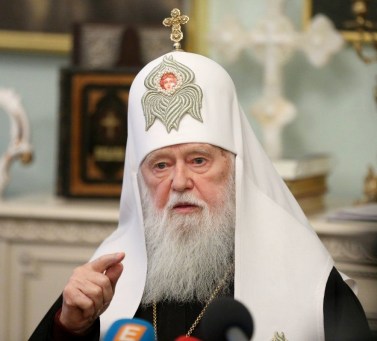
“Honorary Patriarch” Filaret (Denysenko)

Orthodox observers outside of Ukraine who generally support its Church’s autocephaly shook their head in disbelief when the Unification Council of December 15 named former KGB agent Filaret Denysenko as “honorary patriarch.” We hoped at the very least that he would follow in the footsteps of the current Pope Emeritus to a mostly hidden life of prayer and quiet, seldom to be seen or heard from again. Since all Orthodox bishops must first be monks—nominally, if a long monastic formation is not always possible in every case—it would have made perfect sense for former “Patriarch” Filaret to retire to a monastery.  

What a naïve hope that quickly turned out to be.

In a tradition where visual symbols carry the power that they do in Orthodoxy, Filaret’s undiminished itinerary of public appearances and utterances—all while bedecked in the garish headpiece of a Russian (!) patriarch—reduces the real Primate of the Orthodox Church of Ukraine visually to just another metropolitan among many. This glaring symbological disparity in so trivial a matter as a hat probably ensures that Filaret and Metropolitan Epiphanius never be seen together.* Filaret thus maintains his iron grip on his role as leading man on the stage of Ukrainian religious and national life.

(Even the Ecumenical Patriarch wears the simple black hat and veil of an ordinary monk when the occasion does not call for full liturgical vestments.) Read More


THE BEST A MAN COULD BE: WHAT A RAZOR AD CAN TEACH ORTHODOX MEN ABOUT METANOIA by Nic Hartmann and Jason Streit

In January 2019, a new ad campaign for Gillette razors was unveiled to the public. Known for its trademark phrase “The Best a Man Can Get,” the ad featured a group of men and boys engaging in behavior that, while destructive, has been frequently depicted as “men being men,” or “boys being boys.” Fighting. Bullying and picking on others (while being watched by a group of men behind a line of grills). Sexual harassment (both verbal and physical). Speaking (often incorrectly) for the perspectives of women, rather than providing women the opportunity to speak for themselves (known to many as “mansplaining”).

The ad shifts to clips of television interviews discussing the #MeToo campaign, with the intention of presenting the pervasive problem of sexual harassment in everyday life. This part of the ad ends with one former professional athlete saying that men need to hold other men responsible, before shifting to another important segment of men who are stopping these problems from taking place. Men pushing harassing men away from their female targets. Fathers pulling fighting kids off of their hapless victim. Men stopping people in the street from trying to go after another man. Read More


VIDEO: LOVE TO THE END reviewed by Giacomo Sanfilippo

Love to the End: A Documentary Film on Mother Maria of Paris
Anberin Pasha, Director/Producer; Emanuel Sabau, Co-Producer/Production Head
Synaxis Studios, 2018

lovetotheend

Love to the End contains a disturbing segment which makes this the most difficult review that I will ever have to write. I’ve let Ms. Pasha and Mr. Sabau know that they had walked unwittingly into a minefield when they went to Toronto’s St. John the Compassionate Mission to film last year, and that I would address this in my review. I will get to this by and by.

Mother Maria (Skobtsova) has been one of my most beloved and most revered modern Orthodox figures for my entire adult life, since long before her formal glorification as a saint by the Patriarchate of Constantinople in January 2004. If memory serves me right, my parish priest lent me his copy of Father Sergei Hackel’s Pearl of Great Price  (1965) some 43 years ago—and instantly I fell in love with this 20th-century martyr and Desert Mother in the midst of the city. I was delighted when word started making the rounds of Facebook that Anberin Pasha and Emanuel Sabau had been working on a documentary on Mother Maria’s life that was soon to be released.

In a brief summary submitted to Orthodoxy in Dialogue on Christmas Day, Mary E. Danckaert describes the film as Read More


A NEW (OLD) BOOK BY OLIVIER CLÉMENT: SOME THOUGHTS FROM THE TRANSLATOR by Jeremy N. Ingpen

Editor’s Foreword
As a greatly needed breath of fresh air in the suffocating climate of moralism and fundamentalism which masquerade as “Tradition” in some Orthodox circles today, this first-time translation of Olivier Clément’s earliest theological book could not have come at a better time.
Clément stands in a direct line of descent from the flowering of theological creativity that characterized the encounter between the Orthodox Church’s living Tradition and the intellectual, social, political, and cultural currents of modernity. The names which stand out most prominently in this venerable genealogy—representing the best of the Russian Religious Renaissance beginning around 1880 and its heirs—are of course well known to English-speaking Orthodox readers: Soloviev, Florensky, Bulgakov, Behr-Sigel, Lossky, Evdokimov, and many beyond the immediate sphere of Russian Orthodoxy, such as Romania’s Stăniloae and Greece’s Yannaras. Whether we agree or disagree with these thinkers in every instance, they have left their mark as true giants of unfearful, loving Orthodox dialogue with the world in which they found themselves. One reads these remarkable authors and yearns to get on with the business of becoming a saint….
Now a foreign spirit, an ideological rigidity hardly bearing even the most superficial resemblance to the mystical theology and ascetical spirituality of Orthodox Christianity, has come to infest our Church and to lead her, if it can, down  a different path.  
We are deeply grateful to Mr. Ingpen for reaching out to Orthodoxy in Dialogue, and to Dr. Patricia Fann Bouteneff for suggesting that he do so.
Giacomo Sanfilippo, Editor 

✠

clement

Olivier Clément (1921-2009)

The great French Orthodox theologian Olivier Clément died in 2009 at the age of 88. On the 10th anniversary of his death, his first book, Transfigurer le Temps. Notes sur le temps à la lumière de la tradition orthodoxe (1959 – see Yves Congar’s brief review from 1961 here), is published for the first time in an English translation by New City Press. The rediscovery of this almost forgotten text allows us to see Olivier Clément in a new light. His first work already reveals a mature thinker, deeply rooted in the patristic tradition. It lays out many themes to which Clément would return in later books and articles.

But why read Clément’s Transfiguring Time now? Clément foresaw the rise of a new atheistic “gnosticism” and of “Christianity on steroids,” the one trapping its proponents in the hell of their own existence, the other retrojecting on society the all-powerful and vengeful God of the Old Testament. Clément sought instead the locus of human freedom and the flowering of full human potential in the Incarnation and in the encounter with a kenotic God who takes on all of human existence, and who waits, patiently, for us to turn and to hear. Read More