THE FALSE ROMANCE OF RUSSIA by Anne Applebaum

The importance of this article for an Orthodox audience lies in the simple but chilling fact that Patriarch Kirill and Vladimir Putin openly boast of Russia’s church-state relations as a 21st-century reincarnation of Byzantine symphonia: as goes the Kremlin, so goes the Patriarchate—or, more literally, Kremlin and Patriarchate speak with a single voice on both domestic and geopolitical affairs. 
That so many American converts to Orthodoxy look to Russia and the institutional Russian Church with blinders on is alarming enough. That the Primate and Holy Synod of the OCA—which is presumably not only the Orthodox Church in America, but for America—continue to sell their collective soul to the Moscow Patriarchate in exchange for the OCA’s uncanonical autocephaly and the imaginary prestige of a “representation church” in Moscow is nothing less than a damning indictment of the OCA’s anti-American and anti-Canadian loyalties at the highest levels of ecclesiastical governance.
(See, for instance, Ukrainian Autocephaly: An Awkward Spot for the OCA, Ukrainian Autocephaly: What Says the OCA?, Well, Well, Well. What Perfect Timing for the OCA to Reject Ukraine., The Weaponization of Religion: How the Kremlin Is Using Christian Fundamentalism to Advance Moscow’s Agenda, etc., in our Archives.)

kirtik

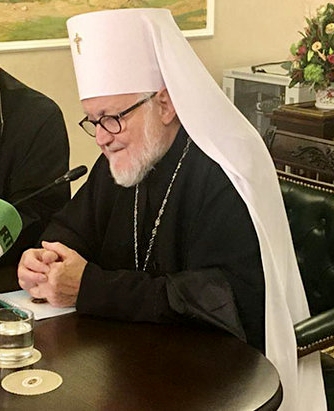
Patriarch Kirill of Moscow (L) and Metropolitan Tikhon of the OCA (R)

American conservatives who find themselves identifying with Putin’s regime refuse to see the country for what it actually is.

Sherwood Eddy was a prominent American missionary as well as that now rare thing, a Christian socialist. In the 1920s and ’30s, he made more than a dozen trips to the Soviet Union. He was not blind to the problems of the U.S.S.R., but he also found much to like. In place of squabbling, corrupt democratic politicians, he wrote in one of his books on the country, “Stalin rules … by his sagacity, his honesty, his rugged courage, his indomitable will and titanic energy.” Instead of the greed he found so pervasive in America, Russians seemed to him to be working for the joy of working. Read More


JANUARY’S COMING: CALL FOR ARTICLES ON “PRO-LIFE” AND “CHRISTIAN UNITY”

keyboard-without-1

Two controversial events associated with the month of January every year are the March for Life in Washington DC and the worldwide Week of Prayer for Christian Unity. We invite our readers to submit thoughtful articles of 1000-1250 words expressive of a diversity of views on these two topics, to be published from January 1 to 31, 2020.

Orthodox Christians, individuals from other ecclesial or denominational traditions, and those who do not subscribe to any religious faith are welcome to have their say. We hope to hear from hierarchs, clergy, monastics , laypeople, and young people. Read More


UNESCO: BYZANTINE CHANT PART OF HUMANITY’S “INTANGIBLE CULTURAL HERITAGE”

As a living art that has existed for more than 2000 years, Byzantine chant is a significant cultural tradition and comprehensive music system forming part of the common musical traditions that developed in the Byzantine Empire.

Highlighting and musically enhancing the liturgical texts of the Greek Orthodox Church, it is inextricably linked with spiritual life and religious worship. This vocal art is mainly focused on rendering the ecclesiastical text; arguably, the chant exists because of the word (‘logos’), since every aspect of the tradition serves to spread the sacred message. Read More


EVOLUTION AND THE FALL by Christopher Howell

pjimage (31)And death shall have no dominion.
Dead men naked they shall be one
With the man in the wind and the west moon;
When their bones are picked clean and the clean bones gone,
They shall have stars at elbow and foot;
Though they go mad they shall be sane,
Though they sink through the sea they shall rise again;
Though lovers be lost love shall not;
And death shall have no dominion.

Dylan Thomas, “And Death Shall Have No Dominion”

“The origin of animal suffering,” writes C.S. Lewis in The Problem of Pain, “could be traced, by earlier generations, to the Fall of man—the whole world was infected by the uncreating rebellion of Adam. This is now impossible, for…animals existed long before men” (138). Here is the problem of evolutionary theodicy in a nutshell: humanity—traditionally the cause of the “the groaning of creation”—is no longer apparently guilty of wrecking the cosmos in a primordial act of rebellion. The world before us was one of predation, destruction, and death, just as it is now. Evolutionary history, then, raises significant questions about theodicy—about God’s goodness in overseeing history, and the role of death and suffering in both creation and human life. The apparent priority of death to sin is an enormous challenge to theological doctrine, and Orthodox theology in particular. However, despite these fearsome challenges, Orthodoxy also brings to bear some unique tools to deal with the problem.
Read More