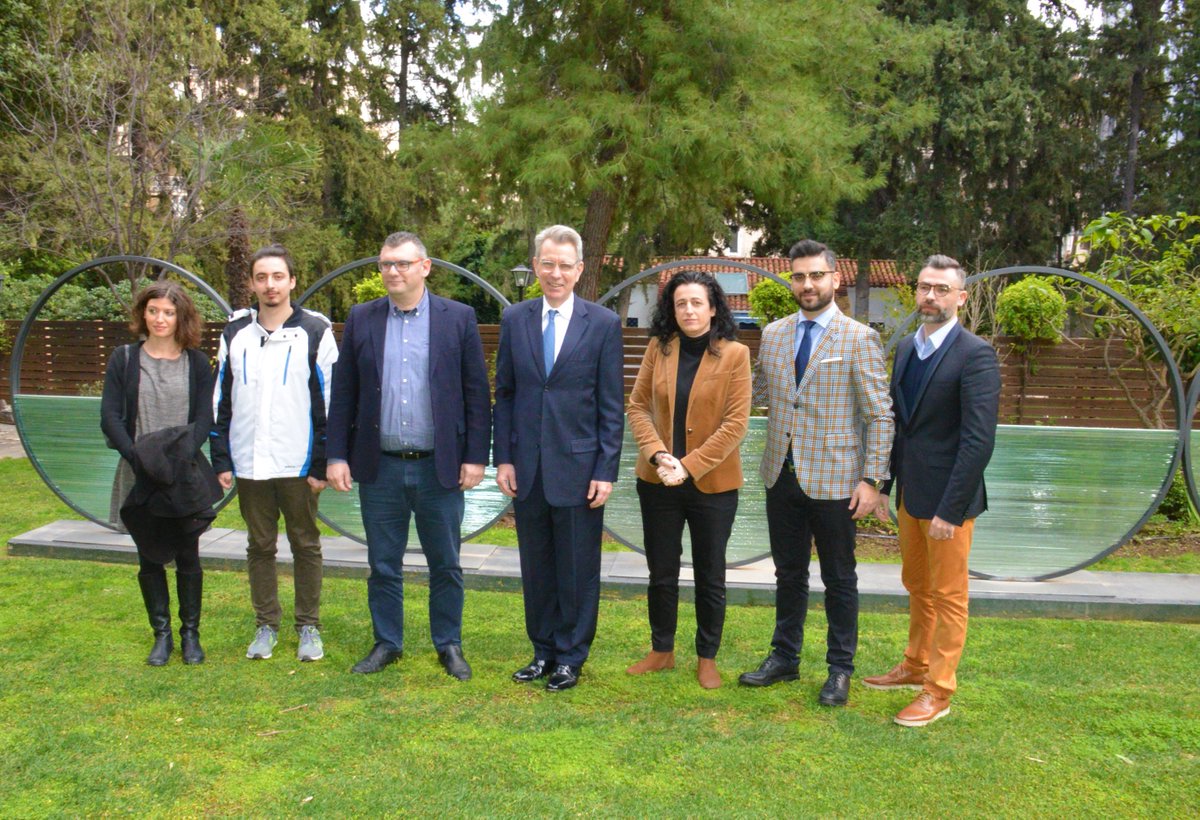
RESILIENCE: BUILDING A EUROPEAN RESPONSE TO THE CHALLENGES OF RELIGIOUS DIVERSITY

Screenshot 2019-12-16 11.37.50

The launch of the Horizon 2020-funded project RESILIENCE in September 2019 marked an important step towards an established European Research Infrastructure on Religious Studies. Twelve academic institutions from ten countries have joined forces to undertake this two-year project with the ultimate aim of building a European response to the challenges of religious diversity.

Religious diversity presents a growing challenge for European society, resulting in an increased need for mutual understanding. An infrastructure on religious studies will support this understanding through scholarly research, in the conviction that knowledge is the best tool for a shared response to the spike in issues related to religious diversity. Read More


SS. SERGIUS & BACCHUS AND THEIR ICON IN GAY CHRISTIAN APOLOGETICS by Giacomo Sanfilippo

The following essay is a condensed and slightly revised version of a paper written in December 2013 for Dr. Jaroslav Skira’s Eastern Christian Icons course at Regis College, University of Toronto.

S&Boriginal

SS. Sergius and Bacchus. Constantinople. 6th or 7th century.

A trend has developed over the past two or three decades in the field of gay Christian apologetics—taking its cue from the late Dr. John Boswell of Yale University [see Boswell’s seminal Christianity, Social Tolerance, and Homosexuality: Gay People in Western Europe from the Beginning of the Christian Era to the Fourteenth Century and Same-Sex Unions in Premodern Europe]—which posits the early 4th-century soldier martyrs, Sergius and Bacchus, as the archetypal gay Christian couple. This idea spread as far afield as an American law review, of all places, where one author, writing in defense of the legalization of same-sex marriage immediately after Boswell’s second book appeared, states unequivocally that “Sergius and Bacchus…were male lovers” [William N. Eskridge, Jr., “A History of Same-Sex Marriage,” Virginia Law Review 79 (1993): 1420]. An article published many years later in another journal, purporting to “reclaim the heritage” of SS. Sergius and Bacchus [Ronald E. Long, “Reclaiming the Heritage of Saints Serge and Bacchus: Towards a Quixotic Gay-Affirmative, Pro-Animal, Vegetarian Christianity,” Theology & Sexuality 17.1 (2011): 101-131], devotes all of one page of a 31-page treatise to the sainted “homosexual lovers” and their “homoerotic bonding” [Ibid., 103-104], and moves with astonishing ease from an account of their martyrdom to a discussion of AIDS, barebacking, S&M, exchange of bodily fluids, animal rights, vegetarianism, and a Trinity that makes love with Itself.   

Read More


SCRIPTURE AND DISSENT: ENGAGING WITH THE NEO-PATRISTIC PARADIGM OF MODERN ORTHODOX THEOLOGY by Phil Dorroll

Dr. Dorroll’s article launches our new Academic Papers series. It first appeared in 2013 in the International Journal of Orthodox Theology.
DorrollPhilip

Dr. Phil Dorroll

This article discusses the legacy of the Neo-Patristic paradigm in American Orthodox theology by examining the recent work of three contemporary American Orthodox theologians: John Behr, Kyriaki Karidoyanes Fitzgerald, and Theodore Stylianopoulos. It begins by first outlining the main conceptual bases of the Neo-Patristic paradigm as established by Georges Florovsky and others, and then discusses some important recent criticisms of this dominant theological mode in contemporary Orthodoxy. The article also explores how categories of identity and authenticity are used theologically in Neo-Patristic projects, and situates these efforts in the context of a broader critique of Enlightenment reason. The article argues that recent works in American Orthodox theology, such as that of Behr, Karidoyanes Fitzgerald, and Stylianopoulos, exhibit a complex engagement with the Neo-Patristic paradigm, and subtly reformulate or even challenge certain of its bases (such as the use of categories of identity and authenticity) by appealing to certain theologies of Scripture. These engagements constitute an important effort to engage with the contemporary foundations of Orthodox theology in America, and reveal specific ways in which these Neo-Patristic foundations are being re-interpreted in a contemporary context. Read More


AND BEHOLD, ALL THINGS WERE VERY BEAUTIFUL by Jeffrey Byer and Nancy Byer

And God saw all the things that He had made, and behold, they were very beautiful.

Καὶ εἶδεν ὁ Θεὸς τὰ πάντα, ὅσα ἐποίησε, καὶ ἰδοὺ καλὰ λίαν.

Gen 1:31

024 (2)

Canada Geese in Flight. Nancy Byer.

~

MY BABY (Mar 2019 Columbia Zoo, SC)

My Baby. Columbia Zoo. Jeffrey Byer.

~

Read More