
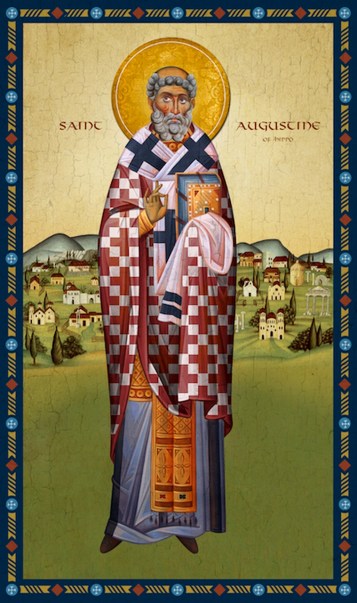
 St. Augustine (AD 354-430) was the Bishop of Hippo. He was brought up with a Christian mother and a pagan father. When he was young, he delved deeply into philosophy and became a Manichean, a banned sect at the time. He was converted in his later years through the prayers of his mother, St. Monica, and the preaching of St. Ambrose while he lived in Milan.
St. Ambrose baptized him on Pascha of AD 387. He returned to Africa, where he founded a monastery, eventually becoming the Bishop of Hippo (in modern Algeria). He wrote many volumes, and impacted the Western Church forever. In spite of popular conceptions, he remained deeply influenced by Platonism.
Augustine taught neither Calvinism nor a legalistic idea of original sin. His teaching on original sin was basically a Platonic way of explaining our relation to Adam. Adam is, according to this approach, the ideal human. He carries not just an individual humanity but the whole human nature in its ideal form. Each of us, coming from him, are concrete particularizations (forms) of that abstract humanity which Adam had. Since Adam sinned and fell, humanity in the abstract ideal fell and became sinful. Each of us, being born from Adam, then partake of this fallen nature inasmuch as we are the particularizations of a fallen abstract humanity inherited from Adam. Read More