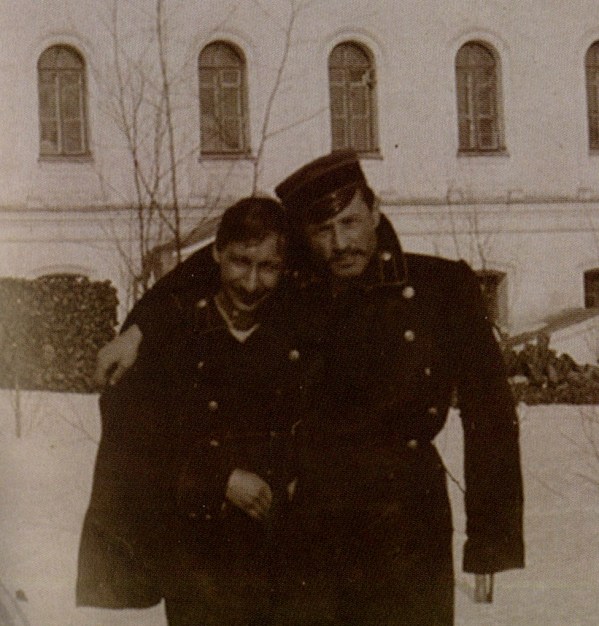

THE JOY OF SAME-SEX LOVE by Giacomo Sanfilippo

(Frontispiece from Priest Pavel Florensky, 1914, The Pillar and Ground of the Truth)
It is necessary not only to “love” one another but also to be close together, to attempt, as much as possible, to come closer and closer to one another. But when are friends closest to each other, if not when kissing?
Priest Pavel Florensky, 1914, “Friendship,” The Pillar and Ground of the Truth
On the feast of the Meeting of the Lord two weeks later, [Florensky] composed the poem “Two Knights” [for Sergei Troitsky]. It depicts a scene in which the knights have removed their armour and laid it under an aspen tree, where resin drips on it from a quivering leaf.
The knights kiss on the mouth, embrace tightly “like brothers,” and “break their spears” with each other.
Even the sun undresses as it sets amidst fiery clouds. Tears flow in almost every stanza.
Giacomo Sanfilippo, 2018, “Father Pavel Florensky and the Sacrament of Love,” The Wheel
✠
The following reflection is conceived primarily as an engagement with Father Aaron Warwick’s Pastoring LGBTQ Individuals in the Orthodox Church, and secondarily with the responses by “an American LGBTQ Christian” and Joshua Rainwater; the insights of Their Eminences, Metropolitan Kallistos and Metropolitan Nathanael; the use of male-male conjugal intimacy by SS. Maximus the Confessor and Symeon the New Theologian as a metaphor for the monk’s personal experience of union with Christ in the Holy Mysteries and in the vision of uncreated light; Protodeacon Theodore Feldman’s brief piece; and lastly, the discussion of morality vs. ethics — misguided in its shared premises, I believe — which seems to have taken place between Aristotle Papanikolaou’s recent Bridging Voices article and Father Andrew Damick’s implicit response — in which the latter coyly declines to name names, but refers to us as “Orthodox” in scare quotes (always a sign of a mature debater) — bearing the most bizarre title ever affixed to an Orthodox essay. (In connection with this, Father Hans Jacobse’s equally bizarre invention of “the moral tradition of the Orthodox Church” also comes to mind.) Read More
SAME-SEX MARRIAGE REDUCES SUICIDE RATES by Rachel Savage
Orthodoxy in Dialogue publishes the present article as further testimony to the copiously documented correlation between suicidal ideation in LGBTQ children, teens, and adults and their rejection by their families, sociopolitical milieu, and faith communities. Every struggle with suicide, every attempted suicide, every completed suicide, cries out to the Church for a better pastoral praxis grounded in a better theological and spiritual approach to understanding sexual diversity in human nature.

The advent of gay marriage has cut suicide rates among lesbians and gay men in Sweden and Denmark—but, divorced, widowed or married, homosexuals are still more prone to suicide than their straight peers, according to a study released on Thursday.
The researchers said reduced stigma for sexual minorities was likely driving the drop in deaths, culled from official data on thousands of same-sex couples in the two countries, both early adopters of gay marriage.
“Being married is protective against suicide,” said Annette Erlangsen of the Danish Research Institute for Suicide Prevention.
“Legalizing same-sex marriage and other supportive legislative measures—they might actually reduce stigma around sexual minorities,” said Erlangsen, the lead author of the study. Read More
A COPTIC OVERVIEW OF ST. AUGUSTINE’S “RETRACTIONS” by Daniel Michalski
St. Augustine (AD 354-430) was the Bishop of Hippo. He was brought up with a Christian mother and a pagan father. When he was young, he delved deeply into philosophy and became a Manichean, a banned sect at the time. He was converted in his later years through the prayers of his mother, St. Monica, and the preaching of St. Ambrose while he lived in Milan.
St. Ambrose baptized him on Pascha of AD 387. He returned to Africa, where he founded a monastery, eventually becoming the Bishop of Hippo (in modern Algeria). He wrote many volumes, and impacted the Western Church forever. In spite of popular conceptions, he remained deeply influenced by Platonism.
Augustine taught neither Calvinism nor a legalistic idea of original sin. His teaching on original sin was basically a Platonic way of explaining our relation to Adam. Adam is, according to this approach, the ideal human. He carries not just an individual humanity but the whole human nature in its ideal form. Each of us, coming from him, are concrete particularizations (forms) of that abstract humanity which Adam had. Since Adam sinned and fell, humanity in the abstract ideal fell and became sinful. Each of us, being born from Adam, then partake of this fallen nature inasmuch as we are the particularizations of a fallen abstract humanity inherited from Adam. Read More