
Metropolitan Tikhon (Shevkunov) is known to English-language readers as the author of Everyday Saints and Other Stories, written when he was abbot of Sretensky Monastery. The following open letter responds to his The Example of Charlie Kirk Is a Lesson for Us, which appeared in Russian on Pravoslavie.Ru with the title “If You Eliminate Me, Others will Rise Up and Speak out Louder”: On Charlie Kirk and His Statements, and in English translation on Orthodox Christianity .
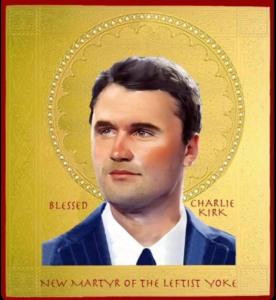
Your Beatitude, Metropolitan Tikhon of Simferopol and Crimea:
I’ve read with some interest your recently published article entitled, “The Example of Charlie Kirk is a Lesson for Us.” I have some thoughts to share.
Even in a country like the United States, with a gun culture so pervasive that many seem to have become almost inured to incidents of gun violence, the killing of public figures often shake us to our core. The assassination of John F. Kennedy in 1963 was an indescribably shocking event for Americans. It had been over 60 years since the last of the three previous presidential assassinations had occurred. Americans believed their political culture had grown and changed in three generations, that these types of events only happened in areas with unstable political structures, and we were suddenly confronted by the unwelcome realization that our complacency was misplaced. Five years later his brother, Robert F. Kennedy, a United States senator, was gunned down in an act of senseless political violence. Only two months earlier, Dr. Martin Luther King had been assassinated. While not an elected official, he was a well-known public figure who held a mirror to the nation to expose our flaws and advance debate in the political sphere to make the country more inclusive. In each case, the nation came together to mourn, to unify, and to recognize the significant contributions the fallen had made to the benefit of all Americans.
Contrast this with the shooting of Charlie Kirk. His name-recognition tended to be limited to followers of right-wing media, particularly those on college campuses. He hosted a talk radio program and podcast, published several books, and created an organization that he was able to grow from a grassroots operation into an influential business and non-profit enterprise which, in turn, enabled him to become a more prominent voice within the MAGA wing of the Republican Party. He appealed to those ensnared in the right-wing culture wars. His exposure grew substantially after to his murder, due to the careful reinventing of his persona, and his elevation to a type of questionable secular martyrdom by his allies. You mentioned his murderer — “and all those who stood behind him” — a strange statement, as all evidence indicates that he acted alone, and virtually everyone has condemned the shooting.
Any act of political violence is unjustifiable. Kirk’s murder was reprehensible. But let’s remember the real Charlie Kirk, who in no way resembles the highly sanitized version you presented. First and foremost, he was a provocateur, not a unifier, and relished in using toxic discourse to divide and offend; he himself would have acknowledged it, it was part and parcel of his self-marketing. He relied on outrageous language, often infused with racial innuendo to draw attention to himself. He promoted the racist Great Replacement theory and the antisemitic Cultural Marxist theory, he skewered the Civil Rights Act of 1964 that ushered in social advancement for minority communities, and lambasted the civil rights leader Dr. Martin Luther King. Rather than unify, his intentionally poisonous rhetoric helped make the country more divided than the feet of clay in Nebuchadnezzar’s dream.
You talk of “Charlie Kirk’s ministry”, as if he were a faith leader guiding a movement of conscience, and of “his complete image – one filled with faith, resolve and Christian love,” a stunningly inaccurate portrayal of a political operative with Machiavellian intent. While he liberally seasoned his polemic with Scripture and professions of faith, I shouldn’t have to remind you that Isaiah was right when he prophesied about hypocrites; as it is written: these people honor <me> with their lips, but their hearts are far from <me>. Kirk’s divisive diatribes were far from Christian love. He called prominent African-American women “affirmative action picks” who “had to steal a white person’s job.” He delved into old antisemitic tropes in saying that Jews control “not just the colleges — it’s the non-profits, it’s the movies, it’s Hollywood, it’s all of it.” He didn’t shy away from Islamophobic comments like “Islam is the sword the left is using to slit the throat of America.” It wasn’t “sincere passion, integrity and conviction” that led him to refer to George Floyd in particularly offensive terms, or to suggest his listeners bail out the man who attacked Nancy Pelosi’s husband with a hammer. It was political calculation. He saw grievance politics as a stepping stone, and rage bait as a useful tactic. His suggestion that “some gun deaths” are worth the cost to preserve the Second Amendment belies his oft-touted claim in the belief of the sanctity of life. His strategic use of biblical verse in university auditoriums and on podcasts was not just praying in the synagogues and on the street corners to be seen by others, it was using 21st-century technology to broadcast in the most ostentatious manner possible.
It seems to me if you’re honestly looking for a true person of faith who “dared to go against the current,” acknowledged “no deals with conscience” and was “not afraid to go against the current…to speak the truth as he understood it,” you would have to look no further than within your own borders. What has become of Father Ioann Burdin, who served as a priest in the village of Karabanovo? Who was fined for “discrediting the Russian army,” who is no longer allowed to conduct services, and whom the church convicted of “heretical” pacifism. Has the Russian Church defrocked and expelled Aleksei Uminsky yet for making anti-war remarks and for failing to pray for the “victory of Holy Russia” in its campaign against Ukraine? Are the peacemakers no longer blessed when it comes to Moscow’s special military operation? Rather than accommodate Putin and embrace his military incursion in Ukraine, shouldn’t the president’s father confessor follow the example of Saint Basil of Moscow and his rebukes of Tsar Ivan the Terrible?
Intentionally using conspiracy theories and inflammatory language to stoke racial resentment and promote division is not a principled way to challenge the status quo. Refusing to support unprovoked military action resulting in the deaths and displacement of thousands of people is the way.
Jan Michael Ostrowski
Jan Michael Ostrowski holds a BFA from the School of Visual Arts in New York City and was a Master’s candidate in Art History at Hunter College, also in New York City, specializing in Late Antique/Early Medieval art and architecture. He spent his entire career in the private sector working in graphic design and marketing. Currently he teaches English foreign language learners, particularly to help those in immigrant communities transition and integrate more easily into their new surroundings in the US. His interests include the early Church, social justice, and humanitarian issues. He enjoys relaxing by reading French literature in the original. He is religiously unaffiliated. He has written previously for Orthodoxy in Dialogue.

 ORTHODOXY IN DIALOGUE