“LIMITS” AND “GENDER IDENTITIES” by Petros Vassiliadis

This abridged translation was made by Dr. Ioannis Lotsios of the University of Thessaloniki. The Greek original appeared on March 5 on the Panorthodox Synod blog.

Orthodoxy in Dialogue has introduced a few minor modifications to the translation for the sake of clarity and stylistic consistency. 
petros

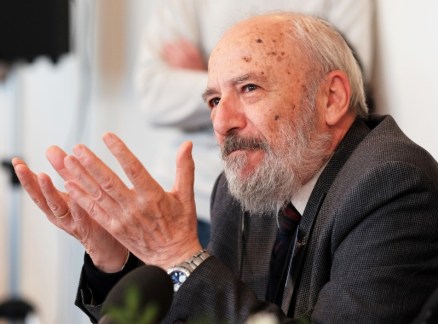
Dr. Petros Vassiliadis

The concept of identity, which is very often used today by scholars, is quite ambiguous. Previously, identity was considered a given. But today, due to the research of the social sciences—though their findings are still questioned by some—it is argued that all identities are “constructions.” This is why we talk about “shaping” the identity of a person or group in the sense of a dynamic process through which the identity of the individual or group is constantly formed by their environment, thereby developing a new ethos. Modern and postmodern ethics, in many ways, attempt to impose an inclusive ethos, while traditional societies—and especially religious ones—advocate an exclusive ethos. The inclusive ethos seeks to integrate a group into its social context, which it often attempts to shape. The exclusive ethos seeks [to maintain] the necessary distance through persistence in traditional values: this is because any “construction” has anthropocentric features, and sometimes it conflicts with eternal or changeless truths.

There are of course cases, even in the New Testament texts, where the ethos of one or another group is mixed, with its “exclusive” side tracing the “limits,” considering everything else as being on the outside, heretical, etc., while its “inclusive” side expresses the manifold, and constantly evolves.

Dr. D.S. Athanasopoulou-Kypriou in her book, To the Limits: Gendered Studies of Christian Presence, History, Crisis, and Hope (Athens 2016), deals with this issue from the point of view of Christian witness. I subscribe to her effort, since in my academic career I have also tried to introduce sociological and feminist interpretations, areas if not entirely unknown in the field of biblical exegesis, at least—for the Orthodox tradition—“to the limit.” Read More

ON “GENDER CHANGE” AND THE HISTORY AND USE OF A RELATED PRAYER by Archimandrite Timothy (Eliakes) ~ Translated by Katherine Kelaidis

Dr. Petros Vassiliadis, professor emeritus of theology at the Aristotle University of Thessaloniki, has graciously brought the present article to our attention. Entitled “Περί ‘αλλαγής φύλου’ και η ιστορία και χρήση μιας σχετικής ευχής,” it appeared on Sunday, October 22 on Father Timothy’s Αγιοκέρι (Agiokeri) blog. We publish it as a sequel to our “Greek Prayer for Transgender Name Change” and “Intersex vs. Transgender.”

In sharing Father Timothy’s article we are not arguing for the now discredited and largely discontinued practice of surgical modification for intersex newborns. As Dr. Vassiliadis aptly notes in the discussion in Orthodoxy in Dialogue’s Facebook group, “The crucial point of that historical event, I think, is not so much the correctness of the surgical intervention, but the readiness of the Church to meet without any prejudice, and in cooperation with both theology and science, the pastoral needs of the time with loving Christian concern. Much more progressive an attitude than nowadays.” More than fifty years later one cannot but wonder at the Church’s intransigent resistance to scientific and social advances in our understanding of human sexuality, sexual orientation, gender and transgender identity, etc. 

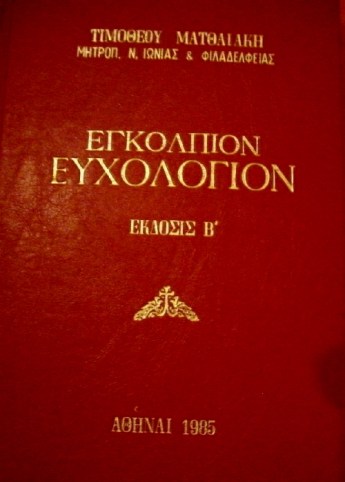
euchologionThe issue of gender change, or rather, of gender correction, was experienced jointly for the first time by the [Greek] Church and the [Greek] State in 1963, when corrective medical intervention was offered to a person with an intersex condition for the first time, and the Ministry of Interior sought the advice of the Church as to the identity of the person. The Metropolitan of Paramythia, Titus (Matthaiakes), handled the matter with his Synod, which sought and received the advice of Amilka Aleivatos, Professor of Canon Law, and Georgios Merikas, Director of the Pathology Clinic at Evangelismos Hospital. Both agreed that only with the intervention of science would this person be able to live a normal life, and that this had already been done; and so all that remained was the matter of renaming the person. They also agreed that the Church, with love and affection, should take special pastoral care of this person and any others who appeared in the future; and that the Church accepted that, when these circumstances arose, there was the need for a special blessing for renaming the person since the person was already baptized.

The void which existed in the Church’s euchologions was addressed by the wise and scholarly Metropolitan Timothy (Matthaiakes), then of Maroneia and later of New Ionia, who drew up a special blessing for this situation. Read More


QUESTIONS À PROPOS PEW RESEARCH CENTER’S REPORT ON ORTHODOXY by Sotiris Mitralexis

pew

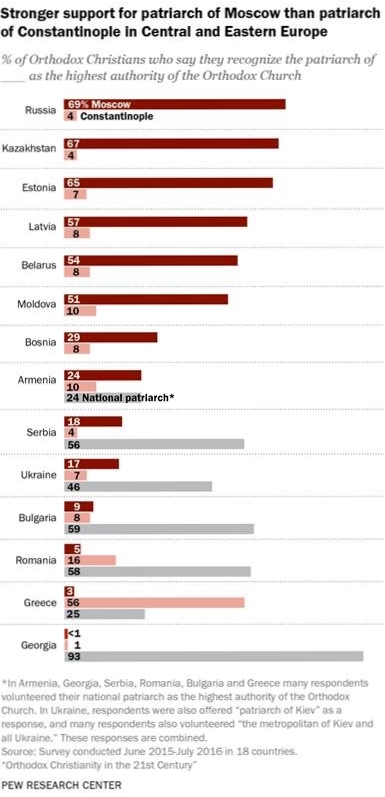
Pew Research Center’s report published on November 8, “Orthodox Christianity in the 21st Century,” contains very valuable data concerning the state of Orthodox Churches and the countries in which they prevail. However, questions concerning a number of the researchers’ choices cannot but emerge.

(1) The report’s definition of what constitutes “Orthodox Christianity” is deeply problematic. The report bundles together the Eastern Orthodox Church with the Oriental Orthodox Churches (also called Old Oriental, Anti-Chalcedonian, Non-Chalcedonian, Pre-Chalcedonian, Miaphysite, or Monophysite Christianity). These have hardly anything in common (compared, for example, to the common theological elements between the Eastern Orthodox Church and the Roman Catholic Church): we are referring here to Churches that are not in communion with each other, haven’t been in communion since the Council of Chalcedon in AD 451, and have developed different theologies ever since.

To illustrate the point, the Eastern Orthodox Church (today a communion of 14 local/national Churches, plus the Orthodox Church in America [OCA]) has ceased to be in communion with the Roman Catholic Church since, conventionally, AD 1054—half a millennium later than the clash with what are today the Oriental Orthodox Churches. The use of the word “Orthodox” in the title of Churches is purely coincidental (a claim made by both Churches, essentially), and problematic as terminology. One struggles to understand what would exactly be the rationale for this bundling of Churches that are not in communion and haven’t been so in more than 1500 years, in spite of current and laudable ecumenical attempts. What would be the definition of “”Orthodox Christianity” in “Orthodox Christianity in the 21st Century” so that it encompasses both the Eastern Orthodox and Oriental Orthodox Churches, but not other Churches? The reader shouldn’t get me wrong: I am inquiring on methodology, not making pronouncements about the Oriental Orthodox Churches.

By excluding certain impossible options (such as an academically reputable terminology, theological grounds, the question of communion, etc.), one is led to identify an orientalist sentiment as the sole possible basis for this definition: i.e., that these Churches “look Eastern,” they look liturgically similar and “exotic,” so naturally they can be bundled together in a report on their current state. There is a way this could work by employing the equally problematic term—although not downright wrong, as would be the case with “Orthodox Church”—of “Eastern Christianity,” which would geographicalize the question and leave other terminological considerations aside. But even in that case, how is it that other Churches, like the Nestorian “Church of the East” or even the Byzantine Rite Catholics, do not fit the description and are not included in the report?

Read More


THE VOCABULARY OF CONJUGAL FRIENDSHIP by Giacomo Sanfilippo

When Public Orthodoxy published “Conjugal Friendship” on May 2, a number of commentators objected in particular to its conflation of friendship with conjugacy. The present reflection seeks to address some of those concerns. 

Floresky-Friendship-Chapter-image-600-px (2)

“Happy Battle” – from Father Pavel Florensky’s 1914 “Friendship”

My use of conjugal in a sense that both subsumes and transcends its marital connotation derives from a number of interrelated linguistic factors, mainly its Latin cognates and their Greek equivalents. I share Florensky’s structuralist approach to language, which gives priority to the embedded etymological meaning of a word over its conventional usage in a given time and place or the idiosyncratic intention of a given speaker. This places us at odds with postmodern assumptions about language while not denying its intrinsic malleability as a living medium of communication. Our attention to the morphemic structure of words, with its implicit premise that language possesses on some level an interior life of its own that operates independently of us—to wit, that language imposes itself on us, both shaping and revealing human reality no less than we shape and reveal our own reality through our creative use of language—remains as central to understanding Florensky’s theology of friendship as it does, for instance, to biblical studies.     Read More