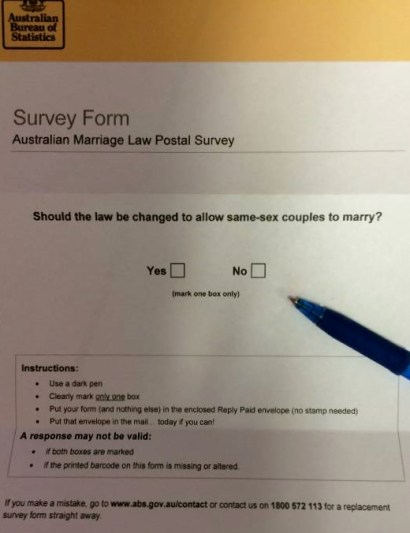
 Leaders of the current political scene in Australia deemed it expedient for Federal Parliament to decide the question of changing the Marriage Act (1961) to allow for same-sex marriage by considering the results of a voluntary plebiscite. Citizens of Australia over the age of 18 years could receive a voting paper in the mail and return it having answered “Yes” or “No” to the question: “Should the law be changed to allow same-sex couples to marry?” The voluntary plebiscite would run over eight weeks, with a non-binding result on lawmakers—the outcome would merely inform a debate on a Bill to enable same-sex marriage.
On November 15 the Australian Bureau of Statistics announced a comfortable win for the “Yes” vote: 61.6% as against 38.4% for the “No” vote. 79.7% of eligible Australians participated, a surprisingly high rate for what amounted to little more than an opt-in survey. On the same day, Senator Dean Smith introduced a bill to legalise same-sex marriage. It is expected to be enacted by mid-December.
Of interest to Orthodoxy in Dialogue’s readers will be the nature of the involvement of various expressions of the Church in Australia as the debate that accompanied the survey unfolded.
The very nature of the plebiscite was controversial. It had never been done before. Various referenda requiring compulsory participation were the nearest comparison, with only 8 out of 44 carried since Federation in 1901. Advocates for the “Yes” campaign were reluctant participants, believing that the conservative referendum pattern was to their disadvantage. Opponents to marriage change, aware of such an advantage, championed the right for democratic participation in such an important question, seemingly forgetting that democracy in Australia is exercised primarily through parliamentary representation.
Once the plebiscite was announced, however, the opposing campaigns got under way without the usual regulatory restraints that constrain referendum debates. Both sides poured in as much energy, resources, and chicanery as they could muster. Read More

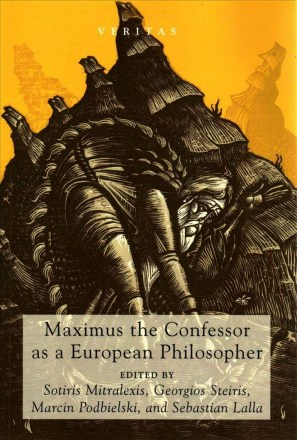 In the English speaking world, three fields of study have grown tremendously in the last few decades: the study of “Byzantine philosophy,” scholarship on Maximus the Confessor, and research in “Continental Philosophy of Religion.” Maximus the Confessor as a European Philosopher is a critical and timely book for bridging these three areas of emerging scholarship. Byzantine philosophy in particular is a new area of research (often thought of as a supplement to the much better researched medieval Latin, Hebrew, and Arabic traditions), with no introductory text or handbook on the subject as of yet. Maximus is sometimes excluded from Byzantine philosophy (which is sometimes viewed as beginning either with Photios or John Damascene). This text takes up precisely this question of how Maximus should be placed within the history of philosophy. As Dionysios Skliris puts it, the questions of this volume are as follows (p. 3): “Is Maximus ‘European’?” “Is Maximus a ‘philosopher’?” “What is Maximus’ contribution to Europe?” “What is his contribution to philosophy?” Likewise, is Maximus more than just a Byzantine or just a theologian? Similarly, Sotiris Mitralexis asks in the introduction (p. xxi), “Should towering figures of Byzantine philosophy like Maximus the Confessor be included in an overview of European philosophy?” These questions connect Maximus scholarship both to the larger attempt to include Byzantine philosophers in the narrative of the history of philosophy, and to the dialogue between contemporary European philosophy and patristic texts, construing Maximus as a predecessor to continental philosophy.


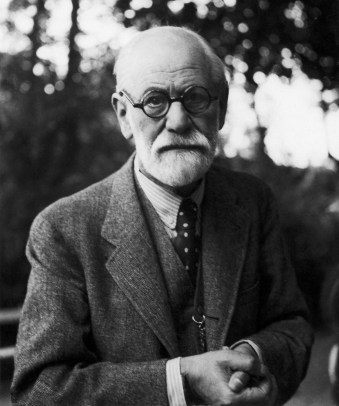 2017 is the centenary of the publication of Sigmund Freud’s Introductory Lectures on Psycho-Analysis, one of his most popular and widely translated works. Curiously, this is also the 90th anniversary of the publication of The Future of an Illusion, Freud’s attempted debunking of “religion.” This latter book was and is his most controversial book, at least among Christians and Jews, many of whom ever after looked upon this “godless Jew” (as he wryly called himself) as an implacable enemy.

