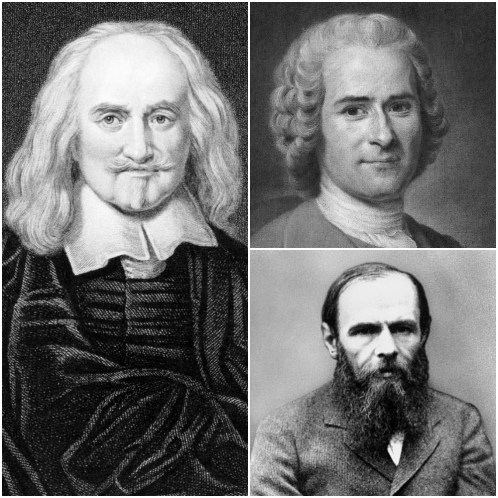
Thomas Hobbes, Jean-Jacques Rousseau, Fyodor Dostoevsky
The discussion about the labels “fundamentalist” and “liberal” as well as the role of dialogue in contemporary Eastern Orthodoxy lead me to do the following reflection on the role of Christian morality in the public sphere. The problem seems to be that there are two conflicting anthropologies which determine the role attributed to Christian morality in the public debate.
On the one hand, we have the traditional anthropological pessimism which was radically restated by Hobbes following the denominational wars that were the consequences of the radical dissolution of norms in the form of the Western Reformations of the 16th century. According to this anthropology, humans have an inescapable capacity for evil which must be restrained through power and norms. Otherwise the human condition will become the war of everyone against everyone (bellum omnium contra omnes).
On the other hand, we have the anthropological optimism of the Enlightenment (e.g., Rousseau), which holds that evil is caused by ignorance and that evil can be destroyed by education. Ironically, anthropological optimism negates human freedom, since evil is not the result of a choice but of external circumstances which can be abolished. Dostoyevsky frequently attacked this anthropological optimism due to its negation of human freedom, which also includes the capacity to become evil (e.g. Notes from Underground and A Writer’s Diary). Read More


 A recent [March 30, 2014] Pappas Post article has highlight that 90% of people in America with Greek heritage