
THE WILL OF ORTHODOX CHRISTIANS IN UKRAINE: METROPOLITAN HILARION (ALFEYEV) vs. THE STATISTICS
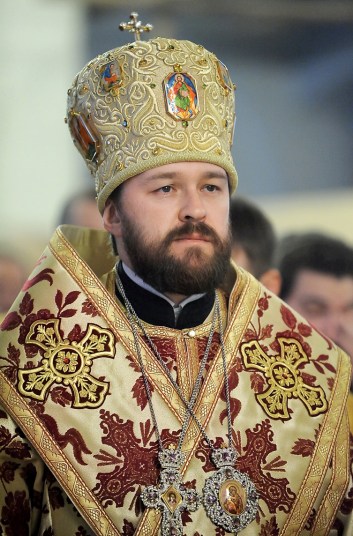
Metropolitan Hilarion of Volokolamsk
On September 8, 2018 the Moscow Patriarchate’s Department for External Church Relations published Metropolitan Hilarion’s “Patriarch Bartholomew Will Bear Personal Responsibility before the Judgment of God and the Judgment of History.” In it His Beatitude responds to the Ecumenical Patriarchate’s moves to normalize the canonical status of the Kyiv (Kiev) Patriarchate as the autocephalous (i.e., fully self-administered) Orthodox Church for Ukraine.
Metropolitan Hilarion’s statement is very brief. We recommend that you take the two or three minutes to read it. For our purposes we draw attention to the following assertion by His Beatitude:
…[The] Ukrainian Church [of the Moscow Patriarchate], which unites a majority of the Orthodox faithful in Ukraine (over 12 thousand parishes, over 200 monasteries) has not asked for any autocephaly, for any independence. […] Thus the Patriarchate of Constantinople is now openly on the warpath. And it is a war not only against the Russian Church, not only against the Ukrainian Orthodox people….
It seems significant that Metropolitan Hilarion should cite the total number of parishes and monasteries rather than actual people. On page 78 of the periodic Public Opinion Survey of Residents of Ukraine—this one conducted March 15-31, 2018 and published on May 21—we find that the Kyiv Patriarchate holds the allegiance of precisely twice as many Orthodox Christians in Ukraine as the Moscow Patriarchate: 39% and 19% respectively of the total population of Ukraine. These figures have remained remarkably consistent over the course of consecutive releases of the same survey. Read More
Share this:

POINT-COUNTERPOINT: CONSTANTINOPLE vs. MOSCOW ON THE AUTOCEPHALY OF THE UKRAINIAN ORTHODOX CHURCH
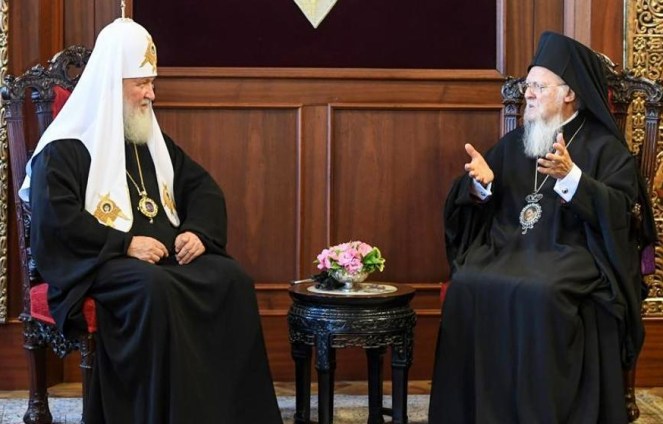
Patriarch Kirill of Moscow (L) and Patriarch Bartholomew of Constantinople (R)
Announcement of the Ecumenical Patriarchate
September 7, 2018
Within the framework of the preparations for the granting of autocephaly to the Orthodox Church in Ukraine, the Ecumenical Patriarchate has appointed as its Exarchs in Kiev [Kyiv] His Excellency Archbishop Daniel of Pamphilon from the United States, and His Grace Bishop Ilarion of Edmonton from Canada, both of whom are serving the Ukrainian Orthodox faithful in their respective countries under the Ecumenical Patriarchate.
At the Ecumenical Patriarchate, the 7th of September, 2018
From the Chief Secretariat of the Holy and Sacred Synod
From the website of the Ecumenical Patriarchate.
——————
Statement of the Holy Synod of the Russian Orthodox Church
September 8, 2018
The Holy Synod of the Russian Orthodox Church expresses its resolute protest against and deep indignation at the communique published on September 7, 2018, by the Chief Secretariat of the Patriarchate of Constantinople Holy Synod announcing the appointment of two hierarchs of this Church – Archbishop Daniel of Pamphilon (USA) and Bishop Hilarion of Edmonton (Canada) as ‘exarchs’ of the Patriarchate of Constantinople for Kiev. Read More
Share this:

CLERICAL CULTURE, CELIBACY, AND THE SHADOW SIDE OF THE SEXUAL ABUSE CRISIS by Kevin Elphick
 The most recent revelations of sexual abuse in the Catholic Church highlight the shadow side of celibate male clerical culture. They reveal the scandal of a publicly vowed celibate life contrasted by the hidden shadow side of sexual misconduct and violence against the most vulnerable. These priests’ public personas as celibates do not match with their dark, criminal activities.
Carl G. Jung gave us language to understand this unintegrated shadow side and its pernicious potential. In 1938 he wrote:
Everyone carries a shadow, and the less it is embodied in the individual’s conscious life, the blacker and denser it is. If an inferiority is conscious, one always has a chance to correct it…. But if it is repressed and isolated from consciousness, it never gets corrected. (Psychology and Religion)
As painful and embarrassing as the current headlines prove to be, they remain a chance to correct and make whole again priestly culture and church leadership. When Pope Francis wrote in response to the scandal, “We feel shame when we realize that our style of life has denied, and continues to deny, the words we recite,” he demonstrates that he understands something of the need to own and make conscious this shadow side of clerical culture—what he names as “our style of life.” Bringing it to consciousness is the first step in the process of healing and holistic integration. Read More


