REFLECTIONS ON ATTENDING THE QUEER & TRANSGENDER STUDIES IN RELIGION CONFERENCE by Lydia Bringerud

Our decision to publish the present article does not imply our endorsement of the church referenced therein or its episcopate. Orthodoxy in Dialogue reiterates its commitment to the canonical Orthodox Church as currently represented in the diptychs of the Patriarchate of Constantinople.
The author and her conference co-presenter are known to our readers through On Being Orthodox & Genderqueer: An Interview with “Lindsey”.

Image result for queer christians

I first learned about the Queer & Transgender Studies in Religion Conference at UC Riverside thanks to Orthodoxy in Dialogue. I’m so glad I attended. I co-presented some preliminary research with Lindsey about Mother Maeve Leroux, a transgendered nun, bishop, and founder of the Universalist Orthodox Church.

As a cisgendered, heterosexual woman myself, I came to this conference primarily to learn about the theories and literature that other folks were using in the burgeoning fields of Queer Theory and Transgender Studies. I was surprised to meet people from a wide range of fields, including biblical studies, theology, anthropology, sociology, Jewish studies, Buddhist studies, Catholic studies, Islamic studies, and art history, to name a few. Also in attendance were clergy from a variety of faith traditions. I met people all along the spectrum of gender expression. Read More

AROCWE CAUGHT BETWEEN A ROCK AND…MOSCOW?

Orthodoxy in Dialogue urges our readers very strongly to read The Daily Signal‘s How Putin Uses Russian Orthodoxy to Grow His Empire and our Report: Archdiocese of Russian Orthodox Churches in Western Europe Votes to Remain in Existence in conjunction with the present article.

Photo: orthodoxie.com

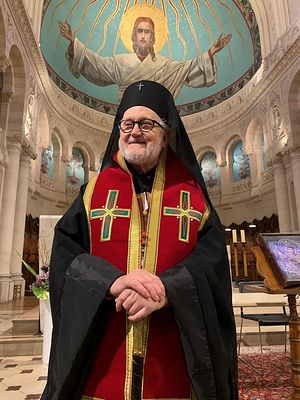
Archbishop John of Charioupolis

Clergy and laity representatives of the Archdiocese of Russian Churches in Western Europe of the Patriarchate of Constantinople gathered in Paris on February 23, where they overwhelmingly voted not to dissolve the Archdiocese, despite the sudden and unexpected decision of Constantinople in late November to revoke the body’s status as an Exarchate and to direct that the parishes move under the local Greek Constantinople hierarchs. The Archdiocese will decide which jurisdiction to transfer to at a later Assembly.

A translation of the letter of His Eminence Archbishop Anthony of Vienna and Budapest, the head of the Moscow Patriarchate’s Synodal Department for the Administration of Institutions Abroad, to His Eminence Archbishop John of Charioupolis concerning the Russian Church’s proposals for the Archdiocese of Russian Churches in Western Europe to reunite itself to the Russian Church has been published in French on Orthodoxie.

The letter was read out by Abp. John at the General Assembly after the participants voted against dissolution. Abp. John openly supports the option of the Archdiocese returning to the Moscow Patriarchate. [Emphasis ours.] In an interview given the day after the Assembly, Abp. John notes that while he is getting older, Constantinople has not allowed any new bishops to be consecrated, and thus, “They have denied us in the future.” Read More


REPORT: ARCHDIOCESE OF RUSSIAN ORTHODOX CHURCHES IN WESTERN EUROPE VOTES TO REMAIN IN EXISTENCE

In November 2018 the Ecumenical Patriarchate annulled the status of the Archdiocese of Russian Orthodox Churches in Western Europe as an exarchate and directed it to dissolve itself as an ecclesiastical entity and to submit its parishes, monasteries, and other institutions to the local Greek metropolitans. For more details see Dr. Victor Alexandrov’s The Choice Facing the Archdiocese of Russian Churches in Western Europe and the additional articles linked in the preface there.
ruedaru

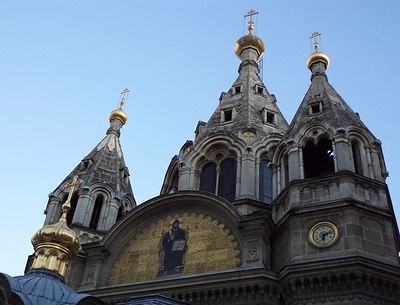
St. Alexander Nevsky Cathedral. Paris.

The Extraordinary General Assembly (EGA) of the Archdiocese, made up of all members of the clergy and lay parish delegates, met in Paris on 23 February 2019, to deliberate on the Ecumenical Patriarchate’s decision to “reorganise the status of the exarchate,” published in the Communiqué of 29 November 2018 of the Holy Synod. Since the Holy Synod of the Ecumenical Patriarchate decided to abolish the status of patriarchal exarchate, the Archdiocese had to decide according to Article 34 of the Statutes of the Diocesan Governing Union of Russian Orthodox Associations in Western Europe whether it wished, yes or no, to put an end to its own existence and that, consequently, its 120 or so parishes would be subordinated to the Greek Metropolia of Western Europe.

Under the presidency of the ruling Archbishop, His Eminence John of Charioupolis, the members of the EGA decided in accordance with the statutes, with a majority of nearly 93% of the votes (191 out of 206), not to dissolve the Archdiocese, but to to remain as a united ecclesiastical entity according to its original form (Association founded on 26 February, 1924, OJ, 28.2.1924, №58, p. 2080). The Council of the Archdiocese has taken note of this decision of the EGA and will promptly communicate the decision to His All-Holiness the Ecumenical Patriarch of Constantinople and his Holy Synod and send a delegation to the Phanar to hand over the letter personally. Read More


GREAT LENT 2019: CALL FOR MEDITATIONS

LentOrthodoxy in Dialogue’s “partial hiatus” has evolved to mean that we will continue to publish over the next few months as seems good to us, but much less frequently than we have done until now.

We will be happy to consider Lenten Meditations from now until Pascha. Note the following differences from last year’s Lenten series:

1). Laypersons (men, women, and youth) are welcome to submit a meditation for consideration as well as hierarchs, priests, deacons, and monastics.

2). This year we seek meditations on the general themes of fasting, asceticism, prayer, repentance, almsgiving, renunciation of the ego, the pursuit of chastity and purity, forgiveness, etc., rather than restricting ourselves thematically to the Sundays of Great Lent. (You may, however, write on the theme of one of the Sundays if you wish.)

3). You need not be Orthodox to write for this series, provided that your meditation have relevance for a mainly Orthodox audience. Read More