ASSEMBLY OF BISHOPS IGNORES DEADLY POLICE BRUTALITY AGAINST BLACK AMERICANS, OPPOSES PROTECTIONS FOR LGBTQ AMERICANS

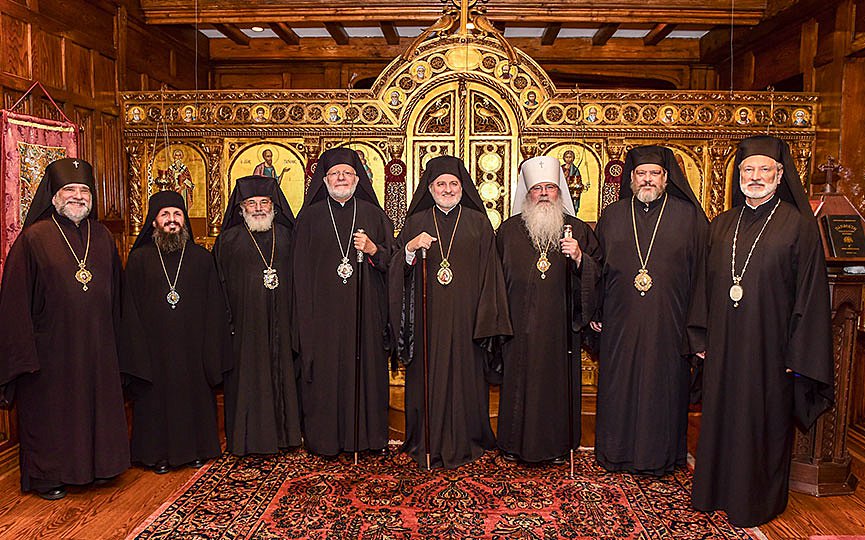
Most of the Executive Committee of the Assembly of Bishops

On April 21, one of Orthodoxy in Dialogue’s readers visited the website of the Assembly of Canonical Orthodox Bishops of the United States of America. He hoped to find a statement on the Derek Chauvin conviction, the overt rise of white supremacy and white nationalism in the US, and the growing epidemic of lethal police brutality against African-American children, women, and men. There was nothing.

On the other hand, he found the Statement of the Executive Committee on the Proposed Equality Act, posted on March 26, 2021. The Executive Committee consists of the following eleven hierarchs:

  • Archbishop Elpidophoros (Greek Orthodox Archdiocese)
  • Metropolitan Joseph (Antiochian Archdiocese)
  • Bishop Matthew (Moscow Patriarchate)
  • Metropolitan Gregory (Carpatho-Russian Diocese)
  • Archbishop Michael (Orthodox Church in America)
  • Bishop Irinej (Serbian Patriarchate)
  • Metropolitan Nicolae (Romanian Patriarchate)
  • Metropolitan Joseph (Bulgarian Patriarchate)
  • Bishop Saba (Georgian Patriarchate)
  • Metropolitan Tikhon (Orthodox Church in America)
  • Bishop Longin (Serbian Patriarchate)
Read More

“AN INDUSTRY OF DECEPTION”: RUSSIAN CHURCH PREPARING DOCUMENT ON PASTORAL CARE FOR TRANSSEXUALS

This report appeared yesterday at Orthodox Christianity. In reprinting it, we at Orthodoxy in Dialogue use this opportunity to reiterate in the strongest possible terms our support for transgender persons and their particular spiritual, social, and emotional needs at every stage of their transition, and for a more dialogical approach within the Orthodox Church than the Moscow Patriarchate’s “no-matter-what-psychologists-surgeons-and-other-specialists-may-say” stance. We pray especially for our transgender brothers and sisters in Christ who find themselves in the Russian Orthodox Church.
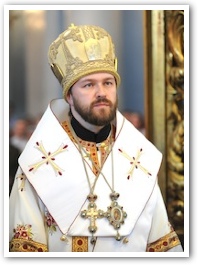
Metropolitan Hilarion (Alfeyev) of Volokolamsk

“The sex change industry is an industry of deception,” His Eminence Metropolitan Hilarion of Volokolamsk told RIA-Novosti on Saturday, commenting on the Russian Orthodox Church’s decision to prepare a special document on the topic.

The Russian Church cannot accept so-called “sex changes” under any circumstances, the Chairman of the Department of External Church Relations said, no matter what psychologists, surgeons, and other specialists may say.

To develop the document, a separate working group “with the involvement of competent experts” will be created under the auspices of the Commission on theology and Theological Education of the Inter-Council Presence of the Russian Orthodox Church, headed by Met. Hilarion.

“The position of the Russian Orthodox Church on so-called ‘sex changes’ is expressed in the Basis of the Social Concept document. This position is not subject to revision. The Church cannot accept a ‘sex change’ under any circumstances,” His Eminence said.

Read More

AN ORTHODOX LOOK AT THE PLACE OF THE VIRGIN MARY IN ISLAM by Andrew James Matthews

Maryam and Isa. From an undated Old Persian manuscript.

In 630, the Prophet Muhammad and his followers conquered the sacred Arabian city of Mecca. Now in control of the city that had persecuted Islam, Muhammad ordered that the Ka’ba, a shrine believed by Muslims to have been built by Abraham and his son Ishmael for the worship of God, be cleansed of all signs of pagan corruption. According to Islamic tradition, Muhammad instructed his followers to remove all the idols and to wash away the images on the walls of the Ka’ba with one exception, an icon of the Virgin Mary with the Christ Child. The Prophet is said to have placed his hands upon the holy image and commanded that it remain untouched.  

While the above may come as a surprise to some Orthodox Christians, especially given the Islamophobic rhetoric spewed by some church leaders, the Virgin Mary has always held a special place in Islam. Muslims often refer to Mary as al-Batūl (Arabic for “the Virgin” or “the Chaste”). She is given this title not only for her physical purity, but for her willingness to submit her entire being, body and soul, to God’s will. A minority of Muslim scholars, including Ibn Ḥazm, have gone as far as to number Mary among the prophets of Islam. Moreover, Mary is also the only woman mentioned by name in the Qur’ān, and the nineteenth Sura (chapter) is even named in her honour. In fact, many Qur’ānic verses about Mary are so similar in both spirit and content to the Eastern Christian understanding of her, that when the first Muslims attempted to escape persecution in Mecca by seeking refuge in Abyssinia, the Christian ruler of the country is said to have been so moved by some of what was written about Mary in the Qur’ān, that he granted sanctuary to the followers of the new religion.

Read More

PAVEL FLORENSKIJ’S MYSTAGOGICAL MANUAL OF ANTINOMIC FRIENDSHIP by Glen Attard O.Carm.

First of all, a word of thanks to the editors of Orthodoxy in Dialogue for kindly inviting me to write this summary of my recently published volume, Closest to the Heart: A Mystagogy of Spiritual Friendship in Pavel A. Florenskij’s The Pillar and Ground of the Truth (Malta: Horizons, 2020), which explores the theme of friendship in Florenskij’s life and works, specifically between 1904 and 1914. My primary intention in this work was to carry out as complete a literary-spiritual exegesis as possible of Florenskij’s seminal text, The Pillar and Ground of the Truth (1914, hereafter Pillar).

Being the first major volume to focus solely on Florenskij’s ideas about and experience of friendship, first and foremost, I re-examine the Pillar from the point of view of Florenskij’s claim in “To the Reader,” “If I nevertheless do attribute some significance to my Letters, it is an exclusively preparatory one, for catechumens. These letters are intended to provide some sustenance for them until they are able to receive nourishment directly from their Mother’s hand.” I take this statement as an indication of Florenskij’s mystagogical intention to outline for “catechumens” a spiritual journey in the faith which finds its culmination in the experience of ecclesial friendship, as explained in the last two letters of the Pillar. In light of this claim, I start by presenting Florenskij as a mystagogue and argue in what way the Pillar is a mystagogical manual. Aware of the numerous controversial debates that have clouded the theme of friendship in Florenskij, I go back to his private letters to explore several of his friendships, starting with God, whom he “befriended” in July 1899 and ending with his wife Anna M. Giacintova, whom he married in August 1910. To understand how Florenskij lives through these experiences and, simultaneously, how these are reflected in the Pillar and other contemporaneous works, I also cross-reference Florenskij’s final version of his doctoral dissertation with earlier versions of the text (mainly the first version of the letters written in 1908), as well as other essays, private letters, poems, etc., that were written in the same timeframe, which help fill in certain gaps that are left open in the Pillar.

Read More