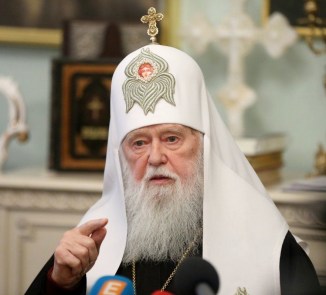
 In The patriarch has no clothes on January 26, I laid out for the readers of the Kyiv Post [and for the readers of Orthodoxy in Dialogue here] the ecclesiastical irregularities of allowing 90-year old egomaniac and former KGB agent Filaret Denysenko to retain the title of “Patriarch” and the silly hat that goes with it in the Russian (not Ukrainian) tradition. To restate the obvious, there has never existed—at any time in the history of the Orthodox Church—a canonically recognized “Kyiv Patriarchate” or “Patriarch of Kyiv.” In granting autocephaly to the Orthodox Church of Ukraine (OCU) on January 5-6, 2019, the Ecumenical Patriarchate of Constantinople expressly designated the Ukrainian Church by its historical status as a “metropolitanate,” and its primate by the historical title of “Metropolitan of Kyiv.” Denysenko’s patriarchal fantasies remain unrecognized by anyone anywhere in the Orthodox Church outside of his diminishing circle of sycophants.
The OCU has itself to blame for this mess. Not only did they permit Denysenko to retain the title of “Patriarch,” but made him a full member of the Holy Synod and ruling bishop of the Diocese of Kyiv—thus ensuring that he continue to be called not only Patriarch, but Patriarch of Kyiv. In this fanciful capacity he continues to function as senior to Metropolitan Epiphanius, the rightful highest ranking bishop of the OCU. It was Denysenko who first congratulated President-elect Zelensky on behalf of the Ukrainian Church following last month’s runoff election. Indeed Denysenko seems to ignore Metropolitan Epiphanius’ existence entirely. Read More