
The present report appeared at the Kyiv Post earlier today under an expanded title. Our readers should bear in mind the vaunted “Byzantine symphonia” model for church-state relations in 21st-century Russia: as goes the Kremlin, so goes the Patriarchate. Note the “accusations of ‘incitement of social and religious discord'” below [emphasis added].
Orthodoxy in Dialogue highly recommends the Kyiv Post for its extensive daily reporting on the Russian invasion of Ukraine and all other news Ukrainian. The previous paywall has been abolished under new ownership/management.
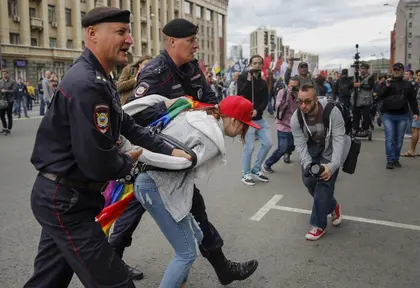
Russia’s highest court has approved the Ministry of Justice’s request to ban and label the “International LGBT Movement” as an “extremist organization,” potentially allowing the government to confiscate donations dedicated to the representatives of the community and make its members [sic] arrests.
The closed-door meeting on Thursday, Nov. 30, only permitted representatives from the Ministry of Justice to be present in the courtroom. Journalists were solely invited to hear the decision announcement, as reported by Mediazona’s correspondent.
The lawsuit, submitted on Nov. 2, claimed the “International LGBT Movement” exhibits “various signs and manifestations of extremist orientation,” with specific accusations of “incitement of social and religious discord.”
Now, since the claim was accepted, it could have significant consequences for a substantial portion of Russian society, affecting the rights of LGBT individuals.
Clear identification as a member of the movement could be documented in a classified file, potentially subjecting any LGBT person to involvement in an “extremist” case.
This broad categorization might give law enforcement the authority to make arrests based on symbols like rainbow flags, which currently result in fines under the “LGBT propaganda” law.
Activists linked to LGBT movements might face charges related to participation in an extremist group, and donations to these organizations could be treated as extremist activities.
Essentially, the state might impose restrictions preventing Russians from openly discussing their association with the LGBT community in any way.
The Ministry of Justice’s lawsuit follows the previous adoption of two repressive laws targeting the LGBTQ+ community.
Initially, the “LGBT propaganda” law, previously applicable only to children, was expanded to include adults.
Subsequently, transgender transition was banned in Russia – both the change of the gender marker in the documents and medical interventions related to the transition.
This move echoes a similar decision made by the Supreme Court in 2020 concerning the “AUE movement.”
Despite not being officially registered as a movement and existing as a subculture rooted in prison concepts, the ban on AUE propaganda led to numerous criminal cases against individuals with “thug” tattoos and those adopting the “convict way.”
Even ordinary citizens faced fines for sharing screenshots from games and films depicting prison life.
See the extensive Sexuality and Gender section in both our Archives linked at the top of this page.
Alisa Orlova is a Deputy News Editor and correspondent for Kyiv Post. For seven years, she has worked as a TV journalist, covering primarily topics on international policy.

 ORTHODOXY IN DIALOGUE