SS. SERGIUS & BACCHUS AND THEIR ICON IN GAY CHRISTIAN APOLOGETICS by Giacomo Sanfilippo

The following essay is a condensed and slightly revised version of a paper written in December 2013 for Dr. Jaroslav Skira’s Eastern Christian Icons course at Regis College, University of Toronto.
S&Boriginal

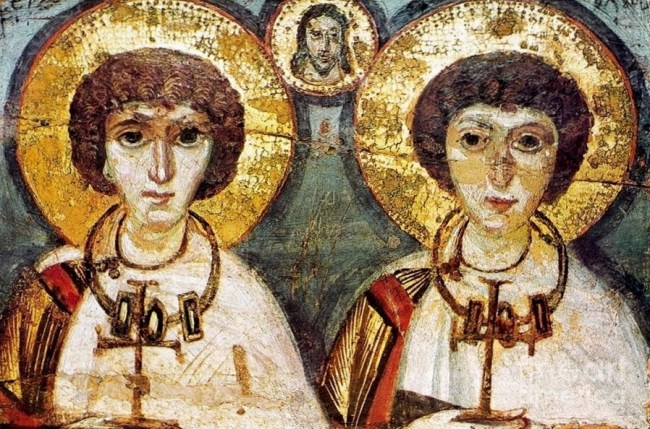
SS. Sergius and Bacchus. Constantinople. 6th or 7th century.

A trend has developed over the past two or three decades in the field of gay Christian apologetics—taking its cue from the late Dr. John Boswell of Yale University [see Boswell’s seminal Christianity, Social Tolerance, and Homosexuality: Gay People in Western Europe from the Beginning of the Christian Era to the Fourteenth Century and Same-Sex Unions in Premodern Europe]—which posits the early 4th-century soldier martyrs, Sergius and Bacchus, as the archetypal gay Christian couple. This idea spread as far afield as an American law review, of all places, where one author, writing in defense of the legalization of same-sex marriage immediately after Boswell’s second book appeared, states unequivocally that “Sergius and Bacchus…were male lovers” [William N. Eskridge, Jr., “A History of Same-Sex Marriage,” Virginia Law Review 79 (1993): 1420]. An article published many years later in another journal, purporting to “reclaim the heritage” of SS. Sergius and Bacchus [Ronald E. Long, “Reclaiming the Heritage of Saints Serge and Bacchus: Towards a Quixotic Gay-Affirmative, Pro-Animal, Vegetarian Christianity,” Theology & Sexuality 17.1 (2011): 101-131], devotes all of one page of a 31-page treatise to the sainted “homosexual lovers” and their “homoerotic bonding” [Ibid., 103-104], and moves with astonishing ease from an account of their martyrdom to a discussion of AIDS, barebacking, S&M, exchange of bodily fluids, animal rights, vegetarianism, and a Trinity that makes love with Itself.   

Read More


SCRIPTURE AND DISSENT: ENGAGING WITH THE NEO-PATRISTIC PARADIGM OF MODERN ORTHODOX THEOLOGY by Phil Dorroll

Dr. Dorroll’s article launches our new Academic Papers series. It first appeared in 2013 in the International Journal of Orthodox Theology.
DorrollPhilip

Dr. Phil Dorroll

This article discusses the legacy of the Neo-Patristic paradigm in American Orthodox theology by examining the recent work of three contemporary American Orthodox theologians: John Behr, Kyriaki Karidoyanes Fitzgerald, and Theodore Stylianopoulos. It begins by first outlining the main conceptual bases of the Neo-Patristic paradigm as established by Georges Florovsky and others, and then discusses some important recent criticisms of this dominant theological mode in contemporary Orthodoxy. The article also explores how categories of identity and authenticity are used theologically in Neo-Patristic projects, and situates these efforts in the context of a broader critique of Enlightenment reason. The article argues that recent works in American Orthodox theology, such as that of Behr, Karidoyanes Fitzgerald, and Stylianopoulos, exhibit a complex engagement with the Neo-Patristic paradigm, and subtly reformulate or even challenge certain of its bases (such as the use of categories of identity and authenticity) by appealing to certain theologies of Scripture. These engagements constitute an important effort to engage with the contemporary foundations of Orthodox theology in America, and reveal specific ways in which these Neo-Patristic foundations are being re-interpreted in a contemporary context. Read More


AND BEHOLD, ALL THINGS WERE VERY BEAUTIFUL by Jeffrey Byer and Nancy Byer

And God saw all the things that He had made, and behold, they were very beautiful.

Καὶ εἶδεν ὁ Θεὸς τὰ πάντα, ὅσα ἐποίησε, καὶ ἰδοὺ καλὰ λίαν.

Gen 1:31

024 (2)

Canada Geese in Flight. Nancy Byer.

~

MY BABY (Mar 2019 Columbia Zoo, SC)

My Baby. Columbia Zoo. Jeffrey Byer.

~

Read More


THE FALSE ROMANCE OF RUSSIA by Anne Applebaum

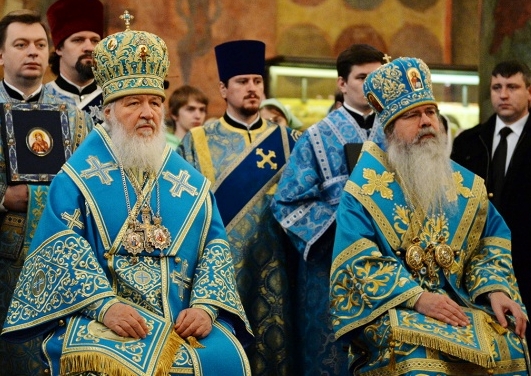
The importance of this article for an Orthodox audience lies in the simple but chilling fact that Patriarch Kirill and Vladimir Putin openly boast of Russia’s church-state relations as a 21st-century reincarnation of Byzantine symphonia: as goes the Kremlin, so goes the Patriarchate—or, more literally, Kremlin and Patriarchate speak with a single voice on both domestic and geopolitical affairs. 
That so many American converts to Orthodoxy look to Russia and the institutional Russian Church with blinders on is alarming enough. That the Primate and Holy Synod of the OCA—which is presumably not only the Orthodox Church in America, but for America—continue to sell their collective soul to the Moscow Patriarchate in exchange for the OCA’s uncanonical autocephaly and the imaginary prestige of a “representation church” in Moscow is nothing less than a damning indictment of the OCA’s anti-American and anti-Canadian loyalties at the highest levels of ecclesiastical governance.
(See, for instance, Ukrainian Autocephaly: An Awkward Spot for the OCA, Ukrainian Autocephaly: What Says the OCA?, Well, Well, Well. What Perfect Timing for the OCA to Reject Ukraine., The Weaponization of Religion: How the Kremlin Is Using Christian Fundamentalism to Advance Moscow’s Agenda, etc., in our Archives.)

kirtik

Patriarch Kirill of Moscow (L) and Metropolitan Tikhon of the OCA (R)

American conservatives who find themselves identifying with Putin’s regime refuse to see the country for what it actually is.

Sherwood Eddy was a prominent American missionary as well as that now rare thing, a Christian socialist. In the 1920s and ’30s, he made more than a dozen trips to the Soviet Union. He was not blind to the problems of the U.S.S.R., but he also found much to like. In place of squabbling, corrupt democratic politicians, he wrote in one of his books on the country, “Stalin rules … by his sagacity, his honesty, his rugged courage, his indomitable will and titanic energy.” Instead of the greed he found so pervasive in America, Russians seemed to him to be working for the joy of working. Read More