THE KYIV POST: TWO BRIEF ARTICLES ON UKRAINIAN AUTOCEPHALY by Giacomo Sanfilippo

Orthodoxy in Dialogue editor Giacomo Sanfilippo has been invited to become a regular contributor of Orthodox Christian commentary at the Kyiv Post, Ukraine’s English-language newspaper and winner of the 2014 Missouri Honor Medal for Distinguished Service in Journalism. Its global audience peaked at more than 65 million pageviews in 2014.

kyipost

Worse than 1054? A Schism of Moscow’s Own Making

In his 1996, “The Clash of Civilizations and the Remaking of World Order,” Samuel P. Huntington predicted the rise of Russia’s “political Orthodoxy” as a global geopolitical threat no less worrisome than political Islam. Some 15 or so years later, Patriarch Kirill and Russian President Vladimir Putin announced the transplant of “Byzantine symphonia” — a model of church-state “co-voice” which produced ambivalent results in Orthodox Byzantium — in 21st-century Russia. The current escalation of Russian military aggression against Ukraine on the eve of the Ukrainian Church’s reception of autocephaly from Constantinople leaves us no choice but to take them at their word: Patriarchate and Kremlin speak with one voice in Russia.

This brief essay focuses on the Patriarchate’s half of that unified voice.

In the wake of the Ecumenical Patriarchate’s announcement that it intended to move forward with the grant of autocephaly to the Ukrainian Church, Metropolitan Hilarion (Alfeyev), chairman of the Moscow Patriarchate’s Department of External Church Relations, responded swiftly with a “prediction” of violence in Ukraine and a worldwide schism “worse than 1054.” Read More


NATIVITY MESSAGE OF METROPOLITAN EPIPHANIUS OF KYIV AND ALL UKRAINE

Note that the Orthodox Church of Ukraine celebrates the Nativity of Christ on January 7.
Ucraina-_Epiphanij

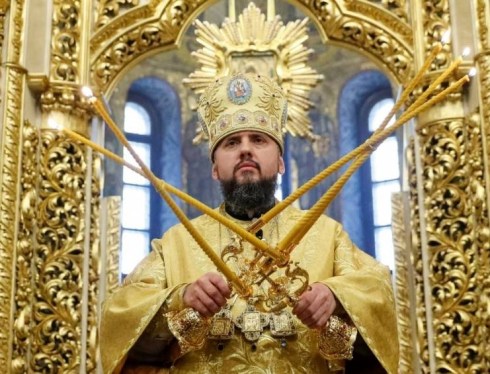
Metropolitan Epiphanius (Epifaniy) of Kyiv and All Ukraine

To the Most Reverend Archpastors, the God-loving Pastors, the Honourable Monastics,

and All the Orthodox Faithful of Ukraine

Dear brothers and sisters!

Christ is born! Let us glorify Him!

Such short and simple words in this our traditional Christian greeting, yet how deep, because they testify to our faith that the promise of God has been fulfilled, the Saviour of the world has truly appeared, the second Person of the Holy Trinity—the pre-eternal Son of God—is born of the Holy Spirit and the Virgin Mary, becoming also the Son of man. “For to us a Child is born, to us a Son is given” (Is 9:6), the holy Isaiah prophesies, showing that the birth of Jesus Christ has come to pass even for us. 

It is this thought that St. Gregory the Theologian explains when he says of the Saviour’s birth:

He appears for our sake, being born, so that as He gave us existence, He would also grant us blessed existence…. This is what we celebrate, this is what we glorify this day: the coming of God to men so that we might change place, or better, return to God…so that, taking off the old man we might put on the new one (Eph 4:22-24), and as we died in Adam so might we live in Christ (1 Cor 15:22), being also born, crucified, buried, and raised with Christ. Read More


A BED UNDEFILED: A PARTIAL RETRACTION by Giacomo Sanfilippo


sergbaccgaladza

SS. Sergius and Bacchus. Constantinople. 6th or 7th century.*

In November 2015 I obtained my MA in Theology from Regis College (conferred by St. Michael’s College under the system in place at the time), one of the member colleges of the Toronto School of Theology at the University of Toronto. My thesis, “A Bed Undefiled: Foundations for an Orthodox Theology and Spirituality of Same-Sex Love,” is available for download free of charge at the University of Toronto’s TSpace. It’s gratifying to see that it has been downloaded almost 800 times. My thesis advisor, Father Gilles Mongeau, SJ, has written one of Orthodoxy in Dialogue’s most popular articles.

John_Boswell

Dr. John Boswell (1947-1994)

Fully aware of the problems that beset the work of John Boswell—who gained a mass of skeptics and critics among the Orthodox (myself included) with his 1980 Christianity, Social Tolerance, and Homosexuality and especially his 1994 Same-Sex Unions in Pre-Modern Europe—I attempted to exercise extreme caution and circumspection when engaging with him. I begin chapter 3 of my thesis as follows (pp. 37-38):

What is a sacrament? On what basis can we recognize with Florensky [in “Letter Eleven: Friendship,” The Pillar and Ground of the Truth: An Essay in Orthodox Theodicy in Twelve Letters, trans. Boris Jakim, Princeton University Press, 1997: 284-330], in the liturgy of adelphopoiesis and in the sanctified relationship that it creates between two men, a sacrament, a holy mystery?

These two questions inform the present chapter. In this way I propose to move the discussion of adelphopoiesis beyond the impasse of the uncritical acceptance of John Boswell’s flawed scholarship versus the equally uncritical dismissiveness of his detractors who ridicule his underlying motive: namely, to explore the possible range of meanings of male pairs in the scriptural, liturgical, and hagiographical witness and their application for us today. This differs in no way from the impetus behind Florensky’s project eighty years earlier, despite the painful contrast between Boswell’s brashness and Florensky’s almost delicate subtlety. Yet to Boswell we owe a debt of sincere gratitude for catapulting this forgotten sacrament into the ecclesiastical, scholarly, and popular consciousness. Read More