FELLOWSHIPS AT AUSCHWITZ FOR THE STUDY OF PROFESSIONAL ETHICS: For Seminarians, Theology Students, and New Clergy

Editorial Note: Given the alarming resurgence of anti-Semitic and other xenophobic violence in today’s sociopolitical climate—often buttressed by false appeals to “religion”—the information offered below seems more timely than ever.
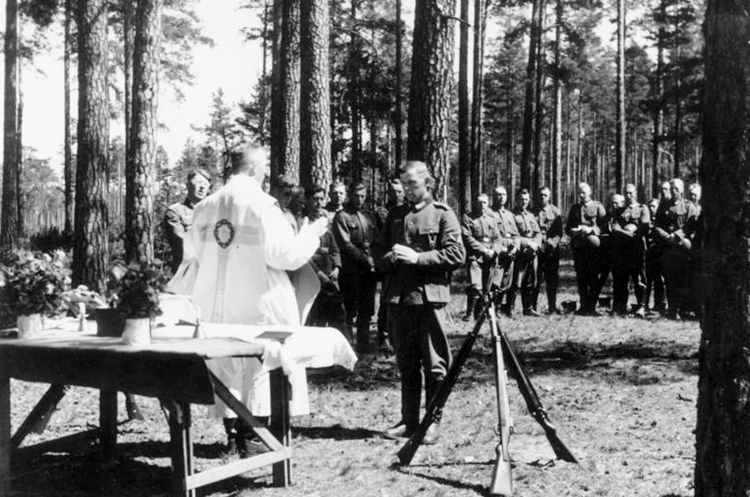
Feldgottesdienst f¸r deutsche Soldaten

An army chaplain blesses Wehrmacht soldiers in German-occupied Poland, 1941.
(German Federal Archive / BArch, Bild 146-2005-0193 / Walter Henisch / CC-BY-SA 3.0)

FASPE Seminary examines the role played by German and international clergy during the period of 1933-1945, underscoring the reality that moral codes governing clergy of all religions can break down or be distorted with devastating consequences. Having demonstrated the power held by religious leaders, FASPE addresses ethical issues now facing individual members of the clergy and religious institutions at large. With the historical background in mind, the FASPE Seminary Fellows are more committed and better positioned to confront contemporary issues.

Each year, FASPE chooses 12 to 18 Seminary Fellows from divinity schools and seminaries, as well as early-career religious leaders, to spend two weeks in Berlin and Poland where they visit key historical sites and participate in daily seminars led by specialized faculty. The Seminary Fellows travel with the Medical Fellows, having the opportunity to exchange views over shared meals and in several interdisciplinary seminars. Read More

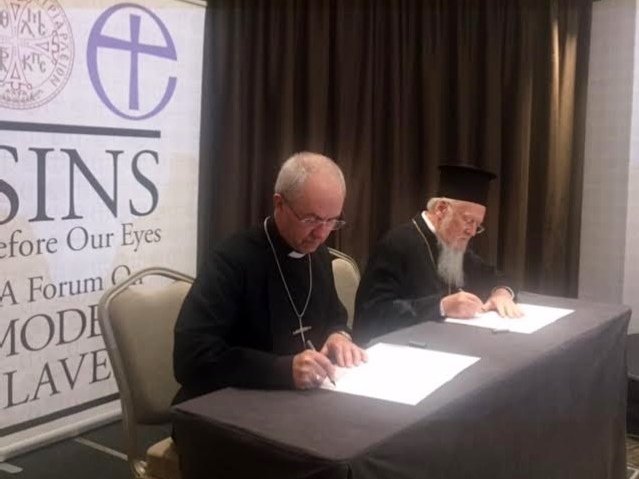
MODERN SLAVERY: ECUMENICAL PATRIARCH TO HOST THIRD INTERNATIONAL FORUM

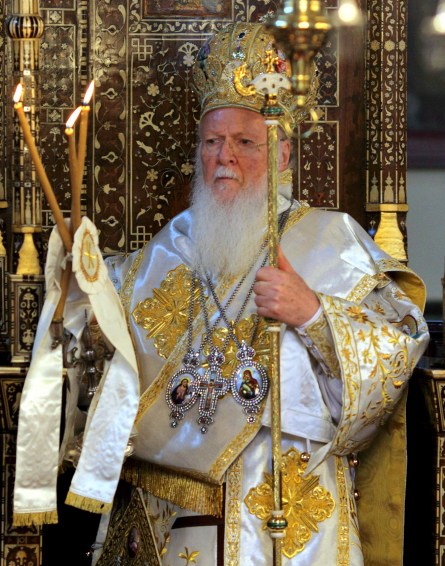
jw-and-patriach-bartholomew

Archbishop Justin Welby of Canterbury and Ecumenical Patriarch Bartholomew of Constantinople
First International Forum on Modern Slavery, Istanbul, February 2017

Awareness, Action and Impact: A Forum on Modern Slavery
January 2019

His All-Holiness Ecumenical Patriarch Bartholomew announced his plans to convene a Third International Forum on Modern Slavery, with the theme “Awareness, Action and Impact.” Recognizing that modern slavery is a global scourge that traps millions of people to lives of suffering, injustice and humiliation, His All-Holiness established a Task Force on Modern Slavery as a commitment of the Ecumenical Patriarchate to learn, to act and to witness towards the elimination of the interconnected forms of visible and invisible enslavement affecting over 46 million people worldwide. This Forum convenes experts, practitioners and policymakers from international, governmental and non-governmental organizations, in consultation with representatives from Orthodox Christian ministries of the Ecumenical Patriarchate. It will concentrate on capacity building, programmatic cooperation and religious literacy improvements by which Orthodox Christian engagement and solidarity can help to eliminate the complex, intersectional causes, contours and consequences of modern slavery. The first Forum, “Sins Before Our Eyes,” was held in Istanbul, Turkey, in February 2017. The second Forum, “Old Problems in the New World,” was held in Buenos Aires, Argentina, in May 2018. Read More


THE CASE FOR CONSTANTINOPLE by Archdeacon John Chryssavgis

Addendum 10/2/19: To advance the discussion of Orthodox ecclesiology and the role of primacy in today’s Church, Archdeacon Chryssavgis’ article from a year ago must be read in conjunction with The Ecumenical Patriarch: First without Equals by Archbishop Elpidophoros of America.

TURKEY GREEK ORTHODOX EASTER

It is tempting to consign the rift between Constantinople and Moscow—this time over autocephaly in Ukraine—to competition within the Orthodox world over power and jurisdiction. The reality is more complex. Beyond the multifaceted religious intrigue lie murky geopolitical ramifications. The matter transcends any exercise of right or even the simple exhibition of might.

The issue of the autocephaly (literally, “self-headed”, or self-governing) of the Church in Ukraine, along with questions of the validity of orders and sacraments, are vital to Orthodox unity, but they pale before the isolationism and nationalism that has plagued Orthodox Christianity in recent centuries. This is the essential context to Moscow’s decision to cut communion with Constantinople. The demoralising effect this is having on the wider Church—coercing bishops and synods into taking sides—only underlines how a handful of Orthodox hierarchs make decisions without concern for or consultation with the lay community. Tragically, it is putting at risk hard-won Orthodox unity in Western Europe and the United States, where Orthodox Churches of all jurisdictions work together on missionary and humanitarian projects.

Of course, the Orthodox Church has never been democratic, even at its most conciliar. But the Early Church understood that the power to discern authenticity—what Orthodox liturgy calls “rightly dividing the word of truth”—does not belong to a bishop or synod alone, but to the Church as a whole. The rights and wrongs of the Ecumenical Patriarchate’s decision—originally issued last April and affirmed this month—to grant autocephaly to the Ukrainian Church (long estranged from Moscow) could be debated by canon lawyers and argued over by church historians. For instance, Moscow may question how Constantinople can restore millions of Ukrainians to communion—but how could Moscow have branded an entire generation of believers “schismatics”? Whenever a mainly Orthodox nation has become an independent state, it has, after a while, gained its own autocephalous Church with its own patriarch; ecclesiastical borders in the Orthodox world frequently follow political borders. But the sweeping reprisals emanating from Moscow suggest something deeper than just a dispute over territory. Yes, Russia stands to lose property; but Constantinople hardly stands to gain wealth or power. Read More


LETTER FROM THE BROTHER OF GOD TO TODAY’S WORLD by Addison Hodges Hart

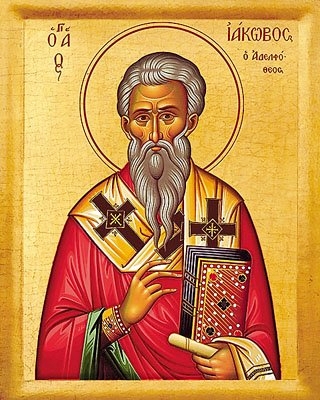
St_James

St. James “the Brother of God”

I was moved to write a commentary on the Letter of James and, as of this past week, it is in print. I have written other books on specifically biblical subjects, one of them a commentary on the Sermon on the Mount (Taking Jesus at His Word: What Jesus Really Said in the Sermon on the Mount, 2012), but that was only a pastoral analysis of a single lengthy passage in Matthew’s Gospel; and another short volume in which I looked at some of the symbolic images in the Gospel of John and explored their meaning (The Woman, the Hour, and the Garden: A Study of Imagery in the Gospel of John, 2016).

But The Letter of James: A Pastoral Commentary is my first venture in commenting on an entire biblical book. There have been many commentaries on James, of course, but I’m audacious enough to think that mine is, at least, timely. If there was ever a season when we would benefit from opening up James afresh and really listening to his message, ours is certainly one such time. A few of my reasons, then, for writing the book might be worth sharing here.

First and foremost, it is the epistle that, above all others in the canon, sounds the most like Jesus Himself, as we find His words in the Synoptic Gospels. This should scarcely surprise us, since—as I argue in the book—I believe the letter is authentic, not pseudonymous. It seems to be an encyclical that comes from the hand or dictation of James “the Just” of Jerusalem, “the brother of the Lord,” written sometime between the years 58 (Paul’s arrest) and 62 (James’ martyrdom) to counter a distorted form of Paul’s message. A distorted form, I should add, that is in many ways still with us today. Read More