PRE-LENTEN AND LENTEN REFLECTIONS: INVITATION TO OUR ORTHODOX HIERARCHS, PRIESTS, AND MONASTICS

bridegroom (1)Zacchaeus Sunday is but two weeks away on January 21, and Forgiveness Sunday on February 18.

Orthodoxy in Dialogue would he honoured to publish a reflection for each Sunday from Zacchaeus Sunday to Palm Sunday, and also one for Lazarus Saturday and another for Holy Week, written by our Orthodox hierarchs, priests, monks, and nuns.

Since we will limit ourselves to only one reflection for each of these days, please check under Lenten Reflections on our Archives by Author page (this is current to the minute) to ensure that the day for which you wish to write is open. Then contact us at editors@orthodoxyindialogue.com to reserve your spot.

We ask for inspirational reflections of no more than 750 words, exclusive of your bio. Your bio need include only the diocese, parish, or monastery to which you are attached. Read More


THE CONSENSUS PATRUM: WHAT IS IT? by Yulia Rozumna and Mina Soliman

This article inaugurates our new Dialogical Series. Each respondent submits his or her essay without knowing in advance what the other has written. 

conpat

~ Yulia Rozumna ~

The principle of consensus patrum was expressed by St. Vincent of Lérins, but was applied during all seven Ecumenical Councils as a criterion for distinguishing true teaching from heretical understandings. It has been later on used for defining the right scriptural interpretation in the Catholic Church. It is also used for defining the teaching of the Fathers on a specific theological question.

This principle does not mean that all Church Fathers agreed on all theological questions. This is impossible, since truth is multi-dimensional and human beings are limited in their cognitive capacities. What it does mean is that most Fathers, who were known for their holy life and, consequently, for deeper theological insights, agreed on the most important theological questions which were crucial for salvation. It resulted in the dogmas and Acts of the seven Ecumenical Councils. Importantly, the Church is led by the Holy Spirit, and the doctrines are expounded by holy people through inspiration of the Spirit of God.

Some wonder who the Church Fathers are. When we want to find an answer on a challenging theological issue, outside the doctrinal sphere, the Fathers of which historical periods and geographical areas should we consult? Whether these are only the Fathers of the seven Ecumenical Councils? Or key figures of later centuries, like St. Gregory Palamas, or non-Greek saints and theologians? Is there a canon of Fathers which should be cited on all questions? Some respond that these should be the Fathers whose authority is approved by the Acts of the Ecumenical Councils.  Read More


ISLAMOPHOBIA AND ORTHODOX TRADITION by Phil Dorroll

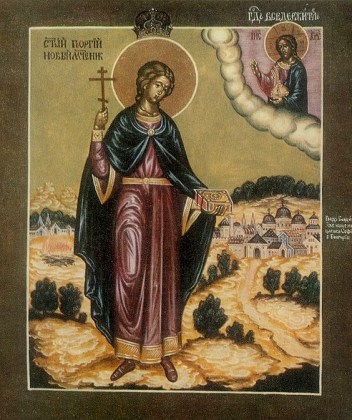
georgekratovo“With this he planted hatred in their hearts.”

The above quote is drawn from the martyrdom of St. George, a goldsmith from Kratovo (d. 1515 in Sofia), as recorded in Father N.M. Vaporis’ authoritative study and summaries of the hagiographic accounts of the Orthodox neomartyrs* of the Ottoman period, Witnesses for Christ (SVS Press, 2000: p. 48). In this account, a local Muslim cleric tries to compel George to convert to Islam, and is angered by his refusal to do so. The mufti incites the local population with hatred against George, who is dragged before the local qadi (imperial judge). The qadi has George arrested and accedes to the demands of the angry Muslim mob to put George in prison.

George refuses subsequent enticements to convert, and is again dragged before the qadi, accompanied by the angry mob of local Muslims, who demand his execution. This time the qadi chastises the anger of the crowds, saying: “Because he praised his faith, and does not accept ours, he should be burned?” (p. 53). After a dialogue reminiscent of Pontius Pilate’s questioning of Christ, the qadi accedes to the wishes of the angry mob and tells them, “His sin is on your souls; do with him what you please” (p. 54). George is then tortured and murdered by the angry mob.

The lives of the Ottoman neomartyrs exhibit a number of common themes. They are often the victims of mob violence, or brutalization at the hands of invading Ottoman armies, or simply of individual prejudice directed against them by local Muslims jealous of their economic success. They are often suspected of sedition or conspiracy against the state by the Ottoman authorities, or are accused of apostasy from Islam or other crimes punishable by death during the Ottoman period. Read More

CALL FOR ARTICLES: CHRISTIAN UNITY: WHAT IS IT?

Addendum: This topic has been made an ongoing series. Ignore the dates and deadlines below.

WEEK OF PRAYER

FOR CHRISTIAN UNITY 2018

January 18 to 25

12aps

The annual Week of Prayer for Christian Unity begins in two weeks. The World Council of Churches has posted this year’s information here, and the Canadian Council of Churches here. Other countries around the world undoubtedly have their own website for this event.

But what is “Christian unity” anyway? Do we have it already, in whole or in part? What does it look like, or what will it look like when we have it? Aside from praying for it once a year, what concrete steps or mechanisms will bring Christian unity to fruition?

What is “ecumenism?” What are its practices and its goals? 

What is “the Church,” for that matter? What is the content of our “good news?” Read More