This is the second article in our Christian Unity Series.
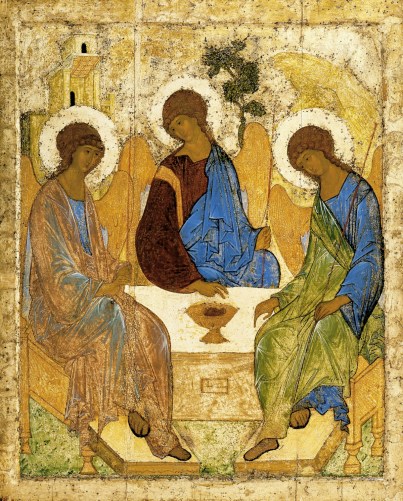 Christian unity is foremost unity established through Christ. More specifically it is participation in the unity of the Trinity: “That they also may be one in Us.” Christ gives this to those believing in Him: “And the glory which You have given to Me, I have given to them, so that they may be one just as We are one: I in them, and You in Me; so that they may be perfected in unity.” So Christian unity is something received from Christ in union with the Trinity.
When we speak of union with the Trinity, this is effected through union with Christ and becoming members of the household of God, the Church, and forming one Body. They are built onto the foundation of the Apostles and Prophets. So the unity of the those united to Christ is seen in the formation of one Body or one Church, which is built on the foundation of the Apostles and Prophets. Christian unity, then, is the the gathering of the faithful in one Body or Church.
The Church is manifest in each location as those gathered around the one bishop and presbyters in that location because, in gathering with the bishop and presbyters, one gathers with Christ and the Apostles as tangibly manifest in that location through the bishop and presbyters. So Christian unity is gathering with the bishop and presbyters of the Church in their particular location. Because there is only one Christ and one Church, there is only one such gathering in each place, and this gathering must then be of the whole catholic Church in that place, because there are no parts of the Church apart from this gathering. Read More

 Every year, in the third week of January (in the northern hemisphere), many Christian individuals, parishes, and associations organize ecumenical liturgies, Bible studies, and other activities to animate a Week of Prayer for Christian Unity (WPCU). The WPCU calls Christians to repentance for sinful events and attitudes that led (and lead) to divisions in the church, and promotes the way of ecumenism, which aims to restore unity within the global Christian family.
 I’d like to take on the issue of what Jesus wrote in the dust. It is, indeed, a riddle: presented as a puzzle, which can be solved from the evidence and information presented around it, and which asks for such a solution. I make no claim to scholarship in the formal sense, but the genre of riddle does not ask for it, being a matter of reading, even reading for the plot, and working with the material itself.
 Is the knowledge for which we strive in theological studies ἐπιστήμη—epistemic knowledge, “scientific” knowledge broadly construed—or is it γνῶσις, gnostic knowledge? The noun ἐπιστήμη derives from the verb ἐπίσταμαι, to know in the sense of “to acquire information about something.” Γνῶσις, on the other hand, represents the kind of knowledge that God is said to have, as well as humans: from the verb γινώσκω, which can mean to know in a higher, esoteric sense; to know someone instead of something; to know even in the sense of the bodily union of erotic intimacy. It comes down, I believe, to the most fundamental of all questions for us: Do we study and teach theology to accumulate and impart facts and ideas about God? To provide religious cover for a worthwhile social or political project? Or do we seek simply to know God, and to help others to know Him, and in so doing become mystically one with Him, and mystically one with one another in Him, insofar as humanly possible through our God-given receptivity to divine grace? “Be still,” the Lord says to us through the mouth of the psalmist, “and know that I am God.” In my favourite line from the Blessed Augustine we read: “The thought of Thee stirs [man] so deeply that he cannot be content unless he praises Thee, because Thou hast made us for Thyself and our hearts find no peace until they rest in Thee.” And again from the psalmist: “O God, Thou art my God, I seek Thee; my soul thirsts for Thee, my flesh faints for Thee, as in a dry and weary land where no water is.” The 20th-century St. Silouan the Athonite wrote: “My soul yearns after the Lord, and I seek Him in tears. How could I do other than seek Thee, for Thou didst first seek and find me…and my soul fell to loving Thee.”
 ORTHODOXY IN DIALOGUE