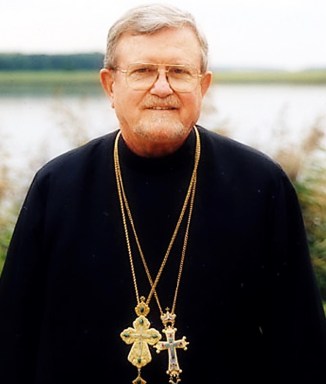
 The Orthodox priest-scholar and my friend Father William Mills passed on to me an e-mail from the Jesuit, Father John Baldovin, who was in to see Father Robert Taft last weekend and reported that he is no longer eating and is very weak and frail. Taft, now in his 86th year, will soon appear, it seems, before the “awesome tribunal of Christ,” as the Byzantine liturgy, which Taft has done so much to help us understand, plaintively puts it.
For those who do not know him, Taft has, more than any scholar of our time, helped Eastern Christians and others understand the Byzantine tradition, tracing out its liturgical history in all its fascinating and often messy details through hundreds of articles and books stretching back more than fifty years.
Though a Catholic, and a Jesuit whose whole life has been lived in the Russian recension of the Byzantine tradition, Taft has shaped many minds in the Orthodox world. Scholars such as Father Alexander Rentel at St. Vladimir’s Seminary in New York studied under him; Sister Vassa Larin was one of his last graduate students; and many other Orthodox and Catholic scholars today have been influenced by his myriad works. It is, in fact, impossible to study liturgy or Eastern Christian history seriously without coming across Taft’s works.
His formidable reputation precedes him, and so, when I was scheduled to be on a panel with him at the Orientale Lumen conference in Washington, DC in June 2011, I was a little nervous, for Taft is a gruff, no-nonsense kind of guy infamous for his take-no-prisoners style. He was still quite vigorous then, but clearly slowing down. We had, I was relieved to discover, a very amicable time together, in part because I had done my homework and was not indulging in some of the things Taft has long denounced, not least “confessional propaganda” masquerading, he says, as church history. Read More

 One day, Damien asks me a question: How can he find out whether his religion is true? He comes to me and not, say, to his own Muslim Chaplain, because I will respect his freedom to search without coercing him (however gently) to my own answer. At the same time, my own faith commitment compels me to respond to Damien in a way that maintains the integrity of Orthodox Christianity, including its claims to exclusive fulness of truth. How do I prepare? I go to that quintessential scriptural interfaith engagement: the Apostle Paul’s speech to the philosophers of Athens (Acts 17:22-31).



 ORTHODOXY IN DIALOGUE