PRESS RELEASE: THE AMMAN FRATERNAL FAMILIAL GATHERING OF THE ORTHODOX PRIMATES AND DELEGATES

The initiative of the Patriarch of Jerusalem to circumvent the primatial authority of the Ecumenical Patriarch was attended by only two other primates—the Patriarchs of Moscow and Serbia—and lower level delegates from only three other Churches: Romania, Poland, and the Czech Lands and Slovakia. The following press release appeared yesterday on the website of the Patriarchate of Jerusalem.
For context on the Ukrainian issue addressed by this gathering see the extensive Ukraine section in Orthodoxy in Dialogue’s Archives 2017-19 and Archives 2020.

Patriarch Theophilos III of Jerusalem (centre)

On February 26, 2020, a meeting of Primates and representatives of Local Orthodox Churches was held in Amman, Jordan, with the primary view of unity and reconciliation within Holy Orthodoxy. The participants noted their understanding of the anguish of the Patriarchate of Jerusalem for the imminent danger of schism within our Orthodox Communion. Read More


BISHOP STEPHEN ANDREWS OF WYCLIFFE COLLEGE ISSUES APOLOGY

The following apology by Bishop Stephen Andrews, principal of Wycliffe College in the University of Toronto, appeared earlier today in The Morning Star in response to our Anglicanism, Christian Unity, and Same-Sex Love: Responding to Catherine Sider Hamilton and Ephraim Radner.
The episcopate of the Orthodox Church in the United States and Canada would be well served to follow the example of Christian humility, sensitivity, and dialogue set by their brother bishop—especially as the countdown to the Sunday of Forgiveness and the beginning of Great Lent has begun.

Image result for BISHOP STEPHEN ANDREWS OF WYCLIFFE COLLEGE ISSUES APOLOGY

Bishop Stephen Andrews, Principal, Wycliffe College

Building Community

by Stephen Andrews

Dear Friends,

The last week in January an article appeared in the Morning Star which some found objectionable and others found personally hurtful. I want to apologise to our community. We should have been more careful in asking ourselves whether the community newsletter was the right place to publish something that had the potential of causing pain. We want to maintain an environment of charity and mutual respect at the College, and we regret that publishing the article in that format did not contribute to these ends. I would invite anyone who was hurt to speak to me personally, and I want our community to know that we are reviewing the mandate and the protocols of the Morning Star. Read More


PRINCETON UNIVERSITY: THE ICONS OF MOUNT SINAI ONLINE

In 1956, Professor George Forsyth, of the University of Michigan, invited Kurt Weitzmann, of Princeton University, to join him on an exploratory trip to Sinai. From 1958 to 1965, the University of Michigan, Princeton University, and the University of Alexandria carried out four research expeditions to the remote Monastery of Saint Catherine at Mount Sinai—the oldest continuously inhabited Orthodox Christian monastery in the world, with a history that can be traced back over seventeen centuries. The documentation collected by the Michigan-Princeton-Alexandria Expeditions to Mountain Sinai, under the direction of Professor George Forsyth (below, right) and Professor Kurt Weitzmann (pictured below left), is a profoundly important resource for Byzantine studies. Read More


UKRAINIAN CHURCHES IN THE CANADIAN PRAIRIES by Areta Kovalska

Editor’s Preface
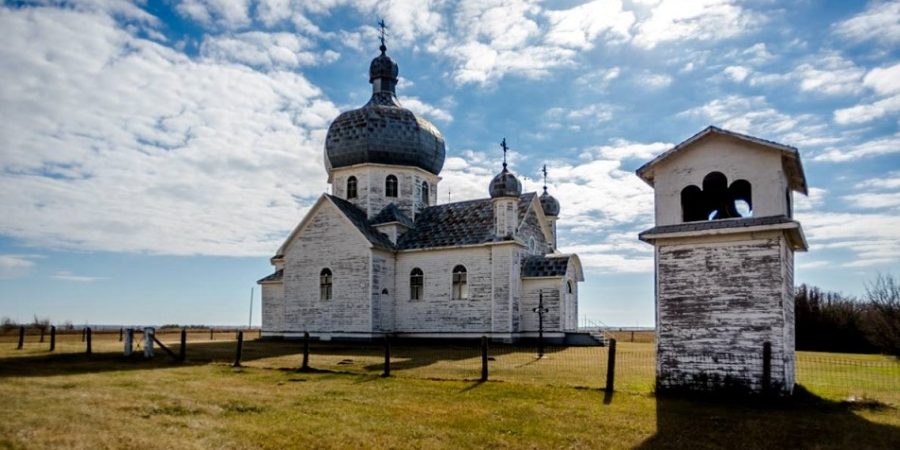
I lived in the Canadian prairie provinces as a university student and seminarian from 1973 to 1976, and as a priest from 1989 to 2001. Wide swaths of countryside in Manitoba, Saskatchewan, and Alberta have so many Orthodox and Eastern Catholic church structures, in various states of repair and disrepair, that you find it easy to imagine yourself mystically transported to 19th- and early 20th-century Eastern Europe.
These churches are not only Ukrainian: a smaller presence of Romanian Orthodox churches stretches from the Roblin-Russell area in northwestern Manitoba to the Kayville-Assiniboia area in southern Saskatchewan, close to the Canada-US border. I spent most of my priesthood surrounded by Ukrainian churches such as those pictured below while I ministered to the children, grandchildren, and great-grandchildren of Romanian immigrants who arrived in Canada to homestead between the 1890s and the 1910s. The Ukrainian Orthodox church in Wroxton sits a short 15- or 20-minute drive from my last parish. My family and I passed it all the time to and from Yorkton, the closest major shopping destination an hour from our home. 
Unremarked in the text below, Orthodox Slavs who immigrated from Austro-Hungary or Poland to Canada during the period in question were served by the existing North American diocese of the Russian Orthodox Church. The parishes they founded over 100 years ago now belong, for the most part, to the Archdiocese of Canada of the Orthodox Church in America (OCA). The much larger Ukrainian Orthodox Church of Canada—canonical for only some 30 years now—has its roots in the return from Uniatism to Orthodoxy for the same reasons that motivated St. Alexis Toth and his followers, i.e., the Vatican’s prohibition of married clergy outside of the Unia’s original territories.
For additional context see the Canadian Orthodox History Project.
Giacomo Sanfilippo, Editor 

Approximately 170,000 Ukrainians from the Austro-Hungarian crownlands of Galicia and Bukovina (Bukovyna) arrived in Canada from September 1891 to August 1914. The vast majority settled in the prairie provinces of Manitoba, Saskatchewan, and Alberta, where they obtained land to farm.

Few of the early immigrants would have called themselves Ukrainian, but rather identified themselves as Galicians, Ruthenians, Hutsuls, Lemkos, or Bukovynians. Most Ukrainians from Galicia, including Ruthenians, Hutsuls, and Lemkos, were Greek Catholic, while those from Bukovyna were Greek Orthodox. 

Read More