Through the prayers of countless friends around the world and after many personal setbacks, my doctoral committee approved my thesis proposal this morning. This advances me, at the age of 65 with a number of new health challenges to deal with, to the status of PhD candidate or ABD (All But Dissertation)—a moment of joy, gratitude, and deep emotion. I thank the many of you for your unflagging encouragement and prayers, and for your faith in my ability to forge ahead.
I especially wish to extend public thanks to my supervisor, Dr. David Neelands of Trinity College; committee members, Dr. James Ginther of St. Michael’s College and Dr. Gilles Mongeau, SJ, of Regis College; former committee member, Dr. Peter Galadza, recently retired from the Metropolitan Andrey Sheptytsky Institute of Eastern Christian Studies, who stayed with me through my comprehensive exams in August; and the additional examiner for my comprehensives, Dr. Jaroslav Skira of Regis College. I would not have reached this point without the support and guidance of each of them.
I also owe a sincere thank you to Dr. George Demacopoulos, Dr. Aristotle Papanikolaou, and Dr. Nathaniel Wood of Fordham University for my first opportunity to share my work on Father Florensky with a wide global audience (Conjugal Friendship, Public Orthodoxy), and to Dr. Inga Leonova of the Boston Architectural College for the opportunity to publish an introduction to my PhD thesis (Father Pavel Florensky and the Sacrament of Love, The Wheel).
Finally, the generous words of support from His Eminence, Metropolitan Kallistos (Ware) (Foreword, The Wheel) and Father Andrew Louth (A Conversation on Theology, Church, and Life, Orthodoxy in Dialogue) remain forever as precious as gold to me.
The following is a partial text, stripped of footnotes. The PDF of the full text, including footnotes and my working bibliography, can be downloaded on my academia.edu profile.
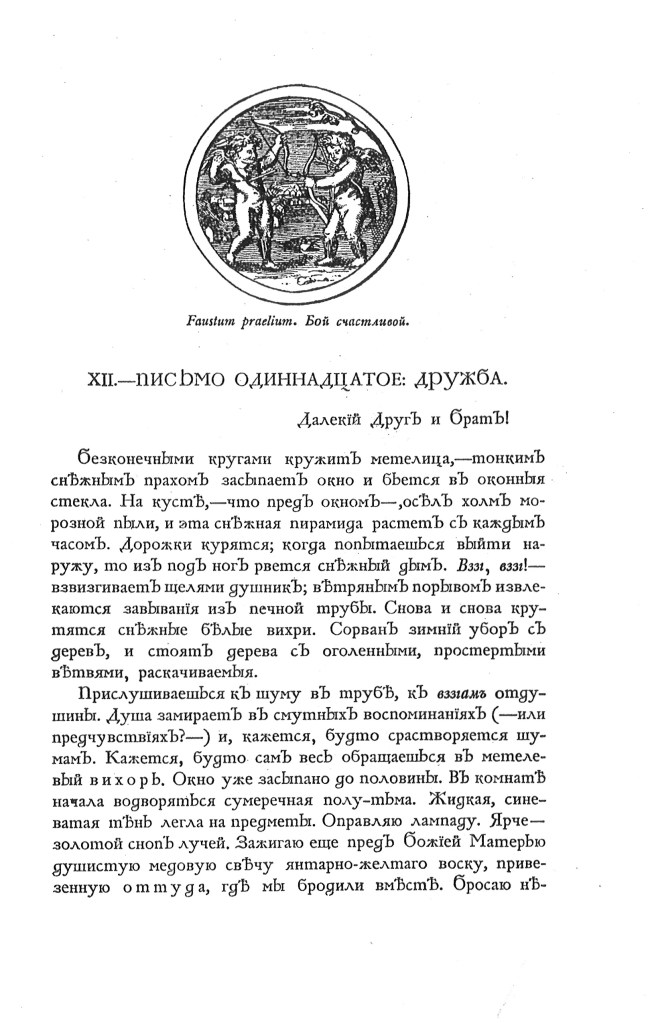
“Happy Battle”
First page of “Friendship” in the original 1914 edition of The Pillar and Ground of the Truth
Thesis Proposal
Conjugal Friendship and the Sacrament of Love: Father Pavel Florensky’s Orthodox Theology of Same-Sex Love
by
Giacomo Sanfilippo
Introduction
Thesis Statement
Status Quæstionis
A polymath who excelled from early childhood in every field of inquiry that piqued his insatiable curiosity—mathematics, natural and applied sciences, engineering, ancient and modern languages, comparative linguistics, art history, sexuality and gender, philosophy, theology, et al.—Father Pavel Florensky is widely regarded as “Russia’s da Vinci,” the 20th century’s most intellectually gifted Orthodox theologian worldwide, and one of the principal religious voices of Russia’s Silver Age for his seminal contributions to the Russian Religious Renaissance, Russian religious philosophy, and Russian sophiology.
With the exception of Father Robert Slesinski’s Pavel Florensky: A Metaphysics of Love (1984) and the translation of Florensky’s Iconostasis by Donald Sheehan and Olga Andrejev (1996), “Florensky studies” begin to appear in English with Boris Jakim’s translation of PGT in 1997. The literature either tiptoes through “Friendship” or circumvents it altogether in favour of other aspects of Florensky’s thought. This reticence on the part of Florensky scholars seems all the more noteworthy in that this is the chapter universally acknowledged as the very dénouement of PGT.
Read More



 ORTHODOXY IN DIALOGUE