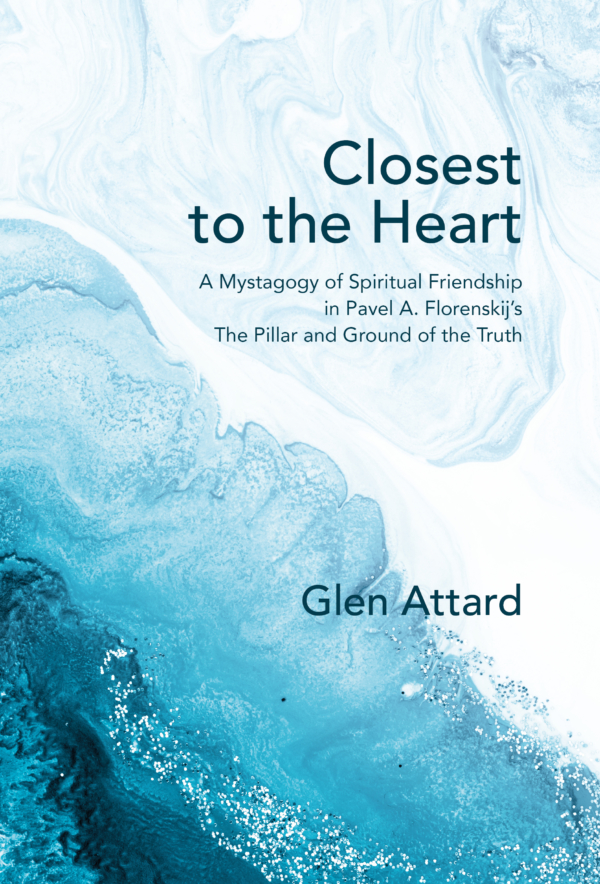
Closest to the Heart: A Mystagogy of Spiritual Friendship in Pavel A. Florenskij’s The Pillar and Ground of the Truth Glen Attard Ħal Qormi, Malta: Horizons, 2020
Father Glen Attard’s book puts me in an unusual spot for a reviewer. Unbeknownst to each other at the beginning of our projects, the author and I were both working on a doctoral thesis/future book on the same topic at the same time. He became aware of me and my work when Public Orthodoxy published myConjugal Friendshipin May 2017; and I, of him and his work when he emailed me in February 2018 to introduce himself as a colleague in Florensky scholarship. He conveyed his disagreement with the central premise around which my entire thesis revolves: to wit, that Father Pavel Florensky wrote “Friendship,” the culminating chapter of The Pillar and Ground of the Truth, as his theological and spiritual response to the era’s—and his own—preoccupation with the recently coined and theorized “homosexuality.” In response to Attard’s request for something more substantive to support my reading of “Friendship,” I referred him to the chapter on Florensky in myMA thesis, a few short pieces of mine at Orthodoxy in Dialogue, and especially my more adequately annotatedFather Pavel Florensky and the Sacrament of Love, scheduled to appear a few months later in The Wheel. I wrote again to let him know when the latter came out. My doctoral thesis proposal,Conjugal Friendship and the Sacrament of Love: Father Pavel Florensky’s Orthodox Theology of Same-Sex Love, was not posted publicly at academia.edu until one month after Attard’s book appeared in print. The timeline of our correspondence and my online publishing record proves relevant later in this review.
John D. Caputo has recently proposed a “weak theology.” This theology is said to focus less on rigid dogmatic formulas of traditional religion, and more on ethical themes such as hospitality and openness to the stranger. Caputo’s work has gathered a significant number of followers in the United States, where he is one of the main theologians today.
Event and Religion proposes to evaluate this new form of religion from out of the various religious and theological backgrounds from Europe’s main countries. Is only a rather secular mindset able to welcome Caputo’s thinking, or does it sit well with a more traditional stance toward religion? The aim of this volume is to gather Catholic, Protestant, and Orthodox voices around Caputo’s work to evaluate the match with the European context.
We are seeking an Eastern Orthodox scholar who engages critically with Caputo’s work in a European context. How does Caputo’s weak theology blend (or not) with the Orthodox tradition? Or, more generally, has there been an Orthodox reception of Caputo’s theology at all? If not, why not? These questions would all make for a fine contribution in this volume, which seeks to portray contextual theologies (and philosophies) throughout Europe in their response to “radical theology.” Is such radical theology but a “secular translation” of theology proper? Or is it a new, valid, valuable path for theology to proceed in a largely secular West?
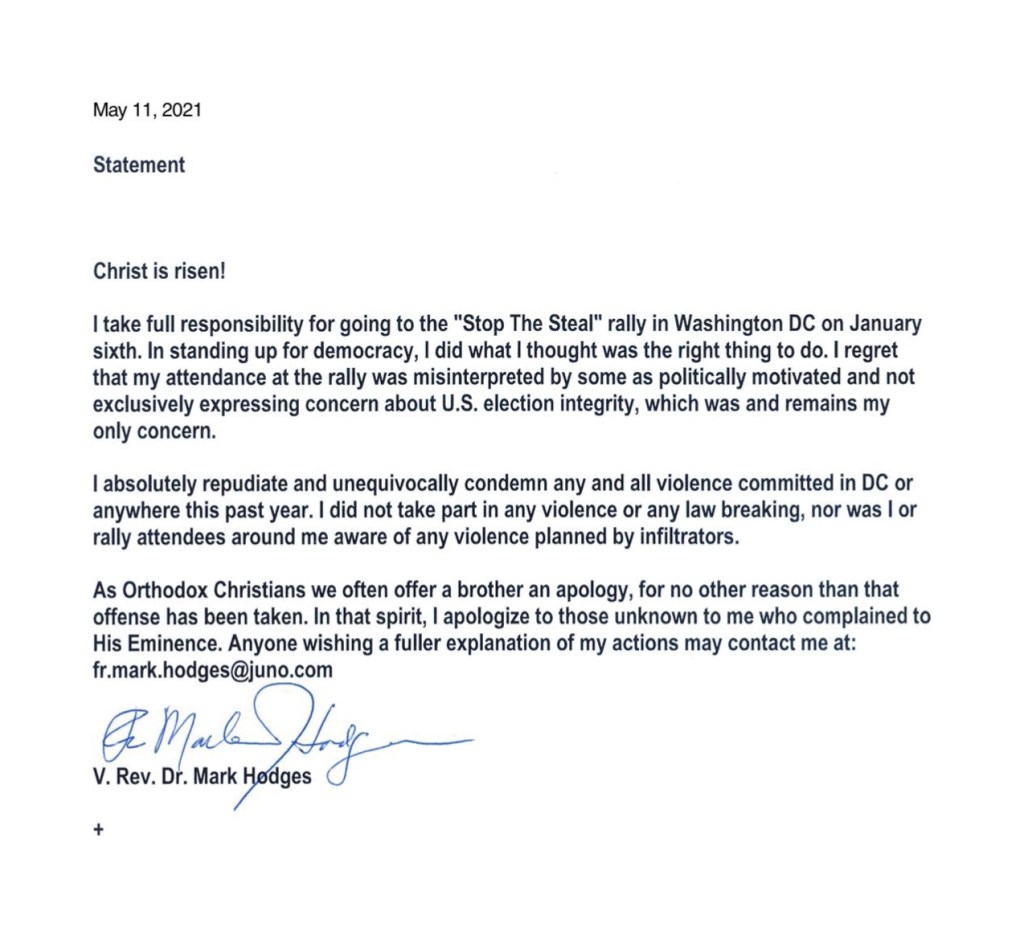
Thewebsiteof the Diocese of the Midwest of the Orthodox Church in America has posted the following notification dated May 13, 2021:
HODGES, Archpriest Mark had his suspension lifted and was returned to Active Duty. He is attached to St. Paul the Apostle Church, Dayton, OH, effective May 13, 2021.
It then provides a link to Father Hodges’ public “apology” — in which it is clear he feels he did nothing wrong in supporting, and continuing to support, the conspiracy theory of a stolen election that wreaks ongoing havoc on American national life and domestic security.





 ORTHODOXY IN DIALOGUE