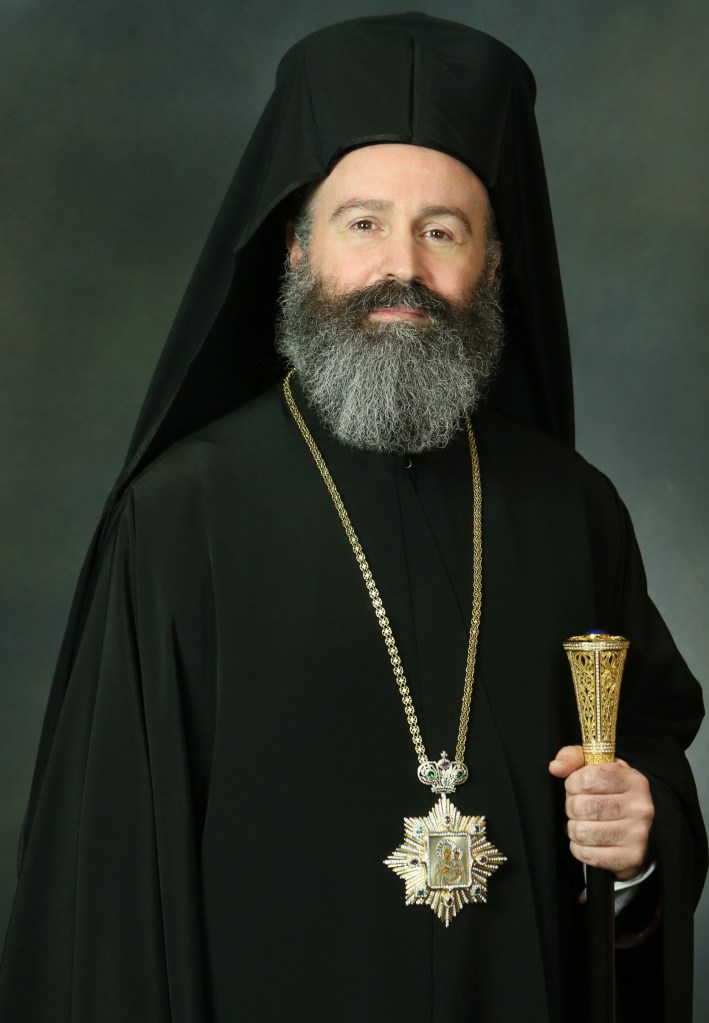
ECUMENICAL PATRIARCH BARTHOLOMEW TO VISIT UNITED STATES THIS FALL
The following encyclical by Archbishop Elpidophoros of America (Greek Orthodox Archdiocese) was published on June 30, 2021 at Orthodox Christian Laity.

Archiepiscopal Encyclical on the Apostolic Visit of His All-Holiness
Ecumenical Patriarch BARTHOLOMEW to the United States
Prot. No. 164/2021
June 30, 2021
Synaxis of the Holy and Glorious Twelve Apostles
Unto the Most Reverend and Right Reverend Hierarchs, Pious Priests and Deacons, the Monks and Nuns, Presidents and Members of Parish Councils, Honorable Archons of the Ecumenical Patriarchate, Members of Leadership 100, the Day and Afternoon Schools, Philoptochos Societies, the Youth, Greek Orthodox Organizations, and the entirety of the Christ-named Plenitude of the Holy Archdiocese of America.
My Beloved Brothers and Sisters in Christ,
Εὐλογημένος ὁ ἐρχόμενος ἐν ὀνόματι Κυρίου! (Ψαλμός 117:25)
Blessed is he who comes in the name of the Lord! (Psalm 117:25 LXX) Read More
IMAGINARIES IN GEOMETRY reviewed by Henry C. Antony Karlson III
Imaginaries in Geometry
Pavel Florensky (Anna Maiorova and Karen Turnball, Translators; Andrea Oppo and Massimiliano Spano, Editors).
Milan IT: Mimesis International, 2021
Published in 1922, while mostly written in 1902 [Editor: When the author was 20!], Florensky’s Imaginaries in Geometry is not an easy text to read because its focus is mathematical in nature. There are philosophical and theological ideas addressed in it which will allow many readers to appreciate his thought. Nonetheless, the mathematical elements which serve as his proof of concept will not likely be understood by many of its readers. I found them to be almost incomprehensible. I say “almost,” because even though I was unable to comprehend his mathematical equations, I was able to use what mathematical knowledge I remember from my studies to follow along with the concepts being expressed. Most of his readers will be able to do so as well, allowing them to discern how the book connects to the greater philosophical picture which Florensky wanted to reveal through his work.
What is that picture? That mathematics and the sciences all serve to translate and interpret reality, each presenting its own worldview that accounts for some element of a greater whole. Just as those who translate poetry from one language to another will lose something in their translation, so something is lost in the translation of reality through their exploration in the sciences. Different models, different worldviews, just like different translations of a book, can and should complement each other. They each have something invaluable to tell us. What is important is that we do not merely embrace one model and try to reduce reality to what can be discerned by it. This is exactly what he felt was the error of the scientific positivism embraced by the Soviets: Read More