THE ETHICS OF TIME: A PHENOMENOLOGY AND HERMENEUTICS OF CHANGE reviewed by Christopher Iacovetti

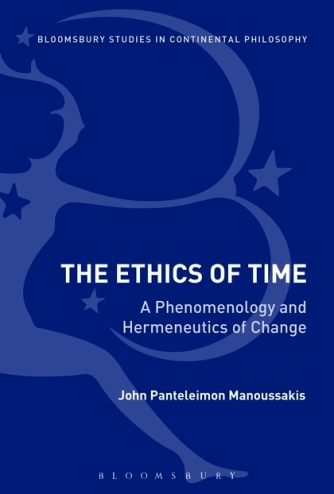
The Ethics of Time: A Phenomenology and Hermeneutics of Change                                        
John Panteleimon Manoussakis                                                                                                    
New York: Bloomsbury Academic, 2017
ethicsoftime

Father Manoussakis is, as William Desmond puts it in his endorsement of this book, a genuine thinker. By this I mean not merely that one encounters original insights and thought-provoking arguments in his writings, but more broadly that he displays an impressive and steady commitment, throughout the body of his work, to considering whatever subjects he addresses from as many angles as possible—often traversing disciplinary boundaries and subverting commonsense assumptions quite radically in the process. It is not often, after all, that one comes across an author willing to engage figures as diverse as Freud, Kierkegaard, Sophocles, and Maximus at length in the same book—particularly when the book in question is as carefully argued and thoughtfully organized as those by Manoussakis tend to be.

The Ethics of Time is, Manoussakis tells us, “in many ways” a sequel to his God after Metaphysics (2007). What connects these books to one another? At the very least, it seems fair to suggest that the two books share a common thematic basis in Chalcedonian christology. This is not to say that either of these books is christological, or even theological, in a straightforward sense. Manoussakis writes as a phenomenologist, and explicitly denies (at least in God after Metaphysics) that he intends to do otherwise. Even at a strictly philosophical level, however, the incarnation is central to both books. This is because, for Manoussakis (as for Augustine and Maximus), the story of the historical enfleshment of the Logos constitutes not only the crux of salvation history, but also a definitive vindication of creaturely existence over against its cultured Platonic and Manichaean despisers—a vindication replete with “scandalous” philosophical implications. Read More


YOUNG AND ORTHODOX IN TRUMP’S AMERICA by Stefan Kleinhenz

stefan (2)

Stefan Kleinhenz

In today’s political world there is much discussion over the nature of the time in which we live. For many reasons on both sides of the aisle, our political parties have become polarized to the point where we are separated into one of two categories, neither of which is based on core or fundamental principles, but rather on simple opposition to the other party.

We are currently at a point of division that many believe history has never seen before. The election, and now the presidency of Donald Trump, has personified this ever-growing political climate simply because we, as Americans, are forced into one of two extreme corners: one extreme being that Donald Trump will be the savior of the world, and the other proclaiming that he will orchestrate the extermination of all life on earth.

Both of these are wrong. Wrong, because these are the beliefs that lead us to the thought that we are living in Trump’s America.

Those who have faced the challenges of history did not set the path for the present by believing they lived in someone else’s world. They understood that they as individuals were the masters of their own destiny. We are the heirs of the patriotic beliefs that not only founded a nation, but revolutionized the world. As the bearers of that ancestral burden—and more profoundly, as Christians—how can we believe that anyone other than ourselves is responsible for our life? Read More


FOR US MEN AND FOR OUR SALVATION: SOME THOUGHTS ON LITURGICAL TRANSLATION by Stephen Morris

creation

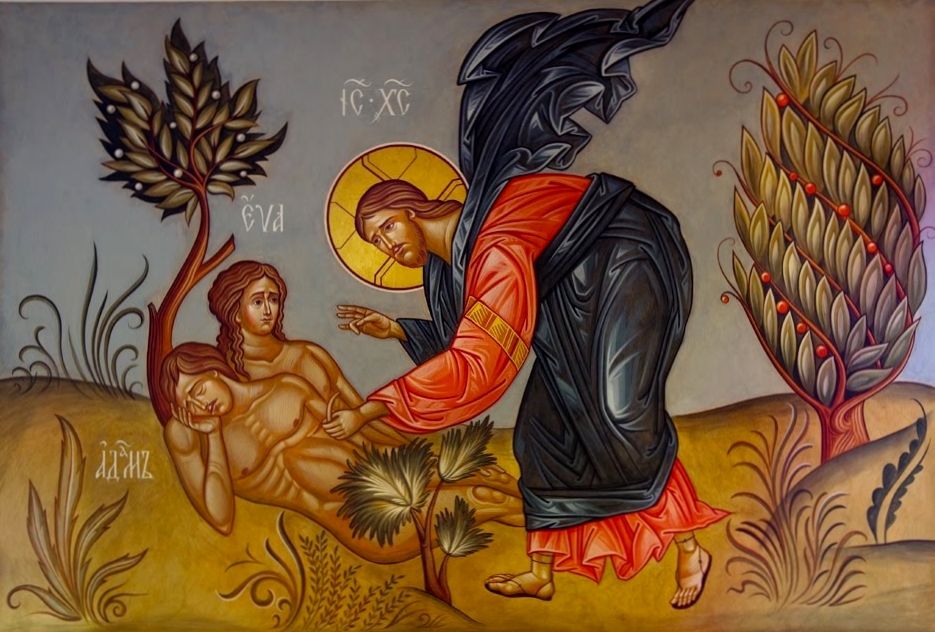
“Therefore shall a man (LXX: ἄνθρωπος, anthropos) leave his father and his mother and shall cleave to his wife, and the two shall be one flesh.” (Genesis 2:24)

Recent efforts by some to re-translate liturgical texts have ignited discussions about how best to express the unchanging teachings of Orthodoxy in language that is comprehensible to modern people, which is a good thing. (See John Fotopoulos and Aristotle Papanikolaou’s article here.) The practice of the Church has always been to adopt local language and custom wherever possible to make the Gospel available to people. That is why Cyril and Methodius undertook their work of translating Scripture and liturgy from Greek into Slavonic. That is why the apostles and early fathers struggled to express Aramaic and Hebrew ideas in Greek. That is the miracle of Pentecost: everyone can say, “We hear them speaking in our own tongues the wonderful works of God” (Acts 2:11). Every time someone understands the Divine Liturgy in their own language, the miracle of Pentecost happens again. Read More


SAME-SEX LOVE: THE CHURCH NEEDS A CONVERSATION by the Editors

In creating Orthodoxy in Dialogue we made a conscious decision, as a matter of editorial policy, not to publish very often on questions of sexuality and gender. The list of upcoming titles on the Archives by Author page gives an idea of the wide range of topics to which we look forward in the coming weeks. Yet we will not hesitate to return to these questions more frequently when circumstances warrant it.

twotheo

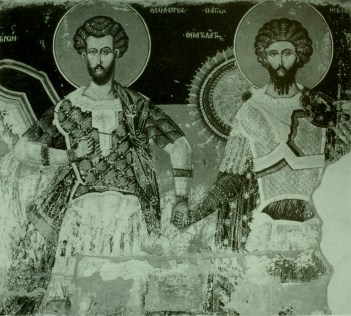
SS. Theodore of Tyre and Theodore Stratelates. (Holy Transfiguration Monastery. Zrze, Macedonia. 14th century.)

It seems to have occurred by sheer coincidence that our elder sister blog, Public Orthodoxy, published Bradley Nassif’s “The Holy Trinity and Same-Sex Marriage” just as we were preparing to release Giacomo Sanfilippo’s interview with Father James Martin, SJ. The contrast in pastoral spirit between Martin and Nassif could not have been juxtaposed more starkly.

Given that Public Orthodoxy had previously published Sanfilippo’s “Conjugal Friendship,” we commend our brother editors for their commitment to presenting more than one side of a question. At Orthodoxy in Dialogue we likewise encourage prospective writers to submit articles irrespective of whether we might agree or disagree with them.

Yet Nassif’s article stands out precisely for adding nothing new to the conversation, nothing that has not already been iterated and reiterated a thousand times before.

To be clear, we do not judge the value of his article so much for his position on same-sex love, as for the disappointment for which he sets up his readers. With great interest we started his second paragraph: “At times, Orthodox responses have been knee-jerk in their opposition to same-sex marriage and the LGBTQ agenda. But a blunt rejection is woefully inadequate. A rebuke is no reply.” Read More