
CHRIST IS BORN!
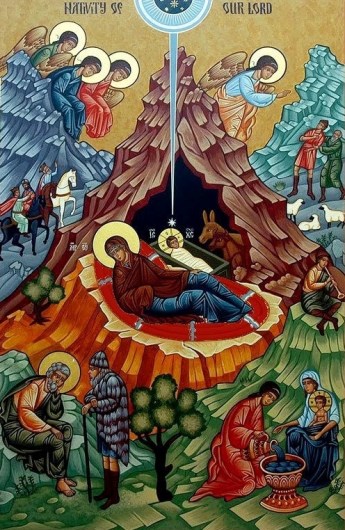

With this Call for Articles we invite you to consider writing for Orthodoxy in Dialogue’s new Dialogical Series.
This ongoing Series will launch soon with two offerings: “The Consensus Patrum: What Is It?” and “Can You Be Orthodox in Communion with Rome?”
The format will combine the responses of two or three contributors to a predetermined question in a single article. Their names will be listed in alphabetical order in the byline, and their individual responses will appear in the same order in the body of the article. Archives by Author will list the article under each contributor’s name and under the Series near the top of the page.
Each contributor must adhere to a strict 1000-word limit or less, exclusive of his or her bio. No exceptions. Contributors agree not to see the other responses until the article is actually published. Read More
The author offers this charitable reflection in response to the financial scandal currently emerging in the life of the Orthodox Church here in Canada.
 Wabi-sabi is an ancient and important element in Japanese history, religion, and culture. It is, essentially, a philosophical and religious principle usually introduced and referred to in Western culture as a quality of artistic expression. Wabi is an adjective that describes something as fresh, yet simple, as simple and quiet, yet also unique in its expression and evolution. Sabi, also an adjective, is a quality of beauty that results from age, a beauty that is marked by wisdom and imperfection, and the artful mending of damage.
Together, these two words denote not only an artistic aesthetic of something that has aged beautifully, but, more importantly, wabi-sabi expresses a conception of beauty that can seem foreign to us in our Western culture: that the most beautiful is that which has aged over a long period of time, that has become broken and undone many times over, yet has found healing and fulfilment despite becoming damaged; very simply, wabi-sabi is simple, elegant, quiet, wise, and unapologetically imperfect. Wabi-sabi is a definition of beauty.
The Classical Greeks had a similar understanding of beauty. “Whitewashed tombs, which on the outside look beautiful, but inside they are full of the bones of the dead and of all kinds of filth,” is how Jesus described the Pharisees’ hypocrisy. He noted that on the outside they look beautiful, oraios—a word, just like all other words in the New Testament, filled with poetic and philosophical meaning and that was used with great calculation and purpose. This word is used specifically to bring attention to the great rhetorical juxtaposition of hypocrisy being a “beautiful tomb.” Such a wildly brilliant and poetic juxtaposition of words, the nuance is striking. Jesus uses this juxtaposition not as a means of validating the Pharisees’ vacuous spirituality; rather, this word here should be understood in term of Jesus’ cutting sarcasm—a “beautiful tomb,” in fact, lacks in the authentic characteristics of true beauty, and that was Jesus’ point. Read More
This excerpt from my MA thesis (pp. 19-23) marks the final instalment to be published for a while on Orthodoxy in Dialogue. The full text is available at the University of Toronto’s TSpace.

Elizabeth Moberly created a sensation at St. Vladimir’s Seminary in the late 1980s when, as a guest lecturer, she claimed a success rate so high in curing men of same-sex orientation through reparative therapy that it strained the limits of credibility even before a sympathetic audience. Universally discredited by the medical, psychiatric, and psychological professions both before and after, her theories on the pathology of same-sex orientation, if not its reparability through psychoanalysis, nevertheless went on to bear some influence on better known Orthodox writers, among them Thomas Hopko and Basil Zion.[1]
Moberly situates the aetiology of “the homosexual condition” in an early childhood deficit in the relationship with the parent of the same sex: “In this sense, the homosexual love-need is essentially a search for parenting.”[2] Here fissures began to appear in her argument at her St. Vladimir’s lecture: her unflinching insistence that—in every case—both of the male lovers seek a father, both of the female lovers a mother, even with an age difference of decades between the two, provoked glances of open disbelief around the auditorium. For her, the sexualization of same-sex love is inappropriate not because immoral, but because inadequate to the task of fulfilling a legitimate but unmet childhood need for same-sex parental love. She infantilizes same-sex oriented persons as “psychologically pre-adult even though they have attained adult years.”[3] Read More


