

Aidan Hart
Icon painting has always been affected by the surrounding culture, incorporating and transforming elements from it. And more recently, icons in turn have been appropriated by and affected that culture. These are the very topical themes that I want to discuss in this article.
Icons are an extension of the Incarnation. This is true not only because of what they depict but also because of how they depict things. The way Christians have painted traditional icons throughout the ages has always been influenced by the culture of which they are, to a degree, a part, and to which they naturally wish to respond. The icon is a union of the eternal and the local.
Put another way, healthy iconography is Pentecostal, for it declares eternal truths in the language of its viewers. One example is the early encaustic icons that used as their basis Romano-Egyptian funerary paintings (often called Fayum portraits). A second instance is the Church illuminations of the Macedonian Renaissance that were based on works from Classical manuscripts. Both these examples we shall discuss below.
In subsequent centuries the style of icons in Byzantium continued to be influenced by the imperial court’s emphasis, or lack of emphasis, on classical learning. And in Medieval Rus distinct schools developed in different principalities, affected by such things as the extent of their trade contacts (a lot in the case of Novgorod) and the influence of monasticism (as in Moscow in the time of St. Andrew Rublev). Celtic Christian art likewise drew much of its inspiration from its pre-Christian traditions. Read More

 Let me start with a parable of division:
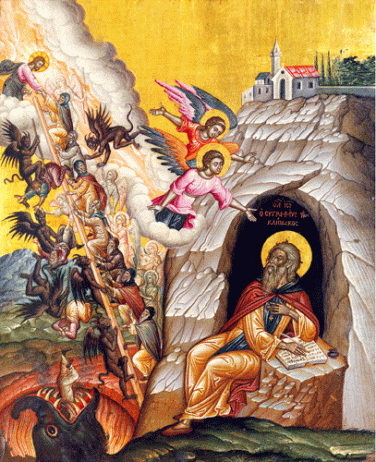 I first read Saint John Climacus’ book, The Heavenly Ladder, when I was a teenager. When you open this monument of Christian spirituality, you discover a new world, very different from the vision of the world that we are used to. The spiritual world is real. Spiritual warfare is real. This was the first lesson I learned when I started reading this book. The struggle is not me against the world. It is me against myself and my passions. This is the reason why at the bottom of the ladder one does not find repentance or vigilance but “on renunciation of the world:”


