THE DANGERS OF FUNDAMENTALISM by David C. Ford

Dr. Ford of St. Tikhon’s Orthodox Theological Seminary offers the following essay as part of Orthodoxy in Dialogue’s ongoing conversation about the place of same-sex love in human nature and Orthodox Christian life. We wish to express our gratitude to him for his unique willingness to engage with us on our own pages. 

featured-orthodox-fundamentalism

Tertullian and the Dangers of the Fundamentalist/Sectarian Mindset  

Adapted from the similarly titled chapter six of Dr. Ford’s Wisdom for Today from the Early Church: A Foundational Study (St. Tikhon’s Monastery Press, 2014). 

There seems to be a tendency today among “progressives” to claim that anyone defending traditional sexual morality must be a “fundamentalist.” Just because all traditionalists reject all sexual relations outside of marriage (as the Church always has done) does not mean that all traditionalists are “fundamentalists”—though of course, some of them are.

I have the feeling that there may be some “progressive” Orthodox Christians who are convinced, or at least suspect, that I myself—and by extension, St. Tikhon’s Seminary as a whole—are “fundamentalist.” However, in reality, I frequently emphasize the dangers of fundamentalism/sectarianism in my church history courses at St. Tikhon’s—especially when we talk about the rigorist early heresies of Montanism, Novatianism, and Donatism; when we study Protestantism and Islam; and when we discuss the Old Believers in Russia, ROCOR before the reconciliation with the Moscow Patriarchate in 2007, and modern-day Greek Old Calendarist groups. Read More


HOW A CHURCH DESTROYED ON 9/11 BECAME MIRED IN CONTROVERSY by Melissa Klein

stnickchurch

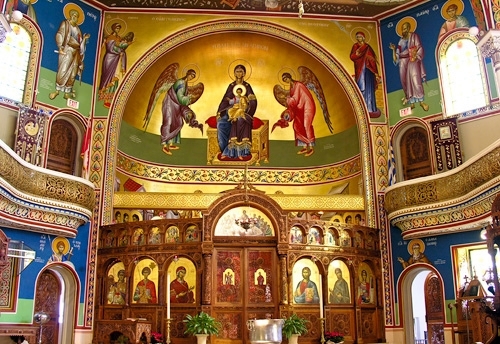
St. Nicholas Greek Orthodox Church was to be a “beacon of hope” at the World Trade Center site, glowing at night as a symbol to the faithful and those seeking solace on hallowed ground.

Thousands of visitors were to walk through the church doors on Liberty Street to worship, light a candle or just sit quietly in a nondenominational meditation room overlooking one of the 9/11 Memorial’s reflecting pools.

Now the church is a half-built eyesore, and when those doors will open is uncertain. The project has been stalled for five months and become a quagmire of accusations and millions of dollars in missing donations and cost overruns.

What was to be the proud symbol of the Greek Orthodox Church in America, and the only house of worship tending to the masses at Ground Zero, is now mired in controversy and second-guessing: Read More


PRELIMINARY THOUGHTS ON THE FEMALE DIACONATE by the Editors

Olimbias__70120.1392071470.1000.1200_large

St. Olympias the Deaconess

We have followed with interest the most recent exchanges in the discussion of the female diaconate, its history, and the arguments for and against its restoration in the Orthodox Church today. Before we summarize our own thoughts on these questions we wish to commend the St. Phoebe Center for the Deaconess for its invaluable, ongoing contributions to our common understanding of the issues.

We editors at Orthodoxy in Dialogue agree with each other in the following areas:

  1. We support a reasoned, informed, methodical approach to the restoration of the female diaconate in the foreseeable future.
  2. We do not regard deacons and deaconesses as liturgically interchangeable, although there is clearly a natural overlap in the exercise of their servanthood outside the liturgy. (The reduction of the male diaconate to a merely liturgical function must correspondingly cease.)
  3. We do not support the ordination of women to the priesthood or the episcopate.
  4. We fail to see how a restored female diaconate constitutes a slippery slope to a female presbyterate or episcopate. We have no apprehensions at all in this regard.
  5. Yet we do not wish to foreclose the discussion of a female presbyterate or episcopate, because one of two things will result: either we as the Church will come to a better understanding and articulation of why we do not ordain women priests and bishops, or we will conclude that no doctrinal reasons forbid it. (Cf. Acts 5:38-39.)
  6. We consider as absolutely indispensable an accurate and unbiased historiographical approach to the question of the female diaconate in particular and the role of women in the Church in general. This means that some of us may courageously have to modify what we have always held as “Tradition.” In this regard we commend the St. Phoebe Center once again, specifically for its outstanding “Towards a Reasoned and Respectful Conversation about Deaconesses” which appeared recently on Public Orthodoxy.
  7. While “A Public Statement on Orthodox Deaconesses by Concerned Clergy and Laity” contains some points with which we might agree, it suffers from an irrational fear of women, a desire to keep them in their place, and a serious confusion of diakonia with “authority.”

Read More


ANDREW RUBLEV, THE THEOPHANY TO ABRAHAM, AND HOSPITALITY by Henry C. Anthony Karlson III

rublevOne of the most important, if not the most important, artistic representations of the Holy Trinity is St. Andrew Rublev’s icon of the Hospitality of Abraham. [The Greek φιλοξενία means the love of strangers, love of foreigners.] Just as Tradition suggests that the three angels who visited Abraham are understood to represent the Trinity, so that Abraham is said to have met with God at Mamre, Rublev’s icon allows us to having a meeting with God. In the writings of Pseudo-Dionysius, he explains to us how symbols of God in Scripture point to and reveal God to us, so that through symbols we can meditate upon and experience the Kingdom of God. This is why Rublev’s icon, representing an important symbol of God in Scripture, directs us to an encounter with God.

We experience the glory of the Trinity through Rublev’s depiction of the three angels: the first, holding his hand over a chalice, his face looking upon the second; the second, looking upon the third; and the third, facing the first. The circle which can be observed being formed by the way that the angels interact with each other demonstrates the loving communion found between the Persons of the Trinity, where they are distinct and yet work together and are united as one. Nonetheless, the circle is not closed; it is welcoming, as the first angel holding his hand out over the chalice can be seen to be welcoming us in to partake with him and share with him the communion of love which the divine Persons have with each other. Read More