The Saint Nicholas Day Snow, Charlotte Riggle (Marion IN: Phoenix Flair Press, 2017)
Catherine’s Pascha, Charlotte Riggle (Marion IN: Phoenix Flair Press, 2015)

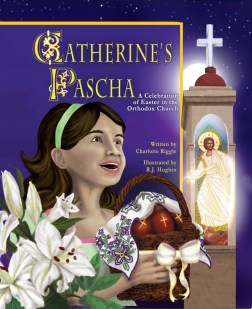 As an Orthodox mom of two young sons, I’m always eager to find new ways to engage their spiritual growth and development. I don’t know who was more excited to read The Saint Nicholas Day Snow and Catherine’s Pascha. Both are written by Charlotte Riggle and illustrated by R.J. Hughes.
Surprisingly, they were an easy addition to our bedtime routine. It’s normally the same books over and over, but these took little convincing. Maybe it was a movement of the Spirit, the colorful artwork, or my helpful 3-year old, but for reasons unknown these books have become new favorites for my sons and me. My 3-year old Elliot’s favorite parts of the books were the snowmen in The Saint Nicholas Day Snow and the celebratory feast (the part where they eat all of the food) in Catherine’s Pascha.
However, my favorite thing about The Saint Nicholas Day Snow is the inclusion of churches named after St. Nicholas, as well as popular depictions of the saint from around the world and throughout history. For example, a Byzantine icon of St. Nicholas is shown near a parish in Athens, Greece from the 9th century. A wooden church is nestled in the Norwegian forest, and a Baroque Russian cathedral sits covered in snow. Parish names are given in English as well as in the local vernacular—this seems to stress the universality of the message. Read More

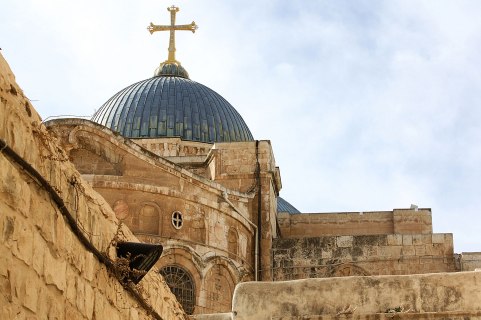 For 2,000 years, Christianity has had an uninterrupted presence in what is now Israel. The Orthodox Patriarchate of Jerusalem traces its roots to the New Testament book of Acts. It has functioned as a patriarchate in fact from the 5th century, and in name from the 6th century until the present. Theophilus III serves as the current Patriarch of Jerusalem, and his Christian flock consists mainly of Palestinian Arabs.
 On Thursday, May 17, while numerous organizations around the world celebrate the