ON THE INCARNATION: GOD COMES TO US AS HEALER by Dallas Thomas

This is the first article in our On the Incarnation series for the Nativity Fast.

healerchristWhat does it mean for me that God has become man? How does it affect the way that I am called to live and relate to myself and other human beings? I would like to answer this question from a Pentecostal perspective that is being ever so transformed by Orthodox theology. Being both from a Pentecostal background and as a practicing psychotherapist, the idea of Christ coming as a healer and physician is of utmost importance to me theologically and practically.

The Word becomes flesh and dwells among us to identify with us and to assume fully what we are, so that He can transform a broken people into His image. Or, as St. Irenaeus of Lyons says, “Jesus Christ, in His infinite love, has become what we are, in order that He may make us entirely what He is.” The Word becoming flesh then, is the first act in bringing healing to humanity and the entire cosmos. This assumption of the flesh opens the door for others to partake by grace of what God is by His very nature.

God becoming man provides a window for His light to shine in the darkness of our pain, exposes our woundedness, shares in our suffering, and embraces us in His presence, which itself is healing and transformative. As a Pentecostal, an important part of my experience and knowledge of God is that He is a healer and wants to heal all that is broken, sick, and dying—even if, after we pray for healing, it does not come to fruition on this side of eternity. Read More


ORTHODOX KIDLIT: SAINT NICHOLAS AND THE NINE GOLD COINS reviewed by Annalise Wolf

Saint Nicholas and the Nine Gold Coins
Jim Forest (Illustrated by Vladislav Andrejev)
Yonkers NY: SVS Press, 2015

nick

Saint Nicholas and the Nine Gold Coins, written by Jim Forest and illustrated by Vladislav Andrejev, dramatizes the most famous story in the life of Saint Nicholas, in which he tosses gold coins through the window of a poor family so that the daughters can marry.  As the story unfurls, the readers are invited to consider alongside Nick what, if any, responsibility he bears towards those in need.  The Byzantine-influenced illustrations reference iconography, proposing an entire world populated with people recognizably similar to icons of saints in many Orthodox art traditions. 

Positioned between “Once upon a time” and the present, the text reminds us through the classic fairy-tale opening and the references to mermaids and sea monsters, paired with hagiographic notes at the back of the book, that we paint a received story full of details.  Implicitly, the text contrasts fairy tale conventions of adventure with the adventurous journey of a faithful life.  Less imaginative than the pictures, the prose is nonetheless clear, deploying stock phrasing to provide a familiar sounding rhythm to a story illustrated in a style unusual for picture books.  This marriage of familiar story language with versions of the human figure familiar (if at all) primarily from icons asks the reader to reckon with a world to be treated as if all present might be saints.  The information on the historical Saint Nicholas at the back of the book serves as an excellent springboard for further exploration.  My own reading rambled outward from the story, turning up modern discussions on the verifiability of relics (St. Nicholas’ are thought to archeologically match the hagiographic profile quite well) and national versus ecclesial claims to relics.  Read More


UNHOLY TRINITY: INCEL IDEOLOGY, COMPLEMENTARIAN THEOLOGY, AND TOXIC MASCULINITY (PART I) by Alexandria Barbera and Allison Murray

Reflective of Orthodoxy in Dialogue’s commitment to welcome a diversity of voices from within and beyond the Orthodox Church to our conversation, we are grateful to the editorial board of Women in Theology for this opportunity to introduce them to our readers around the globe. We urge you to visit them often, to read their articles carefully, and to engage with them thoughtfully. 
incel

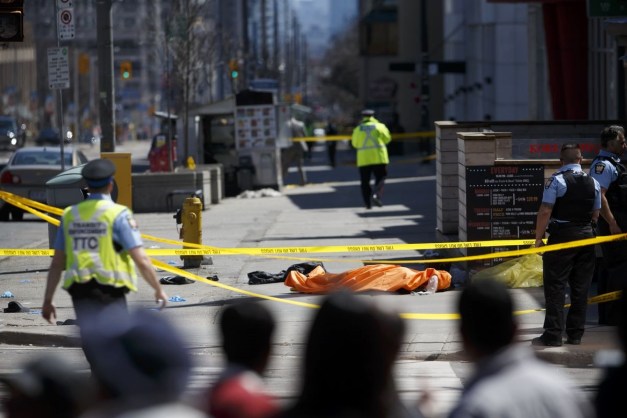
Scene of April 23 van attack in Toronto.

On April 23 of this year, our two co-authors were on opposite sides of the Atlantic reading the same news about a horrific incident in Toronto. 10 people were killed and another 16 injured by a man who chose to drive his van down a kilometer of sidewalk in the north end of the city.  Today [October 23] marks the six-month anniversary of this senseless and tragic event.

Over the course of two posts, Alexandria and Allison will unpack some of the ideological parallels between incel groups, ideas put forward as gospel by complementarian authors, and toxic masculinity more broadly.

In part one, we will examine the notion of toxic masculinity and compare the ways that incel culture and complementarianism perpetuate themselves. In part two, we will turn our attention to the ideological and rhetorical parallels between these two groups.

A note: this post discusses violence against women.

Genteel toxicity is still toxic. It is perhaps all the more insidious because its mask of respectability hides its discursive damage. Like the white moderate bemoaned by Dr. King, the gentle toxicity of the complementarian worldview might pose as significant a hurdle to the well-being of our society as its more aggressive secular counterparts, like the incel movement. In some cases, these groups speak in one voice; in others, the complementarian expression of toxic masculinity is the incel movement’s gentler, less crude echo. Read More


UKRAINE: NOT EUROPE YET by the Editors of the Kyiv Post

In the contentious matter of autocephaly for the Orthodox Church in Ukraine, Western supporters and detractors alike have questioned the involvement of the Ukrainian government in the process, especially vis-à-vis the Ecumenical Patriarchate. Underlying these apprehensions is the widespread ignorance—sometimes wilful, sometimes innocent—of two facts: first, the distinct history, language, culture, and ecclesiastical governance of the Ukrainian people; and second, the endless history of Russian imperial violence against Ukraine in the Tsarist, Soviet, and post-Soviet eras—a history in which the Russian Church has played and continues to play a complicit role. The struggle for Ukrainian independence from the nation’s Russian overlords dates back centuries.
While the following editorial does not touch on ecclesiastical affairs, it begins to provide for Orthodoxy in Dialogue’s readers something of the political context within which to understand the pressing pastoral need for the Ukrainian Church’s canonical independence from the Moscow Patriarchate.

euromaidan

Five years ago, thousands of Ukrainians launched the EuroMaidan Revolution, which later led to the overthrow of President Viktor Yanukovych.

There were two main motives behind it.

First, it was a revolution in support of Ukraine’s national identity in its struggle with Russian imperialism, since Yanukovych was seen as a puppet of Moscow.

Second, it was an uprising in favor of the European values, the main one being a corruption-free state, and integration into the free world. Read More