THE CATHOLIC SEX ABUSE CRISIS: HOW CAN ORTHODOXY HELP? by A.A.J. DeVille

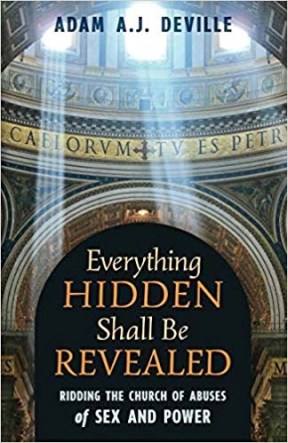
The late Margaret O’Gara of the University of Toronto was fond of using a phrase that the late Bishop of Rome, John Paul II, also employed regularly: an “ecumenical gift exchange.” O’Gara published a book in 1998 under that title, while three years earlier the Pope used it in his landmark encyclical, Ut Unum Sint, on Christian unity. I also use the phrase in my new book, Everything Hidden Shall Be Revealed: Ridding the Church of Abuses of Sex and Power (Angelico Press, 2019, 154pp).
adamdeville

Readers of the book will quickly see that many of my proposed reforms are gifts from the East, starting with Nicholas Afanasiev, especially his book The Church of the Holy Spirit. It was from him that I developed my argument for a three-fold ordering of the Catholic Church: the laics (to use Afanasiev’s somewhat ungainly term), the clerics, and the hierarchs, all existing together, each with voice and vote in the councils of governance of the church—from the lowly parish council through to diocesan, regional, and international synods. All three orders are necessary for the Church to flourish; each of the three acts as a check on the others, ensuring that none can run totally roughshod over the others.

I am equally indebted to examples drawn from the current structures of various Eastern Orthodox Churches—the Russian, the Antiochian, the OCA, and also—and above all—the Armenian Apostolic Church, whose singular and admirable structures I first highlighted in my earlier book Orthodoxy and the Roman Papacy (University of Notre Dame Press, 2011). Read More


MEMORY ETERNAL: ERIC J. ILIFF

eric

Eric J. Iliff

October 11, 1981 ~ March 13, 2007

With the saints give rest, O Christ, to the soul of Thy servant
where sickness and sorrow are no more, neither sighing,
but life everlasting.

Read More


WHEN KREMLIN AND PATRIARCHATE CRY WOLF TOGETHER by Giacomo Sanfilippo

In recent weeks a number of conflicting news items related to Ukraine have appeared in various sources which combine to demonstrate the scope of “Byzantine symphonia” in its 21st-century Russian reincarnation.

Related image

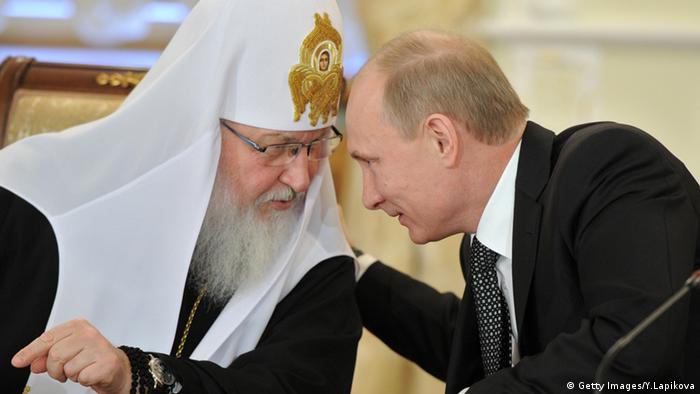
Patriarch Kirill and Vladimir Putin

As I noted previously on these pages, the expression denotes a religio-political ideology from Orthodox Byzantium according to which church and state were said to speak with a single voice. This produced mixed outcomes in the Byzantine Empire, and later in Tsarist Russia, resulting in some of the most shameful pages in the history of the Orthodox Church. In Russia’s case we have only to recall the brutal persecution of its Old Believers from the middle of the 17th century over how to make the sign of the cross and which prayer books to use.

This made it all the more ominous when, at the state-sponsored banquet in honour of his enthronement as Patriarch of Moscow in February 2009, former KGB agent Kirill Gundyaev expatiated on the restoration of Byzantine symphonia as his vision for the Russian Orthodox Church’s relations with the Kremlin in the Putin era. The ensuing ten years have shown how this plays out in the lives of real human beings in Russia and its ever-widening sphere of influence. Implicitly or explicitly, the Russian Church has supported the draconian response to Pussy Riot’s 2012 protest in Christ the Saviour Cathedral; repressive LGBT laws and the wilful blindness of law enforcement and the judiciary to incidents of homophobic violence on Russia’s streets; the weakening of legal redress for children and women subjected to domestic violence; the Kremlin’s geopolitical aggressions near and far, including the unlawful annexation of Crimea, election meddling in the US and elsewhere, Russia’s invasion of Ukraine, and the acceleration of hostilities in the wake of the Ukrainian Church’s autocephaly. The list goes on and on.   Read More


FAITH, QUEER IDENTITIES, AND SUICIDE by Carol Kuruvilla

Chilling Study Sums up Link between Religion and Suicide for Queer Youth

“Religious groups who stigmatize LGBT people should be aware of the potential damage they can do.”

Related image

Faith is supposed to be a source of strength for believers, especially during times of struggle and sorrow. However, a new study suggests that religiosity may be linked to negative feelings among queer individuals ― including increases in suicidal behaviors.

The study, published in the American Journal of Preventive Medicine last month, is a chilling revelation of the ties between suicide and theology that doesn’t affirm queer identity. Read More