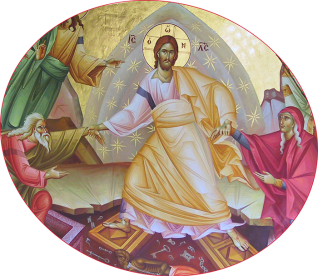
Catechetical Homily of Our Father among the Saints, John Chrysostom, Archbishop of Constantinople Read More

Ukraine comprises a majoritarian Orthodox Christian nation where more than half of the population regards the recent creation of the autocephalous Orthodox Church favourably. In this light, it defies the imagination that Ukrainians should deliver virtually three-quarters of their vote to a Russian-speaking Jewish comedian from a party named after his television show and having no political experience and no discernible policy platform—over against an Orthodox incumbent whose central role in securing the Church’s independence from Russian control was abundantly chronicled in photo op after photo op, from the Phanar to Kyiv and beyond. Orthodox observers in the West who support both Ukrainian statehood and autocephaly, but who cringed when the Ecumenical Patriarchate’s exarchs christened Mr. Poroshenko “the new St. Volodymyr,” must feel their embarrassment all the more acutely after the president’s humiliating electoral defeat. They might also feel a tinge of schadenfreude over his failed appropriation of the Church as an electioneering prop. (I covered some of these concerns previously here.)
This is not to suggest that Mr. Zelensky represented the better of the two seriously flawed candidates who made it to the runoff. We can have little idea of what to expect in general from a Zelensky presidency, and in particular from his dealings with the two Orthodox entities competing on Ukrainian soil—the autocephalous Ukrainian Church and the Russian Church, the latter widely viewed as the Kremlin’s bedfellow. Read More
 On a regular basis, Orthodox priests find themselves in situations in which they need to accurately assess parishioners’ spiritual well-being. Confession is but one setting where this takes place. There are likely few priests who have not occasionally felt daunted by the challenge of distinguishing which kinds of struggles brought by parishioners fall squarely within the purview of spiritual counsel, and which might benefit from referral to professional mental health providers. Coursework provided by some Orthodox seminaries prepares students for counseling that takes place in the parish, and acknowledges that there is a time for referral to outside professionals.
At the same time, within the dioceses of the Orthodox Church in America (OCA), to note one example, there are no uniform policies or guidelines in place to address these situations.
Beyond the relative lack of guidance on this issue, though, there are more immediate factors that make the handling of these situations problematic. These include: Read More
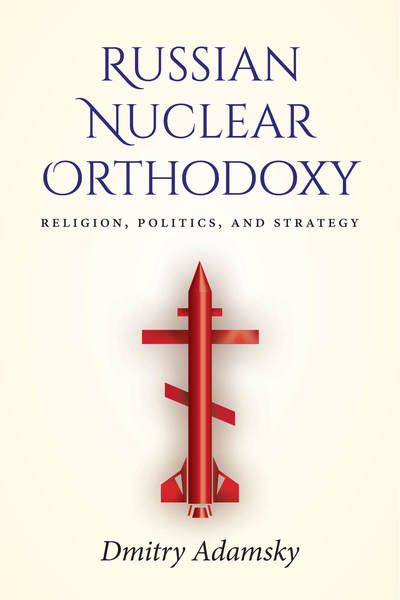 A nuclear priesthood has arisen in Russia. From portable churches to the consecration of weapons systems, the Russian Orthodox Church has been integrated into every facet of the armed forces to become a vital part of Russian national security, politics, and identity. This extraordinary intertwining of church and military is nowhere more visible than in the nuclear weapons community, where the priesthood has penetrated all levels of command and the Church has positioned itself as a guardian of the state’s nuclear potential. Russian Nuclear Orthodoxy considers how, since the Soviet collapse in 1991, the Church has worked its way into the nuclear forces, the most significant wing of one of the world’s most powerful military organizations.
Dmitry Adamsky describes how the Orthodox faith has merged with Russian national identity as the Church continues to expand its influence on foreign and domestic politics. The Church both legitimizes and influences Moscow’s assertive national security strategy in the twenty-first century. This book sheds light on the role of faith in modern militaries and highlights the implications of this phenomenon for international security. Ultimately, Russian Nuclear Orthodoxy interrogates the implications of the confluence of religion and security for other members of the nuclear club, beyond Russia.


 ORTHODOXY IN DIALOGUE