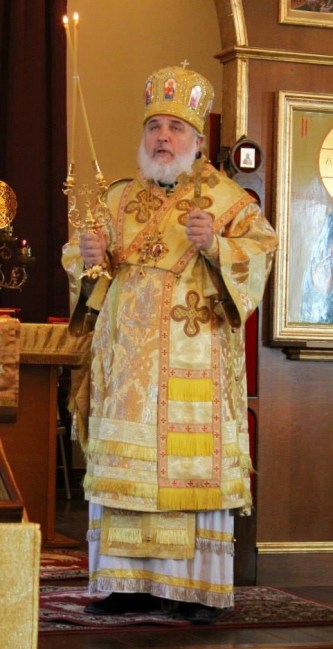
Archbishop Gabriel of Montreal (ROCOR)
This year the annual youth retreat of the Russian Orthodox Church Outside of Russia (ROCOR) took place on December 23-27, 2018 at the Nativity of the Mother of God Church in Albany NY. This event is hosted by the St. Herman Conference, under the chairmanship of Archbishop Gabriel of Montreal, to coincide every year with the Feast of St. Herman of Alaska on the old calendar.
A teenage attendee reports to Orthodoxy in Dialogue that, during a Q&A with Archbishop Gabriel, the young people raised questions about the Moscow Patriarchate’s decision to break communion with the Ecumenical Patriarchate—a decision explicitly ratified by ROCOR in its statement of October 18, 2018.
According to our young friend, Archbishop Gabriel made the following points in his response:
- A blessing to receive Holy Communion in an Ecumenical Patriarchate parish can always be requested by—and granted to—members of ROCOR.
- A blessing will most assuredly be granted to men in ROCOR who wish to visit and take Holy Communion on Mount Athos.
- A blessing will most assuredly be granted also to members of ROCOR who wish to visit and take Holy Communion at St. Anthony’s Monastery in Arizona as well as at any of the other Ephraimite monasteries in the US and Canada.
This is astonishing on a number of counts: Read More


