REPORT: ARCHDIOCESE OF RUSSIAN ORTHODOX CHURCHES IN WESTERN EUROPE VOTES TO REMAIN IN EXISTENCE

In November 2018 the Ecumenical Patriarchate annulled the status of the Archdiocese of Russian Orthodox Churches in Western Europe as an exarchate and directed it to dissolve itself as an ecclesiastical entity and to submit its parishes, monasteries, and other institutions to the local Greek metropolitans. For more details see Dr. Victor Alexandrov’s The Choice Facing the Archdiocese of Russian Churches in Western Europe and the additional articles linked in the preface there.
ruedaru

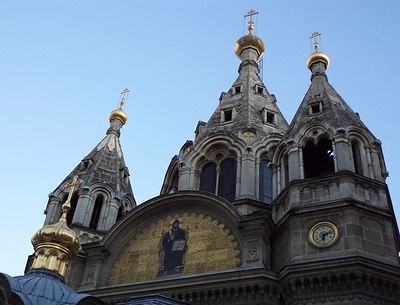
St. Alexander Nevsky Cathedral. Paris.

The Extraordinary General Assembly (EGA) of the Archdiocese, made up of all members of the clergy and lay parish delegates, met in Paris on 23 February 2019, to deliberate on the Ecumenical Patriarchate’s decision to “reorganise the status of the exarchate,” published in the Communiqué of 29 November 2018 of the Holy Synod. Since the Holy Synod of the Ecumenical Patriarchate decided to abolish the status of patriarchal exarchate, the Archdiocese had to decide according to Article 34 of the Statutes of the Diocesan Governing Union of Russian Orthodox Associations in Western Europe whether it wished, yes or no, to put an end to its own existence and that, consequently, its 120 or so parishes would be subordinated to the Greek Metropolia of Western Europe.

Under the presidency of the ruling Archbishop, His Eminence John of Charioupolis, the members of the EGA decided in accordance with the statutes, with a majority of nearly 93% of the votes (191 out of 206), not to dissolve the Archdiocese, but to to remain as a united ecclesiastical entity according to its original form (Association founded on 26 February, 1924, OJ, 28.2.1924, №58, p. 2080). The Council of the Archdiocese has taken note of this decision of the EGA and will promptly communicate the decision to His All-Holiness the Ecumenical Patriarch of Constantinople and his Holy Synod and send a delegation to the Phanar to hand over the letter personally. Read More


GREAT LENT 2019: CALL FOR MEDITATIONS

LentOrthodoxy in Dialogue’s “partial hiatus” has evolved to mean that we will continue to publish over the next few months as seems good to us, but much less frequently than we have done until now.

We will be happy to consider Lenten Meditations from now until Pascha. Note the following differences from last year’s Lenten series:

1). Laypersons (men, women, and youth) are welcome to submit a meditation for consideration as well as hierarchs, priests, deacons, and monastics.

2). This year we seek meditations on the general themes of fasting, asceticism, prayer, repentance, almsgiving, renunciation of the ego, the pursuit of chastity and purity, forgiveness, etc., rather than restricting ourselves thematically to the Sundays of Great Lent. (You may, however, write on the theme of one of the Sundays if you wish.)

3). You need not be Orthodox to write for this series, provided that your meditation have relevance for a mainly Orthodox audience. Read More


LENTEN MEDITATION: THE PRODIGAL SON AND GOD’S CRAZY LOVE by Archpriest Isaac Skidmore

This is the first article in our Lenten Meditations 2019 series.

prodson2As a therapist, when I read the story of the Prodigal Son, I know something has to have been left out. A real family has dynamics that are necessarily more complex than what this story describes. For example, my therapeutic instincts tell me there has likely been some trauma in the life of the younger son, prior to that self-inflicted trauma brought about by his leaving home, though the story mentions nothing of that. Also, the older brother’s behaviors betray the possibility that he is living in compensation of some real or imagined deficiency in himself. Finally, the father’s one-sided response to the younger son belies what, on the surface, appears to be pure and unconditional love.

Something is hidden. What, though, might that be?

Can we playfully explore these psychological questions while remaining faithful to the story as it is told? One way of doing this is to insert into the story a hypothesis that is plausible, from a textual standpoint, and that bridges the gap between the description of this family and what we see of families in real life. To explore one possible hypothesis, I invite the reader to imagine that this family has, at some point, lost their wife and mother, leaving the father as a single parent. If we posit this scenario, we have some basis for understanding the behaviors of this story’s cast of players, and particularly of the enmeshment that seems to typify their interactions with each other—whether it be seen in the desperate attempt of the younger son to find his independence, the exaggerated adaptation of the older son to the environment of his father, or the father’s immoderate embrace of his younger son, and his overlooking of behaviors that might reasonably evoke concern in a loving and wise father. Read More


RUSSIA’S WAR AGAINST UKRAINE by President Petro Poroshenko

Those who oppose the autocephaly of the Orthodox Church of Ukraine ignore two facts: first, Russia’s war against Ukraine; and second, the Moscow Patriarchate’s complicity (the real meaning of “Byzantine symphonia” in our context) in everything the Kremlin says and does. Russia itself is to “blame” for Ukrainian autocephaly and the attendant chaos in the Orthodox world.
Statement by President of Ukraine  at the United Nations General Assembly Debate on agenda item 67  “The situation in the temporarily occupied territories of Ukraine”

President Poroshenko Addressing the UN General Assembly

Statement by President of Ukraine at the United Nations General Assembly Debate on Agenda Item 67

“The Situation in the Temporarily Occupied Territories of Ukraine”

Madam President,

Excellencies,

Ladies and Gentlemen,

I would like to start by expressing my gratitude to President of the UN General Assembly María Fernanda Espinosa Garcés for her leadership in steering the work of the UN main policy-making and representative body.  

Today marks the fifth anniversary of the start of the foreign military aggression against my country, Ukraine. Read More