IN SUPPORT OF FATHER AARON WARWICK: OPEN LETTER TO METROPOLITAN JOSEPH by Deacon Gary and Melissa Braun


braun

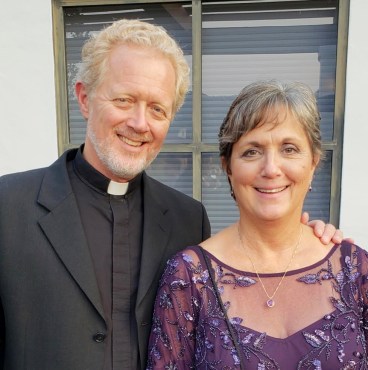
Deacon Gary and Melissa Braun

Dear Sayidna Joseph,

We are writing to you as members in good standing in our Church, as children  of God who love Christ and His Church with ALL our heart, and as Orthodox Christians whose hearts are breaking for so many of our brothers and sisters in Christ.

Specifically today, we write in full support of Father Aaron Warwick. We recently read Pastoring LGBTQ Individuals in the Orthodox Church, an article that he wrote for the website Orthodoxy in Dialogue. We found his words to be a godly breath of fresh air, and he gave us hope that our Church might be able to finally have an honest, Christ-centered conversation about a difficult issue. It is a discussion that is long overdue.

The Church frequently practices “economia” in other areas, such as divorce and remarriage, birth control, no longer telling slaves to treat their masters as Christ, etc. We have been discouraged that our LGBTQ+ brothers and sisters are not also granted the same mercy. So reading Father Aaron’s words gave us hope.
Read More


THEOLOGICAL AND PHILOSOPHICAL DISSONANCE IN THEORIES OF PASTORAL CARE WITH LGBTQ+ IDENTIFYING PERSONS: A RESPONSE TO FATHER AARON WARWICK by Joshua Rainwater

0.0 Introduction

Two Teenage Girls On Camping Trip In Countryside

In the recent article at Orthodoxy in Dialogue, Pastoring LGBTQ Individuals in the Orthodox Church, Father Aaron Warwick presents a case for including sexually active LGBTQ individuals into full communion with the Orthodox Church, and doing so while maintaining the traditional Orthodox stance on human sexuality. He does this by appealing to the Orthodox concept of oikonomia, a pastoral principle in the Church which accommodates for Orthodox faithful who are not living according to the moral ideal of its teachings. Father Warwick asserts that the way in which pastors are taught to respond to the commonplace moral challenges of heterosexual relationships is not afforded to persons with differing sexual orientations. If the majority of heterosexual relationships find the Church’s moral ”ideal” of chastity to be ”impracticable,” why then would we believe that it is best for those with near exclusive homosexual orientations not to approach Holy Communion unless they be celibate (or at least trying to be)? Not only does Father Warwick try to expose the seemingly unjustly discriminatory applications of church law, he even points out that canon law has historically assigned greater penances to adultery and other sexual sins over homosexual intercourse. If we were to truly apply the law equally based on this fact, how many of our parishes would be virtually empty? Read More


DYING, AND BEHOLD WE LIVE by Giacomo Sanfilippo

Orthodoxy in Dialogue’s editor offers the following brief reflection in response to CNN’s report of December 30, 2019, Man Shoots and Kills 2 inside a Texas Church before Parishioners Fatally Shoot Him. He might have preached it as a sermon this Sunday if he were still permitted to serve as a priest.
small-entrance
Illumine our hearts, O Master who lovest mankind,
with the pure light of Thy divine knowledge.
Open the eyes of our mind to the understanding of Thy Gospel teachings.
Implant also in us the fear of Thy blessed commandments,
that trampling down all carnal desires, we may enter upon a spiritual manner of living,
both thinking and doing such things as are well-pleasing to Thee.
For Thou art the Illumination of our souls and bodies, O Christ our God,
and to Thee do we ascribe glory,
together with Thy Father who is from everlasting and Thine All-Holy, and Good, and Life-Creating Spirit,
now and ever, and unto ages of ages. Amen.
Prayer before the Reading of the Holy Gospel
Divine Liturgy of St. John Chrysostom

✠

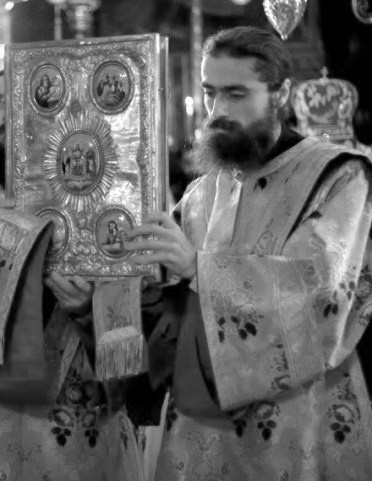
In the Orthodox Church, we bind the four Gospels together into a separate book. We cover it with precious metals, jewels, icons painted on porcelain. We carry it high in solemn procession, surrounded by acolytes bearing candles and representations of the cherubim and the seraphim, who serve as the throne of God and singers of the unceasing Holy! Holy! Holy! We bless with it, bow before it, kiss it, as if it were Christ Himself, the eternal Word of God. We stand motionless during the chanting of its words of eternal life, and respond to its good message with Glory to Thee, O Lord! Glory to Thee! Indeed, during Matins, we pray that we may be accounted worthy even of hearing it. We enthrone it, as if Christ Himself, on the holy Altar Table, both during and outside of divine services.

But do we live the Gospel? Do we die the Gospel, day by day?
Read More