SEXUALITY, GENDER, AND CHRISTIAN TRADITION: A COURSE OUTLINE by Giacomo Sanfilippo

creation

Because of my public profile through Orthodoxy in Dialogue, many people have come to me online and in person for spiritual and emotional support whose children are transgender or who are transgender themselves. 

Recently there occurred a first for me: a married man with small children, whose wife has come out to him as transgender and has begun the surgical component of his transition. For now, they remain married.

What I offer those who seek me out—in my unworthiness and with all my inadequacies—is an open heart, a listening ear, a complete lack of judgmentalism, not a trace of know-it-allism, and no one-size-fits-all responses based on any kind of “ideological purity.” Some of my Orthodox brothers and sisters disdain this approach as “liberal” or “progressive.” I, on the contrary, consider it to be rather traditional.

How many of our bishops and priests in the Orthodox Church are equipped to deal pastorally and sensitively with these real-life scenarios? How many of our future bishops and priests will be sufficiently equipped, especially given the inevitability that these kinds of pastoral issues will arise more frequently over time? Read More


WOMEN OF THE CHURCH: FAITH, SERVICE, AND LEADERSHIP by Donna Rizk Asdourian, Ann Bezzerides, Patricia Fann Bouteneff, Tamara Grdzelidze, and Sister Vassa (Larin)

churchwomen

Orthodoxy in Dialogue is pleased to share the video, Women of the Church: Faith, Service, and Leadership, in collaboration with the Orthodox Christian Studies Center at Fordham University. This reflects our ongoing commitment to welcome a wide diversity of voices on virtually every important topic facing the Orthodox Church in the 21st century.

This event took place on October 9, 2018 at the E. Gerald Corrigan Conference Center, Fordham University, New York City. It featured the following panelists and moderator:

Donna Rizk Asdourian, PhD
Fellow, Orthodox Christian Studies Center, Fordham University

Ann Bezzerides, PhD
Director of the Office of Vocation and
Ministry, Hellenic College Holy Cross Greek Orthodox School of Theology

Tamara Grdzelidze, PhD
Ambassador of the Republic of Georgia to the Holy See

Sister Vassa Larin, PhD
Host, Coffee with Sister Vassa Podcast
Member, Commissions of the Inter-Council Presence of the Russian Orthodox Church
(Commissions on Canon Law and on Liturgy and Church Art)

Moderator
Patricia Fann Bouteneff, DPhil
Director, Pan-Orthodox Women’s Network Read More


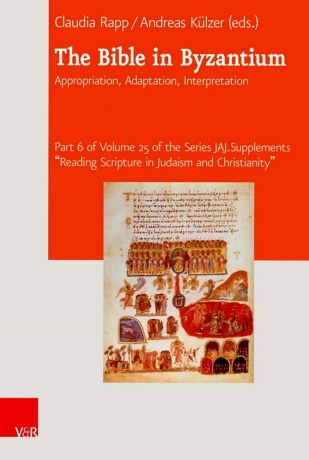
THE BIBLE AND ITS MANY USES IN BYZANTIUM by Claudia Rapp and Andreas Külzer

biblebizThe Bible is the foundational text for the Byzantine Empire in all its political, religious, and cultural manifestations. The nine papers in the newly released The Bible in Byzantium (the introduction and three of them in English, the remainder in German, but all of them—we like to think—worth reading) explore its reception through appropriation, adaptation and interpretation.

Most of the men, women, and children in Byzantium would have encountered the Holy Scriptures predominantly in the context of the Divine Liturgy. They would have seen the preciously decorated book covers as the codex was carried from behind the iconostasis into the congregational space for the liturgical reading, they would have heard the priest recite passages from the Gospels according to the liturgical calendar of readings, and all the while, they may have noted in the church around them depictions on icons or frescoes of selected words and phrases from the Bible associated with figural or scenic representations.

The living liturgical tradition continues to shape the reception of the New Testament in the Orthodox Church to the present day. Viewed from this angle, what may come as a surprise to the scholar in search of the Urtext is perfectly understandable for the church-going believer: there exists to date no authoritative text of the New Testament in the Greek Orthodox Tradition. Karl Klimmeck (“Auf der Suche nach dem Byzantinischen Bibeltext”) contextualizes and elucidates this issue, based on his own involvement with the creation of the Byzantinische Text Deutsch, under the auspices of the Schweizerische Bibelgesellschaft, for use by Orthodox communities. He points out that in the Orthodox tradition, the Bible acquires life, meaning, and significance as it is embedded in the divine mystery which is the Liturgy. Read More


RUE DARU RESPONDS: COMMUNIQUÉ OF THE ARCHDIOCESAN COUNCIL OF THE RUSSIAN ARCHDIOCESE OF WESTERN EUROPE

While awaiting an official English translation from the Archdiocese of Russian Orthodox Churches in Western Europe, Orthodoxy in Dialogue offers our own to our readers. For context see Archdiocese of Russian Orthodox Churches in Western Europe/Exarchate of the Ecumenical Patriarchate to Be Abolished and It’s Official: Ecumenical Patriarchate Dissolves Russian Archdiocese of Western Europe. (Note: “Rue Daru” is used for our purposes as the commonly known nickname for the Archdiocese, not necessarily with specific reference to the cathedral itself.)

eglise-alexandre-nevsky (2)

Communiqué of the Archdiocesan Council – November 30, 2018

The Archdiocese of Russian Orthodox Churches of Western Europe, which constitutes one of the oldest Orthodox ecclesial entities in our regions, was placed under the pastoral responsibility of Metropolitan Evlogy (Georgievsky) by St. Tikhon, Patriarch of Moscow, by decree of April 8, 1921. Cast into exile by the Bolshevik Revolution, the Russian emigrants established, with faith and courage, an ecclesial presence founded on the major principles of the unfinished Council of Moscow of 1917-18. Established first in Berlin, the see of the Archdiocese was transferred to Paris, to the Cathedral of St. Alexander Nevsky, where it assumed the form of an association in accordance with French law, composed of communities and parishes established in France and throughout Western Europe: thus it remains to this day. The statutes of this association—The Guiding Diocesan Union of Russian Orthodox Associations in Western Europe—were submitted to the prefecture on February 26, 1924 and are still in force today.

In 1931, to guarantee its independence and permanence, the Archdiocese requested to depend on the Ecumenical Patriarchate of Constantinople, which was accepted by a patriarchal and synodal Tomos of February 17, 1931, giving the Archdiocese the status of a provisional Exarchate of the Ecumenical Patriarchate. Read More